• Skip to primary navigation
  • Skip to main content
Velocity Ascent

Velocity Ascent

Looking toward tomorrow today

  • Research
  • Design
  • Development
  • Strategy
  • About
    • Home
    • Who we work with…
      • Product Leaders
      • Innovation Teams
      • Founder-Led Organizations
    • Services
    • Contact Us
  • Show Search
Hide Search

Managed Coordination Protocol

Secure Agentic Pipelines for Regulated Industries

Velocity Ascent Live · March 2, 2026 ·

Why secured networked AI agents are the operational layer financial services has been waiting for.

Most organizations adopting AI in regulated environments are doing it backwards. They start with the model and work outward, hoping compliance will follow. It rarely does.

The fundamental challenge is not whether AI can generate content, write reports, or produce imagery. It can. The challenge is whether every output can withstand scrutiny from compliance teams, clients, and regulators. In financial services, healthcare, and legal practice, the answer to that question determines whether AI is an asset or a liability.

The Compliance Problem Nobody Talks About: Can Agentic AI do the work in a way that every stakeholder in the chain can verify.

Traditional AI pipelines are monolithic. A single system ingests data, processes it, and produces output. When something goes wrong; a licensing violation, a hallucinated claim, a brand-inconsistent asset – the effort required to identify where the failure occurred can be substantial.


Agentic Architecture: Specialized Agents, Governed Workflows

Agentic pipelines take a fundamentally different approach. Instead of a single monolithic system, the work is distributed across specialized agents, each responsible for a discrete function. An orchestration layer coordinates handoffs, enforces sequencing, and maintains the audit trail.

Consider a production pipeline for compliance-sensitive content. Rather than a single AI tool doing everything, the architecture employs dedicated agents for sourcing, verification, model training, generation, quality assurance, and delivery. Each agent operates within defined boundaries. Each produces records that downstream agents and human reviewers can inspect.
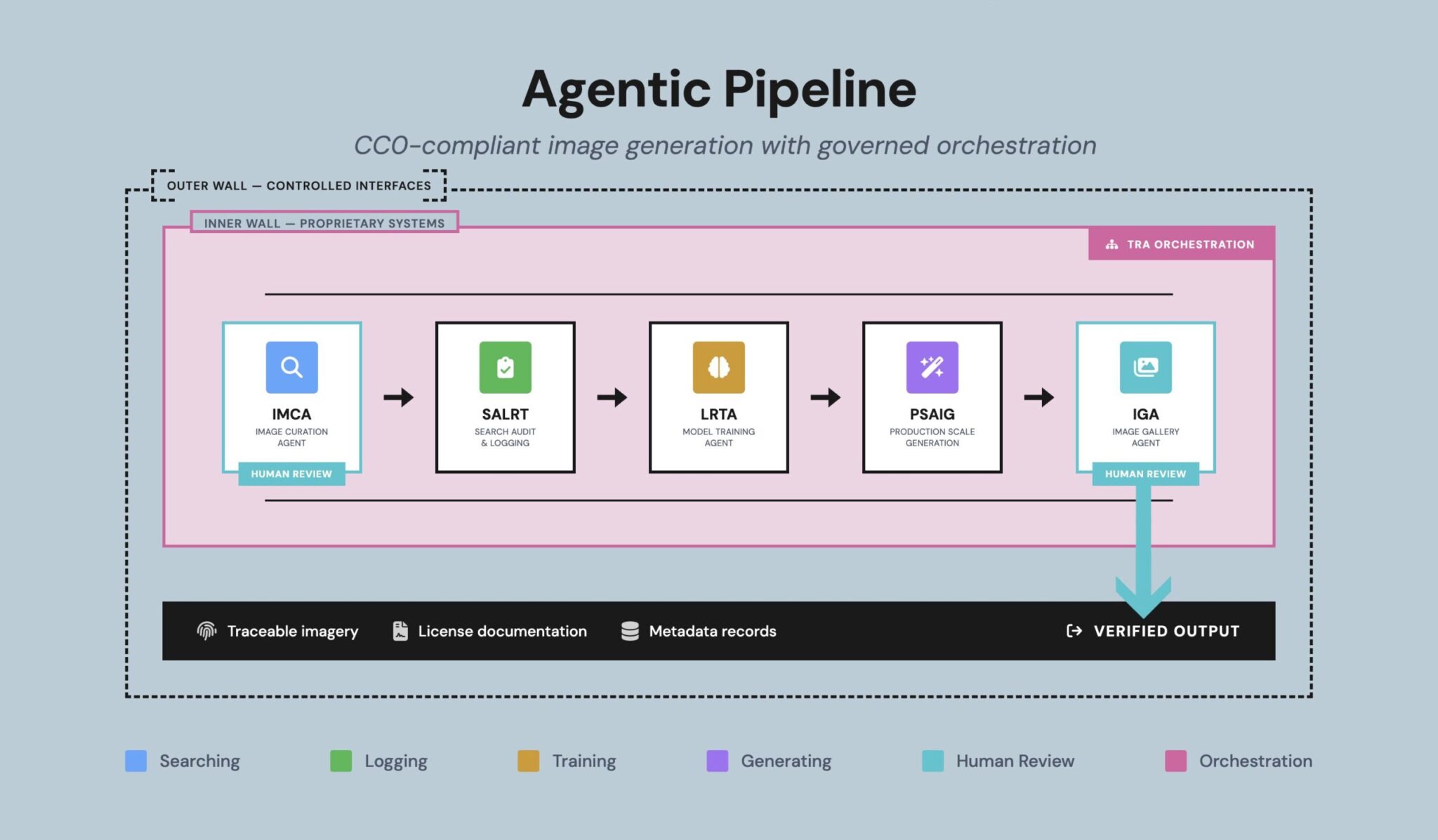
Agentic pipeline architecture: specialized agents with governed orchestration and human review gates. From Joe Skopek’s Financial Marketer article: “Marketing’s next frontier is autonomous networked intelligence.“

The orchestration agent functions as a traffic controller, routing work between agents based on status, priority, and pipeline rules. It does not make creative or compliance decisions. It enforces process. Human review gates are positioned at the points where judgment is irreplaceable–source curation and final output quality.

This is not theoretical architecture. Production systems built this way are operating today, handling thousands of assets through end-to-end pipelines where every step is logged, every input is traceable, and every output is defensible.

Trust You Can Demonstrate

In regulated environments, trust must be demonstrable rather than implied. Agentic systems are designed to produce clear, reviewable records of origin, licensing, and decision flow. Compliance discussions move away from subjective assurances and toward documented system behavior.

Every agent in the pipeline writes to a shared provenance record. When a sourcing agent identifies an asset, it logs the license type, the retrieval date, and the verification status. When a training agent builds a model, it records the dataset composition, the training parameters, and the lineage back to original sources. When a generation agent produces output, the full chain of custody is available on demand.

This matters because regulators do not ask whether your AI is good. They ask whether you can prove it did what you say it did. Agentic pipelines answer that question by design, not by retrofit.

Collaboration Without Exposure

Financial services firms have historically avoided collaboration on models or data because the risk outweighed the benefit. Sharing training data exposes proprietary logic. Sharing models reveals competitive advantage. The default has been isolation.

Agentic architecture changes this calculation through what we call the Double Garden Wall. The inner wall protects proprietary datasets, screening logic, and brand-governance frameworks. These remain sealed and non-negotiable. The outer wall exposes only what external systems require: controlled capability interfaces, verifiable records, and traceable outputs.

Built this way, systems gain interoperability without dilution, collaboration without intellectual property leakage, and scale without compromising compliance.

Advances in distributed learning and controlled execution now allow verified partners to contribute capability without sharing raw data or proprietary logic. Agents can be registered in decentralized directories, verified against published capability specifications, and bound by enforceable policy contracts–all without exposing internal methods. Capability expands while risk remains bounded.

Parallel Workflows Without Parallel Headcount

Traditional AI pipelines execute sequentially. One step finishes before the next begins. Networked agentic systems enable multiple stages of work to operate concurrently across compatible agents. This event-driven, contract-based execution model allows firms to handle volume surges without linear increases in staffing or infrastructure.
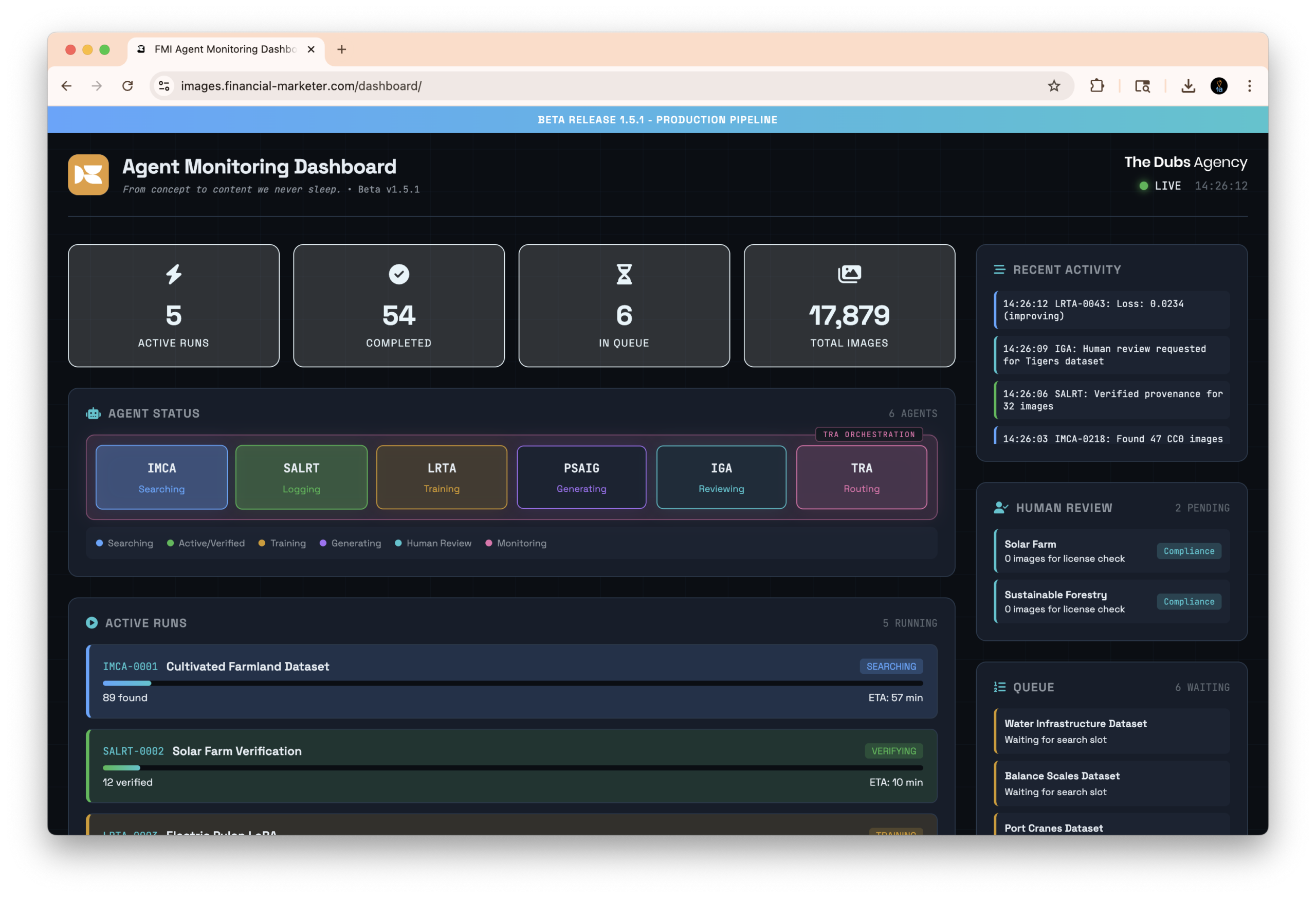
Agent orchestration and monitoring dashboard: real-time visibility into scalable concurrent pipeline operations.

A production monitoring dashboard shows the reality of this approach. Multiple agents operating simultaneously across sourcing, verification, training, and generation. Active runs with estimated completion times. Queue management for incoming work. Human review requests surfaced precisely when human judgment is needed–not before, and not after.

This is the operational difference between AI as a project and AI as infrastructure. Projects require constant management. Infrastructure runs, scales, and reports.

A Live Production Case

To make this concrete: a production-grade pipeline operating today generates CC0 (Creative Commons Zero) compliant imagery for regulated industries. The system employs specialized agents for sourcing, dataset preparation, model fine-tuning, production-scale generation, and gallery management. Governance is strict: public-domain inputs only, full chain-of-custody tracking, and aesthetic screening for accuracy and consistency.

Membership image gallery with category-based organization, aspect ratio filtering, and curated industry-specific collections.

The output is not experimental. These are production assets used in client-facing materials where compliance review is mandatory. Each image can be traced back through the generation agent, through the model that produced it, through the training data that informed the model, back to the original public-domain source with full license documentation.

The system delivers assets in multiple aspect ratios–landscape, square, portrait–with metadata tagging for camera view, color palette, weather conditions, and semantic content. Every asset is available in tiered quality levels for different use cases, from full-resolution production to optimized web previews.

Once agents are registered, verified, and policy-bound, the pipeline enables controlled collaboration through decentralized registries, zero-trust interoperability where each agent governs its own exposure, distributed fine-tuning across verified compute without revealing private datasets, elastic job distribution across compatible agents, and production-scale auditability where every autonomous step leaves a clear record.

ELEVATOR PITCH:

Regulated industries need AI that produces auditable, compliant output at production scale. Agentic pipelines deliver this by orchestrating specialized AI agents through governed workflows where every action is logged, every source is traceable, and human judgment is preserved at the decisions that matter. The result is faster execution with stronger controls–not weaker ones.

Why the C-Suite Should Care

The value proposition is straightforward. Stronger controls. Faster output. Broader capability without compromising compliance posture. This is the difference between AI as a novelty and AI as operational infrastructure.

Financial services leaders should evaluate agentic systems against three uncompromising questions:

1. Can the system scale without weakening oversight?

2. Can every output withstand compliance, client, and regulator review?

3. As the firm grows, does the technology reinforce discipline–or fracture under pressure?

The industry does not need spectacle. It needs systems that behave predictably across volume spikes, regulatory cycles, and brand-governed workflows. When implemented with rigor, agentic AI is not about disruption. It is about operational reliability at a scale previously out of reach.
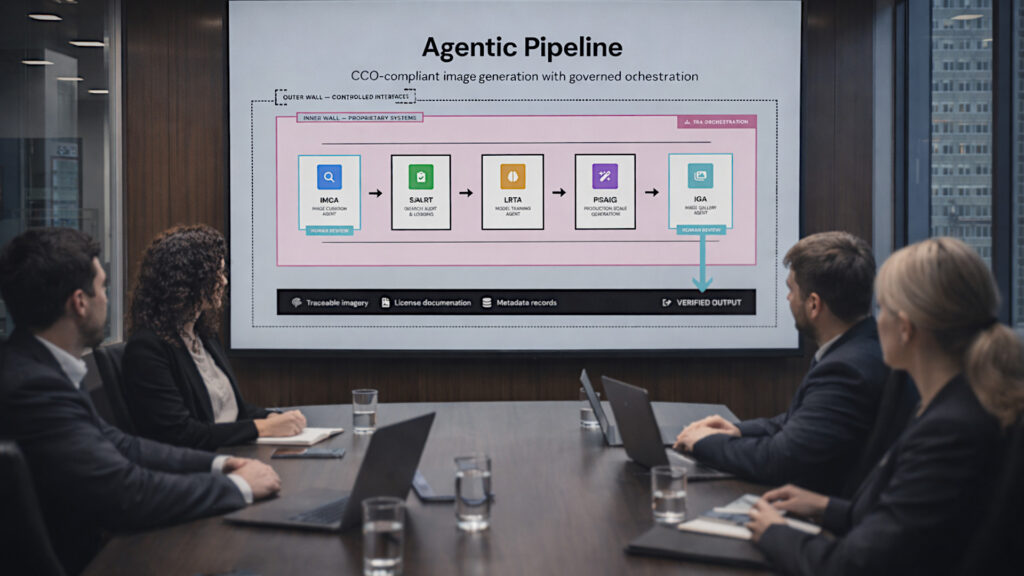
The firms that excel will not be those deploying the most colorful demonstrations. They will be the ones deploying systems that deliver controlled growth, verifiable governance, rapid execution, and credible audit trails.

The Challenge of Building in an Evolving Space

There is an honest tension in this work that deserves acknowledgment. The infrastructure layers that make agentic pipelines possible–agent discovery protocols, capability registries, policy enforcement standards–are still maturing. Building production systems on evolving foundations requires a specific kind of engineering discipline: design for what exists today while architecting for what arrives tomorrow.

This is not a reason to wait. The core principles – specialized agents, governed orchestration, traceable provenance, human gates at judgment points – are stable and proven. The interoperability layer that connects these systems across organizational boundaries is advancing rapidly through open standards and community-driven development.
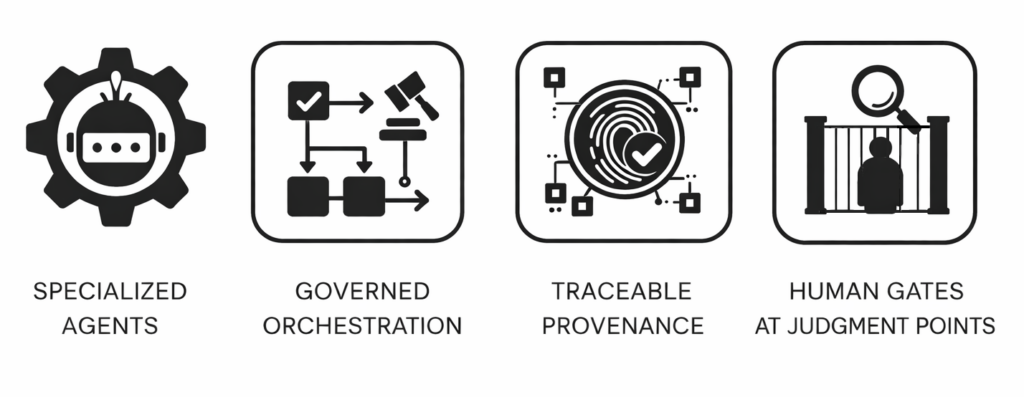
What this means practically is that early movers gain compounding advantages. The organizations investing now in agentic infrastructure are building institutional knowledge, training teams, and establishing operational patterns that late adopters will spend years replicating. The learning curve is real, and it rewards those who start.

The shift toward networked agentic pipelines is already underway. The institutions that master it early will define the standard others are forced to follow.

THE BOTTOM LINE

Agentic pipelines are not about replacing human judgment. They are about automating every mechanical step between the moments where human judgment actually matters – and proving that the mechanical steps were executed correctly. For regulated industries, that combination of speed, scale, and verifiable compliance is not optional. It is the next operational baseline.

Velocity Ascent builds AI-powered solutions for regulated industries. We specialize in agentic solutions including; pipeline architecture, ethical AI sourcing, and production-scale automation with full provenance tracking.



Scaling Digital Production Pipelines

Velocity Ascent Live · February 11, 2026 ·

Agentic Infrastructure in Practice

Enterprise AI conversations still over-index on models, focusing on benchmarks, parameter counts, feature comparisons, and release cycles. Yet production environments rarely fail because a model lacks capability. They often fail because workflow architecture was never designed to absorb autonomy in the first place.

When digital production scales without structural discipline, governance erodes quietly. When governance tightens reactively, innovation stalls. Both outcomes stem from the same architectural flaw: layering AI onto systems that were not built for persistent context, background execution, and policy-bound automation.

The competitive advantage is not in the model – it is in the pipeline.

The institutions that succeed will not be those experimenting most aggressively. They will be those that design structured agentic systems capable of increasing throughput while preserving accountability. In that environment, the competitive advantage is not the model itself but the production pipeline that governs how intelligence moves through the organization.

The question is not whether to use AI. The question is whether your infrastructure is designed for autonomy under constraint.


Metaphor: The Factory Floor, Modernized.


Think of a legacy archive or production system as a dormant factory. The machinery exists. The materials are valuable. The workforce understands the craft. But everything runs manually, station by station. Modernization does not mean replacing the factory. It means upgrading the control system.

CASE STUDY: Sand Soft Digital Arching at Scale
In the SandSoft case study, the transformation began with physical ingestion and structured digitization. Assets were scanned, tagged, layered into archival and working formats, and indexed with AI-assisted metadata.

That was not digitization for convenience. It was input normalization. Once the inputs were stable, LoRA-based model adaptation was introduced. Lightweight, domain-specific training anchored entirely in owned source material .

Then came the critical layer: agentic governance.

Watermarking at creation. Embedded licensing metadata. Monitoring agents scanning for IP misuse. Automated compliance reporting. This is not AI as a creative distraction. It is AI as a controlled production subsystem.

Each agent has a bounded mandate. No single node controls the entire flow. Every output is logged. Escalation paths are predefined. Like a well-run enterprise desk, authority is layered. Execution is distributed. Accountability remains human.

That is the difference between experimentation and infrastructure.

Why This Matters to Senior Leadership

For CIOs, operating partners, and infrastructure decision-makers, the core risk is not technical failure but unmanaged velocity. Agentic systems accelerate output, and if governance architecture does not scale in parallel, exposure compounds quietly and often invisibly.

A disciplined production pipeline does three things:

  1. Reduces manual drag without decentralizing control
  2. Creates persistent institutional memory through logged workflows
  3. Converts AI from cost center experiment to auditable operational asset

In regulated or credibility-driven environments, autonomy without traceability creates risk. When agentic systems are deliberately structured, staged in maturity, and governed by explicit policy constraints, they shift from liability to resilience infrastructure. The distinction is not cosmetic. It is structural. This is not about layering AI tools onto existing workflows. It is about redesigning how work moves through the institution – with autonomy embedded inside accountability rather than operating outside it.

For leaders responsible for credibility, the most significant risk of agentic AI is not technical failure per se but unmanaged success – systems that move faster than oversight can absorb can create risk exposure that quietly accumulates. A recent McKinsey analysis on agentic AI warns that AI initiatives can proliferate rapidly without adequate governance structures, making it difficult to manage risk unless oversight frameworks are deliberately redesigned for autonomous systems. Similarly, enterprise practitioners have cautioned that rapid deployment without structural guardrails can create a shadow governance problem, where velocity outpaces policy enforcement and exposure compounds before leadership has visibility.

Agentic systems do not create exposure through failure. They create exposure when success outpaces oversight.

The opportunity, however, is substantial. Well-designed agentic workflows reduce manual drag, surface meaningful signal earlier in the lifecycle, and preserve human judgment for decisions that matter most. By embedding traceability, auditability, and policy enforcement directly into operational workflows, organizations create durable institutional assets – documented reasoning, consistent standards, and reusable analysis that withstand turnover and regulatory scrutiny.

This is how legacy organizations scale responsibly without eroding trust or sacrificing control.


Elevator Pitch

We are not automating judgment. We are structuring production pipelines where agents ingest, analyze, monitor, and validate under explicit policy constraints, while humans remain accountable for consequential decisions. The objective is scalable output with embedded governance, not speed for its own sake.


Less Theory, More Practice: Agentic AI in Legacy Organizations

Velocity Ascent Live · December 22, 2025 ·

How disciplined adoption, ethical guardrails, and human accountability turn agentic systems into usable tools

Agentic AI does not fail in legacy organizations because the technology is immature. It fails when theory outruns practice. Large, credibility-driven institutions do not need sweeping reinvention or speculative autonomy. They need systems that fit into existing workflows, respect established governance, and improve decision-making without weakening accountability. The real work is not imagining what agents might do in the future, but proving what they can reliably do today – under constraint, under review, and under human ownership.

From Manual to Agentic: The New Protocols of Knowledge Work


Most legacy organizations already operate with deeply evolved protocols for managing risk. Research, analysis, review, and publication are intentionally separated. Authority is layered. Accountability is explicit. These structures exist because the cost of error is real.

Agentic AI introduces continuity across these steps. Context persists. Intent carries forward. Decisions can be staged rather than re-initiated. This continuity is powerful, but only when paired with restraint.

In practice, adoption follows a progression:

  • Manual – Human-led execution with discrete software tools
  • Assistive – Agents surface signals, summaries, and anomalies
  • Supervised – Agents execute bounded tasks with explicit review
  • Conditional autonomy – Agents act independently within strict policy and audit constraints

Legacy organizations that succeed treat these stages as earned, not assumed. Capability expands only when trust has already been established.

Metaphor: The Enterprise Desk

How Agentic Roles Interact

    A useful way to understand agentic systems is to compare them to a well-run enterprise desk.

    Information is gathered, not assumed. Analysis is performed, not published. Risk is evaluated, not ignored. Final decisions are made by accountable humans who understand the consequences.

    An agentic pipeline mirrors this structure. Each agent has a narrow mandate. No agent controls the full flow. Authority is distributed, logged, and reversible. Outputs emerge from interaction rather than a single opaque decision point.

    This alignment is not cosmetic. It is what allows agentic systems to be introduced without breaking institutional muscle memory.


    Visual Media: Where Restraint Becomes Non-Negotiable

    Textual workflows benefit from established norms of review and correction. Visual media does not. Images and video carry implied authority, even when labeled. Errors propagate faster and linger longer.

    For this reason, ethical image and video generation cannot be treated as a creative convenience. It must be governed as a controlled capability. Generation should be conditional. Provenance must be explicit. Review must be unavoidable.

    In many cases, the correct agentic action is refusal or escalation, not output. The value of an agentic system is not that it can generate, but that it knows when it should not.

    Why This Matters to Senior Leadership

    For leaders responsible for credibility, the primary risk of agentic AI is not technical failure. It is ungoverned success. Systems that move faster than oversight can absorb create exposure that compounds quietly.

    The opportunity, however, is substantial. Well-designed agentic workflows reduce manual drag, surface meaningful signal earlier, and preserve human judgment for decisions that actually matter. They also create durable institutional assets – documented reasoning, consistent standards, and reusable analysis that survives turnover and scrutiny.

    This is how legacy organizations scale without eroding trust.


    Elevator Pitch (Agentic Workflows):

    We are not automating decisions. We are structuring workflows where agents gather, analyze, and validate information under clear rules, while humans remain accountable for every consequential call. The goal is reliability, clarity, and trust – not speed for its own sake.”

    Agentic AI will not transform legacy organizations through ambition alone. It will do so through discipline. The institutions that succeed will not be the ones that adopt the most autonomy the fastest. They will be the ones that prove, step by step, what agents can do responsibly today. Less theory. More practice. And accountability at every turn.

    NANDA: Networked Agents And Decentralized AI

    Velocity Ascent Live · April 16, 2025 ·

    Pioneering the Future of Decentralized Intelligence

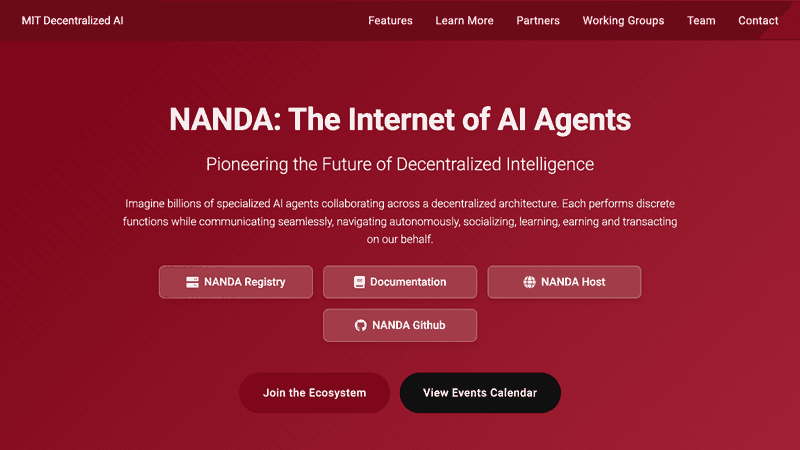
    Imagine a network of specialized AI agents working together across a secure, decentralized architecture. Each agent handles specific tasks, communicates effortlessly, and operates autonomously—enabling your business to innovate, streamline processes, and make data-driven decisions in real-time.

    “Just as DNS revolutionized the internet by providing a neutral framework for web access, we need a similar infrastructure for the “Internet of Agents.” We’re launching NANDA – an open-protocol for registry, verification, and reputation among AI agents – in collaboration with national labs and global universities (decentralized across 8 time zones!)
    NANDA will pave the way for seamless collaboration across diverse systems, fully compatible with enteprise protocols like MCP and A2A. This initiative is a step toward democratizing agentic AI, creating an ecosystem where specialized agents can work together to solve complex challenges—just like DNS did for the web.”

    Ayush Chopra
    PhD Candidate at MIT

    This dynamic ecosystem operates within a secure, decentralized infrastructure that ensures privacy, trust, and accountability at every level. This concept is brought to life through the NANDA (Networked Agents And Decentralized AI) initiative, which aims to create a truly decentralized Internet of AI Agents.

    The Internet of AI Agents

    At the MIT Decentralized AI Summit, the Model Context Protocol (MCP) was introduced as a standardized method for enabling communication between AI agents, tools, and resources. While MCP serves as a foundational interaction protocol, NANDA goes beyond the basics by addressing the infrastructural challenges required to support a truly decentralized, large-scale network of AI agents.

    NANDA builds upon MCP to provide the critical components needed for a distributed ecosystem where potentially billions of AI agents can collaborate across organizational and data boundaries. The protocol extends the capabilities of traditional AI systems, fostering seamless agent collaboration at scale—something that current centralized models struggle to achieve due to rigid data structures and lack of transparency.

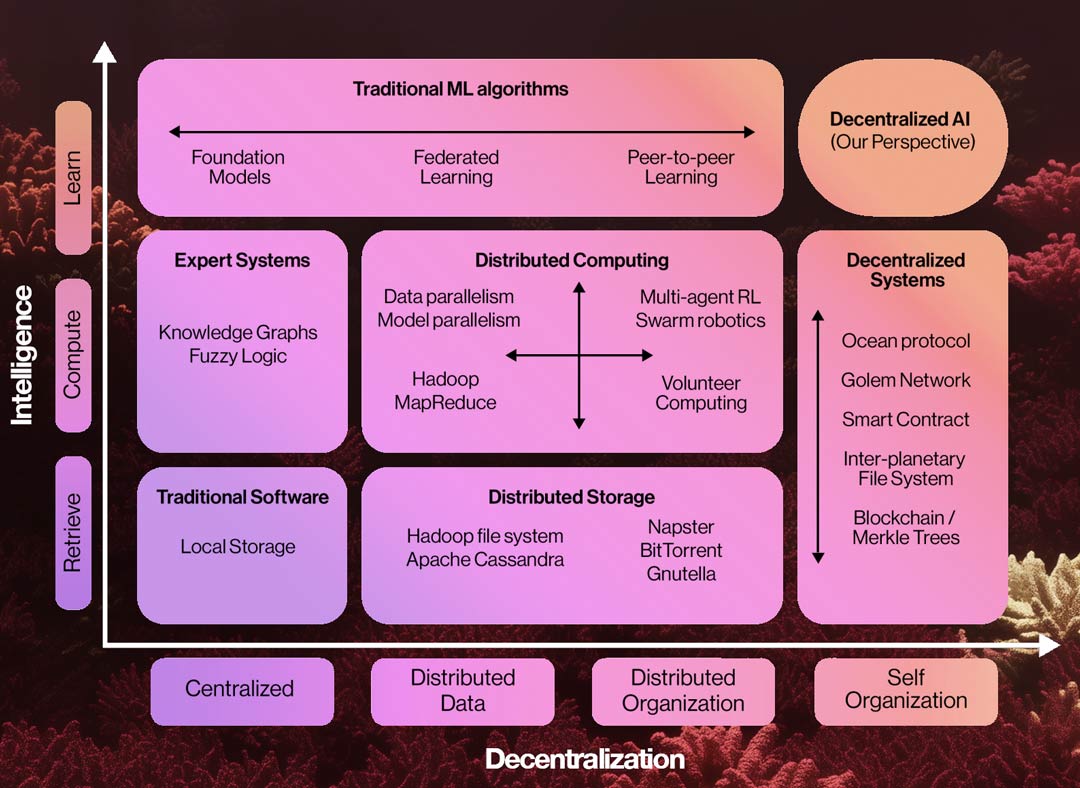
    “Enter the landscape of existing paradigms and the path towards decentralized AI. ML algorithms like foundation models excel in AI capabilities but remain centralized. Decentralized systems, like blockchains and volunteer computing, distribute storage and computation but lack intelligence. We argue that bringing the two capabilities together can have an outsized impact. We call upon the AI community to focus on the open challenges in the upper-right quadrant, where decentralized architectures can give rise to anew generation of AI systems that are both highly capable and aligned with the values of a decentralized society.”

    A Perspective on Decentralizing AI
    Abhishek Singh, Charles Lu, Gauri Gupta, Nikhil Behari, Ayush Chopra, Jonas Blanc, Tzofi Klinghoffer, Kushagra Tiwary, and Ramesh Raskar
    MIT Media Lab

    Everyman Metaphor

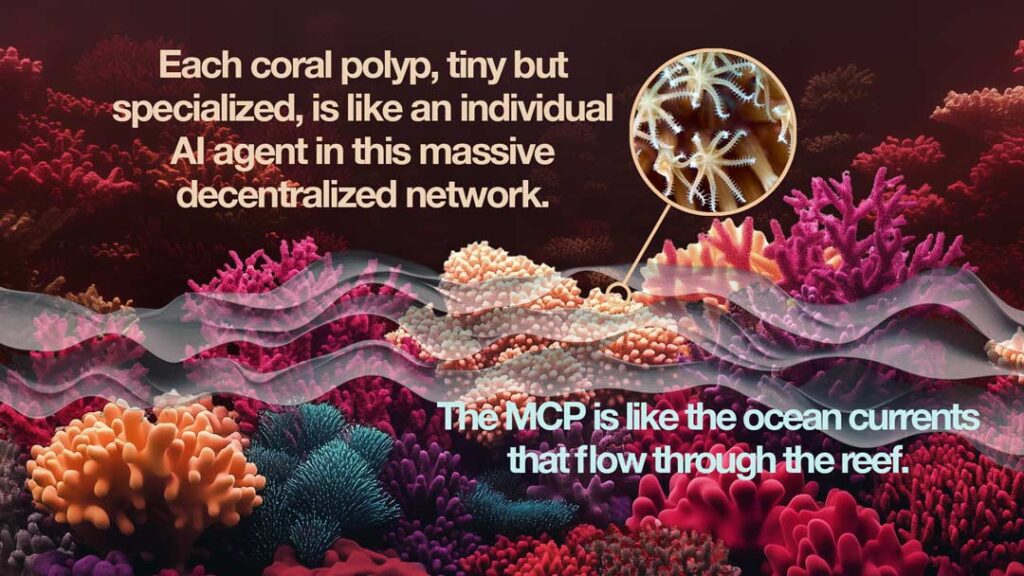
    Imagine a vast coral reef ecosystem.

    Each coral polyp, tiny but specialized, is like an individual AI agent in this massive decentralized network. Some filter nutrients, others build the reef, and still others host symbiotic relationships with fish, algae, and crustaceans—each with its unique role.

    Similarly, AI agents in NANDA perform specific tasks—learning, navigating, transacting, and interacting—each contributing to the broader ecosystem.

    The Model Context Protocol (MCP) is similar to the ocean currents that flow through the reef. These currents are consistent, structured, and essential—they allow nutrients, larvae, and signals to move through the system. In the same way, MCP ensures that information flows smoothly, securely and predictably between agents, tools, and resources.

    But ocean currents alone don’t make a thriving reef.

    That’s where NANDA comes in—it’s the reef structure itself, the intricate, interconnected framework built over time that supports the life within. NANDA provides the scaffolding—the decentralized architecture—where all these AI agents (like reef dwellers) can thrive together. It allows for scalability, resilience, and collaboration across countless agents, just like a healthy reef sustains an immense variety of life.

    So in this metaphor:

    • AI agents = reef creatures and coral polyps
    • MCP = ocean currents and nutrient flows
    • NANDA = the coral reef’s skeleton, enabling life to flourish at scale

    Together, they form a self-sustaining, adaptive ecosystem—an Internet of AI agents as vibrant and alive as a coral reef teeming with collaborative intelligence.


    Why NANDA Matters to a CEO

    Strategic Advantage
    Adopting NANDA positions organizations to lead in AI-driven markets by supporting everything from R&D to regulated processes. Its infrastructure enables flexibility for creative automation and ensures reliability for mission-critical applications. By aligning AI maturity with business goals, NANDA facilitates a smoother path to AI adoption, providing long-term competitive advantages in industries where agility and scalability are key.

    Decentralized Intelligence at Scale
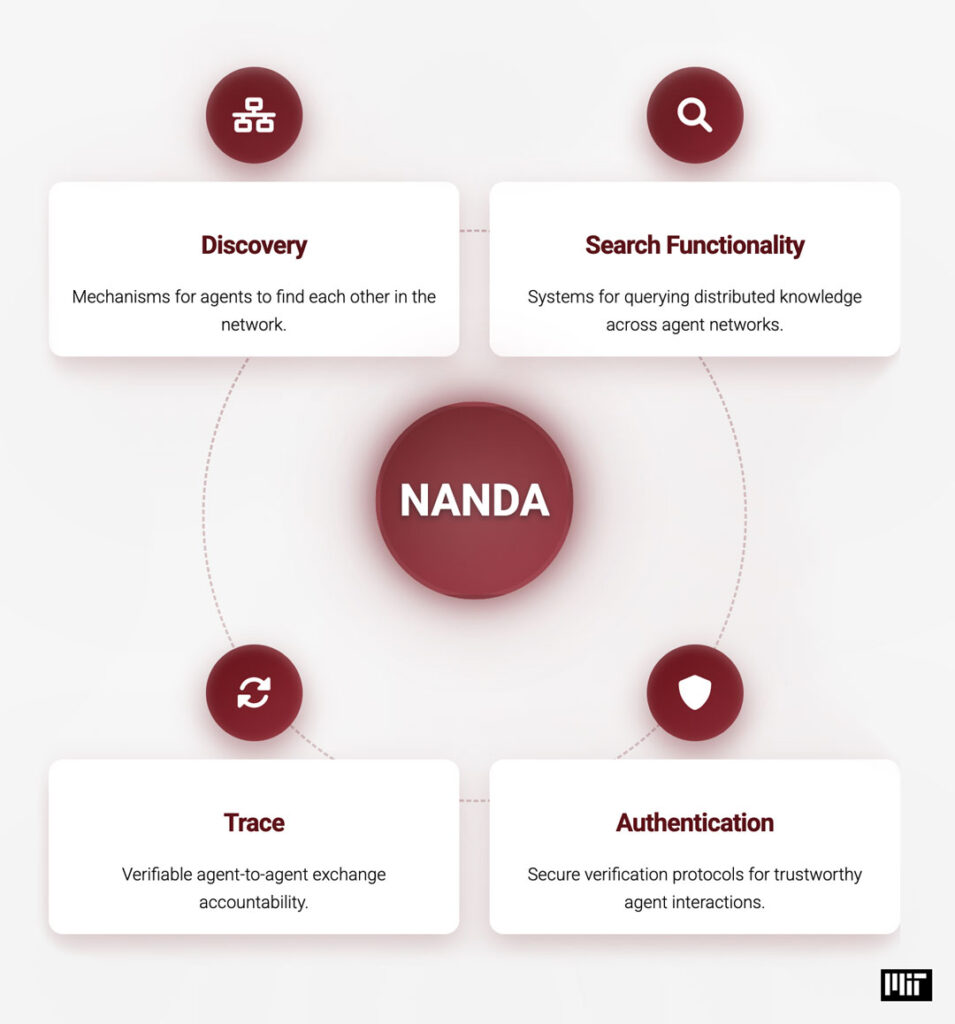
    NANDA’s approach transforms traditional AI systems by decentralizing both the data and control, enabling an intelligent ecosystem of agents that collaborate seamlessly. This enables secure, dynamic workflows across industries, from healthcare to finance. Unlike standalone AI systems, NANDA offers enhanced capabilities for discovery, search, authentication, and interaction traceability—ensuring secure and scalable intelligence for enterprise environments.

    Innovation with Governance
    With NANDA, organizations can embrace innovation while maintaining full control over security and compliance. NANDA balances rapid development with the need for governance by providing developers with tools for building secure, verifiable applications and agents. Secure authentication protocols and verifiable interaction logs (“Trace”) ensure that the system remains accountable, transparent, and aligned with regulatory standards for sensitive operations.

    Why NANDA Will Quickly Provide a Secure Solution

    For institutions like hospitals or financial organizations, adopting a decentralized system like NANDA may initially raise concerns regarding security and compliance. However, NANDA is designed to address these concerns head-on. Built from the ground up with trust and accountability at its core, NANDA leverages secure multi-layered encryption, authentication mechanisms, and immutable trace logs to ensure the integrity of data and interactions.

    Additionally, NANDA’s infrastructure is designed to scale while meeting the most stringent privacy and regulatory requirements. By incorporating real-time verification, verifiable agent-to-agent interactions, and decentralized control, NANDA provides a robust security framework that enables organizations to trust its decentralized agents with mission-critical tasks while ensuring compliance with industry standards. The framework’s focus on decentralized trust eliminates the need for a single point of failure, further strengthening its suitability for high-security environments like healthcare or finance.

    Core Value Proposition and Enabling Technology

    NANDA explicitly positions itself as not just an interaction protocol (like MCP) but as a comprehensive infrastructure designed to support decentralized, large-scale AI collaboration. By providing a network fabric with critical components such as:

    • Registries for discovering agents, tools, and resources
    • Interaction databases for auditing and referencing agent interactions
    • Developer tools and SDKs to integrate third-party applications

    NANDA creates the foundation for building a secure, scalable ecosystem where AI agents can collaborate across industries with confidence.

    Key Differentiation Factors in the AI Agent Ecosystem

    NANDA distinguishes itself from other AI agent frameworks through its explicit focus on decentralization, its large-scale infrastructure, and its strong academic foundation. By prioritizing decentralized trust, NANDA addresses the core limitations of centralized AI models and networks. Furthermore, NANDA’s traceable accountability systems ensure that every action is verifiable, creating a trustworthy environment for enterprise-scale applications.

    Unlike frameworks like LangChain or AutoGen, which focus on individual agents or small-team coordination, NANDA aims to build the “interstate highway system” for decentralized AI—creating the infrastructure needed for billions of agents to collaborate seamlessly across the globe. This vision, coupled with a deep academic research foundation, positions NANDA as a true leader in the development of decentralized intelligence.


    Elevator Pitch (AI Strategy Lens):

    NANDA is a secure AI framework that helps businesses innovate with confidence. It connects specialized AI agents across a decentralized network, enabling them to collaborate, learn, and make decisions autonomously. Built on Anthropic’s MCP, NANDA offers strong security with encrypted communication, real-time authentication, and verifiable logs, ensuring that sensitive operations stay secure and compliant. With easy integration and developer tools, NANDA supports rapid innovation, making it a scalable and reliable solution for your business to harness AI safely and effectively.

    NANDA Ecosystem

    Discovery within the NANDA ecosystem enables agents to find and interact with one another efficiently across the network. This includes robust Search Functionality for querying distributed knowledge, and Authentication mechanisms to ensure secure and trustworthy agent interactions. A Trace layer supports verifiable accountability in agent-to-agent exchanges. The system is built on a modular architecture comprising a Protocol Layer that forms the foundation for AI communication, Developer Tools to empower builders within the ecosystem, an Infrastructure Layer maintaining a registry of agents, resources, and interactions, and a suite of Applications that support third-party integrations via SDKs, registries, and databases.

    SOURCE:

    General Information


    Velocity Ascent

    © 2026 Velocity Ascent · Privacy · Terms · YouTube · Log in