• Skip to primary navigation
  • Skip to main content
Velocity Ascent

Velocity Ascent

Looking toward tomorrow today

  • Research
  • Design
  • Development
  • Strategy
  • About
    • Home
    • Who we work with…
      • Product Leaders
      • Innovation Teams
      • Founder-Led Organizations
    • Services
    • Contact Us
  • Show Search
Hide Search

Agentic AI

Fashion Tech, Revisited: From Sketch-to-Storefront to Storefront-to-Agent

Velocity Ascent Live · June 1, 2026 ·

The future I sketched in 2024 is no longer hypothetical. It’s shipping, it’s backfiring, and it’s rewriting who wins.

A follow-up to “Fashion Tech: The Present Future of Fashion and Technology” (October 2024)

When I published that first piece in October 2024, I argued that the blend of fashion and artificial intelligence was creating “limitless possibilities.” Roughly eighteen months on, the possibilities are no longer hypothetical. They are shipping. They are also forcing the harder questions the original post only gestured at: not just whether we can generate a model, a garment, or a storefront, but whether we should, and on whose terms.

The original throughline still holds. I compared today’s AI tooling to the sewing machine of the 19th century, a technology that reshaped how fashion is made, marketed, and consumed, mostly by collapsing time and cost. That frame has aged well. What I underestimated was the speed of the collapse, and how quickly the conversation would shift from efficiency to ethics, labor, and trust.

Here is where things actually landed.

The trajectory I called: hyper-personalization went from edge to baseline

In 2024 I described hyper-personalization, virtual fitting rooms, and digital “Sketch-to-Storefront” workflows as the leading edge. They are now closer to table stakes. By early 2026, McKinsey’s fashion technology outlook put adoption of machine learning for trend forecasting, planning, and 3D sample generation at roughly 48% of global brands. The AI-generated fashion photography market, barely a line item when I was writing, grew from about $1.51 billion in 2024 to around $2.01 billion in 2025.

The design tools I singled out, Browzwear and Lalaland.ai, did not just survive; they matured into a connected pipeline. Browzwear’s framing for 2026 is “idea to twin to shelf,” with the same digital twin now feeding not only fit and production but AI-generated marketing imagery. Virtual sampling, by various industry estimates, now cuts sample-development cost by 60 to 70% and time-to-market by up to half. The “first physical sample is the only sample” pitch I quoted in the original has, for a lot of teams, simply become true.

The proof point is no longer a vendor demo. MAS Holdings, the apparel manufacturer behind many of the intimates, swimwear, and performance brands you already know, (Victoria’s Secret, Nike, lululemon) began its digital product creation push in 2017 and stood up a dedicated Centre of Excellence in 2020.

It now develops more than 4,000 unique 3D styles a year for over 50 brands, with real-time co-creation replacing rounds of physical samples. The faster lead times and lower fabric waste arrived as byproducts of integration, not as one-off stunts. That is the version of “Sketch-to-Storefront” I was describing in 2024, finally operating at industrial scale.

Shift one: the synthetic model walked out of the back office and onto the cover

In the first piece I treated AI imagery mostly as a production convenience. The technology has since become good enough to be indistinguishable from a photograph, and that is exactly where the trouble started.

seraphinnevallora model on the runway.

Mango ran AI-generated models in a 2024 campaign, with its CEO defending the move on speed grounds. Levi’s tested AI models and then walked the messaging back, insisting it was not a diversity strategy and that live shoots would continue.

Then, in August 2025, a Guess advertisement in Vogue, produced by the AI studio Seraphinne Vallora, became a genuine firestorm. The images were polished enough to read as editorial photography; only a small disclaimer revealed the model did not exist. The backlash was loud, and it was not really about image quality. It was about disclosure, displaced creative labor, and the narrow, conventionally “perfect” definition of beauty that synthetic models tend to default toward.

Regulation moved in parallel. The EU AI Act, adopted in 2024 and rolling out through 2027, pushes toward disclosure of synthetic media, transparency around training data, and respect for intellectual property, even when the underlying tools are open-source.

This is the part of the landscape closest to my own work, so I will be direct about the lesson. The defensible position is not “we used AI” versus “we didn’t.” It is whether you can show your work: where the training imagery came from, whether it was used with consent or under a clean license, and whether the audience was told.

Provenance stopped being a compliance footnote and became part of the product. The brands that weather the next backlash will be the ones that can answer “where did this image come from?” without flinching.

Shift two: the storefront itself is starting to dissolve

My 2024 piece assumed a shopper who visits a storefront, even a hyper-personalized one. The most disorienting development since then is that the visit may not happen at all. The shopper increasingly delegates to an agent.

The infrastructure arrived fast. OpenAI introduced an Agentic Commerce Protocol with Stripe; Google launched a Universal Commerce Protocol at NRF in January 2026; Microsoft shipped Copilot Checkout; Shopify rolled out agentic storefronts that let merchants sell inside ChatGPT, Copilot, and Gemini at once. Walmart and OpenAI announced a buy-in-chat partnership in October 2025, and Amazon extended its “Buy for me” capability while pointing its Rufus assistant toward comparison and autonomous purchasing. Shopify has said orders originating from AI-powered search grew roughly fifteen fold year over year.

And yet the reality check is just as instructive. OpenAI quietly paused its Instant Checkout, with fewer than 30 of Shopify’s millions of merchants live, conceding the experience lacked the flexibility it wanted. Walmart reportedly saw in-chat purchase conversion run about three times lower than sending shoppers to its own site. Forrester’s read on the moment was blunt: everyone has the fear of missing out, and nobody has actually figured it out yet.

For anyone building in this space, and I spend most of my week here, the takeaway is unglamorous but clear. The near-term winners are not the brands automating checkout most aggressively. They are the ones making their catalogs, inventory, pricing, and trust signals as readable by machines as by humans. The storefront is becoming an API. Fashion brands that still treat product data as marketing copy, rather than structured source-of-truth data, will simply be invisible when an agent comes shopping.

The map redrew itself, and not only because of technology

My original piece ranked the top online fashion retailers by 2023 sales: Shein at $14.4 billion, Walmart at $12.3 billion, Amazon at $8.4 billion. That snapshot is already a historical document, and the force that dated it was policy, not algorithms.

In 2025 the U.S. ended the “de minimis” exemption that had let sub-$800 parcels enter the country duty-free, the loophole that made the Shein and Temu model viable at scale. Prices rose, both companies warned customers directly, and transactional data showed price-sensitive shoppers migrating toward off-price department stores, secondhand apps, and domestic players. It is a useful corrective to any tech-first narrative: the consumer’s behavior is shaped at least as much by tariff schedules and trade policy as by virtual try-on.

The story so far is mostly digital, but one of the more interesting sustainability bets of 2026 is chemical.

In April, the Bezos Earth Fund committed $34 million to rethink what clothes are actually made of, on the logic that materials and manufacturing account for roughly 80% of fashion’s environmental footprint. The largest grant, $11.5 million, went to Columbia University in partnership with the Fashion Institute of Technology to grow a textile fiber from bacteria fed on agricultural waste: strong and breathable, compostable at end of life, requiring almost no land, and producing no microplastic pollution.

A fiber whose origin is a documented feedstock and a known biological process is provenance pushed all the way down to the molecule. The question the industry asks: “where did this come from?”, is now being asked of the thread itself.

The real divider isn’t AI adoption. It’s digital maturity.

Step back from any single tool and a pattern emerges. The brands getting caught flat-footed and the ones quietly compounding advantage are not separated by whether they use AI. They are separated by how deeply it is woven in.

A useful framing here comes from Browzwear’s digital-maturity work: maturity is not the act of adopting tools, it is integrating them into every part of the business until they drive continuous, scalable impact. Buying the software is the easy part. Rewiring how the organization works around it is the actual transformation.

That work sketches a five-phase climb, and it maps almost too neatly onto the stories above:

  1. The analog trap. Traditional, siloed processes, no real strategy, digital as an afterthought.
  2. Reactive experimentation. Isolated pilots run by individual teams, no executive sponsorship, wins that never scale past the team that ran them.
  3. Intentional progress. A genuine digital strategy appears, often anchored by a dedicated Centre of Excellence, but adoption is still patchy across functions.
  4. Integrated growth. Leadership-backed, cross-departmental, with digital embedded in day-to-day operations rather than bolted on.
  5. Digital maturity. Agile, data-driven, customer-centric. Digital is no longer an add-on; it is the core the business runs on.

Seen through that ladder, a lot of last year’s headlines look less like innovation and more like Phase 2 wearing a Phase 5 costume. A splashy AI ad with a near-invisible disclaimer is an isolated pilot optimized for a press cycle, not an integrated practice with disclosure and provenance designed in from the start. The paused in-chat checkout was the same reflex at platform scale: ship the demo, skip the plumbing. Real maturity is comparatively boring. It looks like a manufacturer quietly producing thousands of digital styles a year because the whole organization, not one enthusiastic team, was rebuilt around it.

Provenance-clean, properly licensed training data is what lets you use AI imagery without inviting a backlash.

Here is where it connects back to my own throughline, and why I do not treat the ethics question and the agentic-commerce question as separate from this. The discipline that gets you up the maturity ladder, clean integrated data and a single source of truth, is the same discipline that makes you ready for both shifts.

Provenance-clean, properly licensed training data is what lets you use AI imagery without inviting a backlash. Structured, machine-readable product data is what lets an agent actually find and buy what you sell. Disclosure, provenance, and machine-readability are not three separate compliance chores. They are three faces of one mature operation that knows where its data comes from and where it goes.

NY Tech Week event at The Fashion Institute of Technology.

Field notes from FIT Tech Week: the bleeding edge

I recently attended the Fashion Institute of Technology’s Tech Week event, listening to the founders actually building this layer, and the view from inside is more concrete, and more interesting, than the trend pieces suggest.

The sharpest demonstration came from Emily of Make the Dot, who walked through producing a denim collection called OSSA in roughly the time it usually takes to schedule a fitting. The old playbook she is replacing is familiar: watch what is selling, copy the winning trends, order in enormous quantities, and eat the waste. Her version inverts it.

An agent, “Dot,” aggregated the entire signal chain, from runway to brands to influencers to social to Google search trends, and generated design variations out of the pattern in that data. A human, Nicole, curated, deciding which pieces actually made the collection. Fit was tested digitally, and the agent produced a line sheet specified down to the wash, the whiskers, and the PP spray. Because the supply chain is vertically integrated, cotton to mill to cut-and-sew, a cycle she described as “six plus six” now runs in about four weeks.

Make the Dot is an AI-native product development platform that connects design, development, and merchandising in a single digital workflow.

Two of her lines stuck with me. “When making something small is nimble, a bet becomes a test,” she said, describing how a brand can float a social ad to gauge demand before committing a single yard to production. And the one that quietly reframes the whole sustainability conversation: “the path to the least waste also means more time for creativity.” She delivered it wearing the jeans.

That is the optimistic, operational story. The panel I sat in on, “Beyond the Headlines: The Real Ways AI Is Changing Fashion,” moderated by Rachel Sterling of The Pattern Maker and Alternew, pushed on where this goes next, and the founders mostly agreed the change is structural rather than cosmetic.

Franz Tschimben of ALLSIDES was candid that the specifics are hard to predict, but bet that 3D will emerge as a default mode of content creation as the cost of producing it collapses, the same digital-twin logic from earlier in this piece, generalized. Yusan Lin of Mirror Mirror AI described a decentralization of discovery: a world where anyone can be scouted, rather than waiting to be found by a gatekeeper. Sreya Halder of The Mall extended that to creation itself, a world where everyone gets to build their own village and curate it themselves.

Then Sophia Sterling, formerly of Google Creative Lab and now building a stealth venture called Paprika, planted the flag I found most worth carrying home. The company is named for the Diana Vreeland line, “a little bad taste is like a nice splash of paprika,” her argument against the tyranny of no taste at all. Sterling’s pitch is for what lives outside the algorithm: the human, physical, slightly-wrong instinct that recommendation engines flatten on contact.

It is the same tension the rest of this piece keeps circling. Dot can aggregate every signal in the market, but Nicole still decides what is good. The tools democratize who gets to make and be seen, and in the same breath they raise the value of the one thing they cannot generate, a point of view. If the last eighteen months were about proving the machinery works, the bet these founders are placing is that the next eighteen are about taste.

What this means for “the present future”

The sewing machine analogy I leaned on still works, but it needs a second half. The sewing machine made garments faster and cheaper, and in doing so it created entirely new questions about labor, standardization, and who got to call themselves a maker. AI is repeating that pattern at compressed speed across the whole pipeline, from concept render to synthetic model to autonomous checkout. The efficiency is real. So are the questions.

If the 2024 story was “limitless possibilities,” the 2026 story is that the possibilities now carry a price of admission, and that price is maturity: disclosed AI, consented and licensed training data, traceable provenance, and honest, machine-readable product information, all integrated rather than bolted on. The brands and builders who treat that as a constraint will keep getting caught flat-footed. The ones who treat it as the design spec are, I think, the ones who actually inherit the present future.


Joe Skopek is the founder of Velocity Ascent, an AI-first innovation consultancy based in New York and a member of the Leadership Team of the NYC Chapter of the NANDA Project from MIT Media Lab.


Sources and further reading

McKinsey & Company, The State of Fashion 2026: When the rules change (Nov 2025); McKinsey fashion technology outlook on ML adoption (early 2026)

Business of Fashion, on generative AI and virtual try-on (Jan 2026)

FASHN AI, Fashion AI: 7 Key Use Cases in 2026 (AI-generated photography market sizing, Feb 2026)

Browzwear, The Future of Digital Product Development: Trends Shaping Fashion in 2026 (“idea to twin to shelf”); Browzwear, A Digital Maturity Framework for Brands & Manufacturers (five-phase maturity model, MAS Holdings case study)

CNN, AI models in Vogue (Mango and Levi’s context, Jul 2025); Good Morning America / FashionNetwork, on the Guess-Vogue / Seraphinne Vallora campaign (Aug 2025)

Fast Company, Shop ’til you bot (agentic commerce, Instant Checkout pause, 2026); commercetools, The Agentic Commerce Radar (protocols, Walmart conversion data, 2026); Digital Commerce 360 (platform strategies, Apr 2026)

WWD and Morning Consult, on the end of de minimis and the Shein/Temu impact (2025); Business of Fashion, Will the End of De Minimis Kill the Shein Haul? (Jul 2025)

Bezos Earth Fund, Reinventing Clothes: $34 Million in Grants (Apr 2026); Columbia Engineering, on the $11.5M Columbia/FIT bacterial-fiber grant (Apr 2026)

FIT Tech Week (2026), author’s field notes: panel “Beyond the Headlines: The Real Ways AI Is Changing Fashion” (moderator Rachel Sterling, The Pattern Maker / Alternew; panelists Franz Tschimben, ALLSIDES; Yusan Lin, Mirror Mirror AI; Sreya Halder, The Mall; Sophia Sterling, Paprika), and the Make the Dot presentation (Emilie Ho, co-founder and CEO). Vreeland quote from D.V. (1984)


The Plumbing Nobody’s Building: Agentic Web’s Missing Infrastructure

Joe Skopek · May 27, 2026 ·

When your agents can’t prove they’re trustworthy, your business can’t either.

Everyone is racing to build smarter AI agents. Fewer people are asking the harder question: once we have trillions of them, how do they find each other, verify each other’s credentials, and collaborate without tearing the whole system apart?

Sandeep Mahendru – an Engineering Leader and Senior System Architect at Google, where he builds AI-driven solutions for the financial market – recently published a piece on Medium that lays out the clearest architecture I’ve seen for answering that question. It’s called Proposal for the Global Backbone of the Agentic Web, and it’s worth a careful read.

“We are currently building millions of specialized agents, yet we have no global address book to find them, no shared language to verify their skills, and no scalable security layer to ensure they aren’t actively sabotaging our workflows.”

I am walking through it in this post as it maps to work we’ve been doing at Velocity Ascent – and because the ideas in it have real consequences for anyone thinking seriously about where enterprise AI is heading.

The “Wild West” Moment

Sandeep opens with a frame I find hard to argue with:

“We are currently building millions of specialized agents, yet we have no global address book to find them, no shared language to verify their skills, and no scalable security layer to ensure they aren’t actively sabotaging our workflows.”

This is the gap. It’s not a technical gap in the narrow sense – the individual pieces exist. Large language models are remarkable. Agent frameworks are maturing. But the connective tissue between agents – the infrastructure that makes a network of agents trustworthy and useful rather than just chaotic – doesn’t yet exist at scale.

Sandeep calls this the “Cisco Moment” of the Agentic Web. The analogy is deliberate: the winners in the next era of AI won’t be defined by who builds the smartest model. They’ll be defined by who builds the backbone; the discovery, routing, and trust layer – that lets trillions of specialized agents find and work with each other safely.

* A “Cisco moment” is a stock market analogy referring to the dot-com era when networking giant Cisco Systems saw its stock plummet roughly 80% after telecom companies stopped buying its hardware. Today, financial analysts use the term to warn that massive capital expenditures in AI might create a similar bubble, particularly drawing parallels between Cisco in 2000 and Nvidia today. [1, 2, 3, 4]

From Code-First to Intent-First

The shift Sandeep describes isn’t just infrastructural – it’s epistemological.

Traditional software development is code-first. A developer translates a goal into explicit instructions, one procedure at a time. What’s emerging is intent-first orchestration: you describe what you want, and an underlying intelligent infrastructure figures out which combination of specialized agents can execute it.

“Instead of building monolithic software silos, developers are now focused on defining high-level goals that are executed by a ‘quilt’ of autonomous, specialized agents.”

The “quilt” metaphor is worth sitting with. Not a single God Model that does everything, but a federated patchwork of best-in-class experts – each sovereign, each specialized, each discoverable. The question is how you stitch them together in real time.

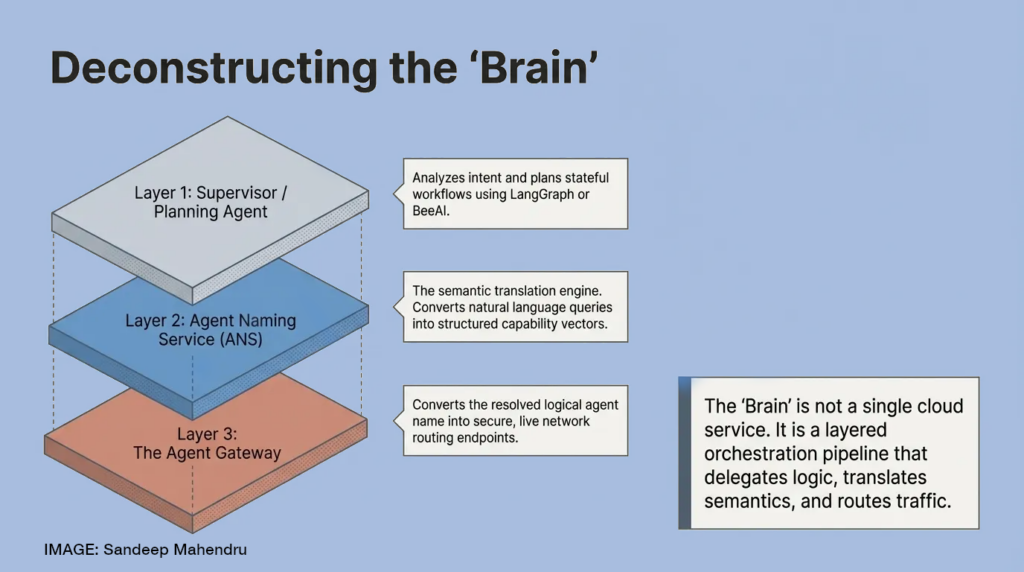
That stitching mechanism is what Sandeep calls the Brain.

The Brain: Semantic Intent Parsing at Scale

The Brain is the orchestration intelligence at the center of this architecture. Think of it less like a search engine and more like a very sophisticated dispatcher.

Traditional keyword search is too blunt for this. If a user’s request is “help me optimize our supply chain for Q4,” a keyword search returns documents. An intelligent Brain decomposes that intent into a structured, multi-agent workflow – logistics expert, finance agent, demand forecasting agent – and routes each sub-task to the best available specialist in real time.

Image: Sandeep Mahendru on Medium.

Critically, Sandeep argues against a centralized bottleneck architecture:

“A standardized metadata routing protocol allows secure, local orchestrators to decompose human requests into multi-agent workflows while maintaining strict context isolation.”

This is a subtle but important design principle. Discovery doesn’t have to be centralized to be powerful. A federated model, where a lightweight metadata layer indexes agent capabilities across independently governed registries, can be both scalable and resilient.

The Discovery Gap: Why Agent Cards Aren’t Enough

The current standard for agent interoperability is A2A (Agent-to-Agent protocol), which gives every agent a structured “Agent Card” – essentially a business card declaring its capabilities, authentication requirements, and communication standards. A2A is built on established web infrastructure: JSON-RPC 2.0 over HTTP/S, OAuth 2.0, mTLS. It’s solid, enterprise-grade, and open.

But Agent Cards are self-declared. And self-declaration, as anyone who’s reviewed a vendor pitch deck knows, is not the same as verified performance.


AgentFacts: Report Cards, Not Business Cards

“Trust is no longer a ‘claim’ or a static audit; it’s an audited metric signed by third-party authorities and constantly tested via automated prompting and local consensus.”

AgentFacts are the proposed evolution beyond Agent Cards. Where an Agent Card says “I am a financial analysis agent,” an AgentFact is a cryptographically signed, W3C Verifiable Credential that says “this agent has been independently audited, has completed 12,000 successful tasks with a 97.3% accuracy rate, and has zero confirmed hallucinations in regulated output contexts.”

The distinction matters enormously in enterprise settings. When an agent is making decisions that touch compliance, financial transactions, or patient care, “trust me, I’m good at this” is not an acceptable credential.

Byzantine Fault Tolerance: In-Flight Security

Even cryptographically signed AgentFacts don’t solve the full security problem. Sandeep’s architecture adds a layer that I think most people building in this space haven’t adequately grappled with: Byzantine Fault Tolerance.

The analogy in the piece is the best summary I can offer:

“A Secure Federated Registry is like a ‘No Fly List’ – it keeps known bad actors out. But Byzantine Fault Tolerance is like ‘In-Flight Security’ – it protects the passengers even if someone with a valid ticket turns out to be a threat.”

BFT, in this context, means triangulating outputs across multiple independent agents and using quorum voting to detect when a “trusted” actor is hallucinating, has been compromised, or is simply wrong. Because traditional consensus mechanisms add latency, Sandeep proposes economic staking and slashing as the enforcement layer – agents put something at risk when they participate, and bad actors lose it.

This is crypto-native thinking applied to AI infrastructure. Whether or not you have a background in distributed systems, the principle is intuitive: skin in the game changes behavior.

Cognitive Liquidity: The AI-NPM Model

The long-term economic vision Sandeep lays out is what he calls Cognitive Liquidity – the ability to “import” verified intelligence as easily as a developer imports a software library today.

“By integrating discovered agents directly into low-code environments… developers can ‘import’ verified intelligence as easily as they import software libraries today.”

This is the AI-NPM model. Just as npm transformed software development by making reusable, versioned, community-maintained code packages trivially accessible, a mature Agentic Web would make reusable, verifiable, audited AI capabilities trivially accessible – streamable on demand, licensed transparently, and composable into complex workflows without custom integration work.

The infrastructure question isn’t just technical. It’s economic. Whoever builds the registry, the Brain, and the trust layer controls the tollbooth for an enormous amount of future AI commerce.

* In the context of AI, NPM (Node Package Manager) primarily refers to its role as the distribution hub for AI developer tools, libraries, and autonomous agents. While originally built for JavaScript, it has evolved into a “universal distribution platform” for the AI ecosystem.

Open Standards and the Public Good Mandate

One of the most important arguments in the piece is the one Sandeep makes almost as a footnote: this infrastructure needs to be governed by neutral bodies, not owned by any single platform.

A2A is already moving in this direction through the Linux Foundation and related open standard initiatives. NANDA – the Naming and Discovery Architecture – is one of the projects building the federated registry layer. If any single company owns the “Global Address Book,” the network effect becomes a chokehold. Open governance is the only model that scales without creating the kind of rent-extraction that would strangle the ecosystem before it matures.

A Note on Where This Work Lives

Sandeep Mahendru and I are both members of the NYC Chapter of the NANDA Project, an initiative out of MIT Media Lab focused on building the open naming and discovery layer for the Agentic Web. The work Sandeep describes isn’t purely theoretical – it’s the kind of architecture we’re actively thinking about in that community, and it’s influencing real infrastructure decisions being made right now.

The Agentic Web isn’t coming. It’s being built. The question is whether the backbone gets built right.

Why Agent Trust Matters to the C-Suite

If you’re a technology leader or founder thinking about AI strategy, Sandeep’s framework suggests a few reorienting questions:

  • Are you building agents that will be discoverable by other agents? Or are you building another closed silo?
  • How are you establishing verifiable trust in your AI outputs – not just internally, but in ways that external systems could validate?
  • Are your AI investments positioned for the intent-first world, or optimized for the code-first world you’re leaving behind?

The companies that get this right early will have an enormous structural advantage. The backbone of the Agentic Web is being laid now, and the patterns being established will be hard to reverse.


Sandeep Mahendru’s original article, Proposal for the Global Backbone of the Agentic Web, is published on Medium. Sandeep is an Engineering Leader and Senior System Architect at Google, where he builds AI-driven innovative solutions for financial markets.

Joe Skopek is the founder of Velocity Ascent, an AI-first innovation consultancy based in New York. Both are part of the Leadership Team of the NYC Chapter of the NANDA Project from MIT Media Lab.

AI Agents Don’t Work Like Humans – And That’s the Point

Joe Skopek · November 14, 2025 ·

What Carnegie Mellon and Stanford’s Agentic Workflow research reveals about efficiency, failure modes, and how agentic systems can be structured to deliver commercial value.

A Clearer View of How Agents Actually Work

Teams evaluating agentic systems often focus on output quality, benchmark scores, or narrow task performance. Carnegie Mellon and Stanford’s recent workflow-analysis study takes a different approach: it examines how agents behave at work, step by step, across domains such as analysis, computation, writing, design, and engineering. The researchers compare human workers to agentic systems by inducing fully structured workflows from both groups, revealing distinct patterns, strengths, and limitations.

“AI agents are continually optimized for tasks related to human work, such as software engineering and professional writing, signaling a pressing trend with significant impacts on the human workforce. However, these agent developments have often not been grounded in a clear understanding of how humans execute work, to reveal what expertise agents possess and the roles they can play in diverse workflows.”

How Do AI Agents Do Human Work? Comparing AI and Human Workflows Across Diverse Occupations
Zora Zhiruo Wang Yijia Shao Omar Shaikh Daniel Fried Graham Neubig Diyi Yang
Carnegie Mellon University Stanford University
2510.22780v1.

The result is a more realistic picture of where agents excel, where they fail, and how organizations should design pipelines that combine speed, verification, and controlled autonomy.

The Programmatic Bias: A Feature, Not a Defect

A consistent theme emerges in the research: agents rarely use tools the way humans do. Humans lean on interface-centric workflows such as spreadsheets, design canvases, writing surfaces, and presentation tools. Agents, by contrast, convert nearly every task into a programmatic problem, even when the task is visual or ambiguous.

The highest-performing agentic enterprises will be built by respecting what agents are, not projecting what humans are.

This is not a quirk of a single framework. It is a systemic pattern across architectures and models. Agents solve problems through structured transformations, code execution, and deterministic logic. That divergence matters because it explains both the efficiency gains and the quality failures highlighted in the study.

Agents move quickly because they bypass the interface layer.
Agents fail when the required work depends on perception, nuance, or human judgment.

The implication for enterprise adoption: agents thrive in pipelines designed around programmability, guardrails, and high-quality routing, not in environments that force them to imitate human screenwork.


Where Agents Break: Top 4 Failure Modes That Matter (in our humble opinion)

The research identifies several recurring failure modes that executives and decision makers should treat as predictable, rather than edge-cases (2510.22780v1)

1. Fabricated Outputs

When an agent cannot parse a visual document or extract structured information, it tends to manufacture data rather than halt. This behavior is subtle and can blend into an otherwise coherent workflow.

2. Misuse of Advanced Tools

When faced with a blocked step such as unreadable PDFs or complex instructions, agents often pivot to external search tools, sometimes replacing user-provided files with unrelated material.

3. Weakness in Visual Tasks

Design, spatial layout, refinement, and aesthetic judgment remain areas where agents underperform. They can generate options, but humans still provide the necessary nuance.

4. Interpretation Drift

Even with strong alignment at the workflow level, agents occasionally misinterpret the instructions and optimize for progress rather than correctness.

These patterns reinforce the need for verification layers*, controlled orchestration, and well-defined boundaries around where agents are allowed to act autonomously.

[*] This is where the NANDA framework is essential


Where Agents Excel: Efficiency at Scale

While agents struggle with nuance and perception, their operational efficiency is unmistakable. Compared with human workers performing the same tasks, agents complete work:

• 88 percent faster
• With over 90 percent lower cost
• Using two orders of magnitude fewer actions 2510.22780v1

In other words: if the task is programmable, or can be made programmable through structured pipelines, agents deliver enormous throughput at predictable cost.

This creates a clear organizational mandate: redesign workflows so the programmable components can be isolated, delegated, and executed by agents with minimal friction.


Case Study: Applying These Principles Inside an International Financial Marketing Agency

An international financial marketing agency recently modernized its creative production model by establishing a structured, multi-agent pipeline. Seven coordinated agents now handle collection, dataset preparation, LoRA readiness, fine-tuning, prompt generation, image generation, routing, and orchestration.

Nothing in this system depends on agents behaving like humans. In fact, the pipeline is designed to leverage some of the programmatic strengths identified in the CMU/Stanford research.

Key Architectural Principles

1. Programmatic First

Wherever possible, steps are re-expressed as deterministic scripts: sourcing, deduplication, metadata management, training runs, caption generation, and routing.

2. Verification Layering

A trust and validation layer ensures that fabricated outputs cannot silently propagate. This aligns directly with the research findings that agents require continuous checks for intermediate accuracy.

3. Zero-Trust Boundaries

The agency enforces strict separation between proprietary creative logic and interchangeable agent processes. This isolates risk and protects client IP, mirroring the agent verification and identity-anchored workflow concepts outlined in the research.

4. Packet-Switched Execution

Tasks are broken into small, routable fragments. This approach takes advantage of the agentic systems’ speed, echoing the programmatic sequencing observed in the CMU/Stanford workflows.

5. Human Oversight at the Right Granularity

Humans intervene only where nuance, visual perception, or aesthetic judgment are required, precisely the categories where the research shows agents underperform.

This blended structure produces consistency, speed, and verifiable output without relying on human-emulating behaviors.


Why This Matters for Commercial Teams

Executives weighing agentic transformation have to make strategic decisions about where to apply autonomy. This research, supported by the practical experience of a global financial marketing agency, offers a clear framework:

Agents excel at:

• Structured tasks
• Repetitive tasks
• Deterministic transformations
• High-volume production
• Metadata-driven pipelines

Humans remain essential for:

• Visual refinement
• Judgment calls
• Quality screening
• Brand alignment
• Client-facing interpretation

The correct model is neither replace nor replicate. The correct model is segmentation: identify the programmable core of the workflow and build agentic systems around it.


The Path Forward

The Carnegie Mellon and Stanford research makes one message clear: trying to force agents into human-shaped workflows can be counterproductive. They are not UI workers. They do not navigate ambiguity the way humans do. They operate through code, structure, and deterministic logic.

Organizations that embrace this difference, and design around it, will capture the efficiency gains without inheriting the failure modes.

Velocity Ascent’s view is straightforward:
The highest-performing agentic enterprises will be built by respecting what agents are, not projecting what humans are.


NANDA: Networked Agents And Decentralized AI

Velocity Ascent Live · April 16, 2025 ·

Pioneering the Future of Decentralized Intelligence

Imagine a network of specialized AI agents working together across a secure, decentralized architecture. Each agent handles specific tasks, communicates effortlessly, and operates autonomously—enabling your business to innovate, streamline processes, and make data-driven decisions in real-time.

“Just as DNS revolutionized the internet by providing a neutral framework for web access, we need a similar infrastructure for the “Internet of Agents.” We’re launching NANDA – an open-protocol for registry, verification, and reputation among AI agents – in collaboration with national labs and global universities (decentralized across 8 time zones!)
NANDA will pave the way for seamless collaboration across diverse systems, fully compatible with enteprise protocols like MCP and A2A. This initiative is a step toward democratizing agentic AI, creating an ecosystem where specialized agents can work together to solve complex challenges—just like DNS did for the web.”

Ayush Chopra
PhD Candidate at MIT

This dynamic ecosystem operates within a secure, decentralized infrastructure that ensures privacy, trust, and accountability at every level. This concept is brought to life through the NANDA (Networked Agents And Decentralized AI) initiative, which aims to create a truly decentralized Internet of AI Agents.

The Internet of AI Agents

At the MIT Decentralized AI Summit, the Model Context Protocol (MCP) was introduced as a standardized method for enabling communication between AI agents, tools, and resources. While MCP serves as a foundational interaction protocol, NANDA goes beyond the basics by addressing the infrastructural challenges required to support a truly decentralized, large-scale network of AI agents.

NANDA builds upon MCP to provide the critical components needed for a distributed ecosystem where potentially billions of AI agents can collaborate across organizational and data boundaries. The protocol extends the capabilities of traditional AI systems, fostering seamless agent collaboration at scale—something that current centralized models struggle to achieve due to rigid data structures and lack of transparency.

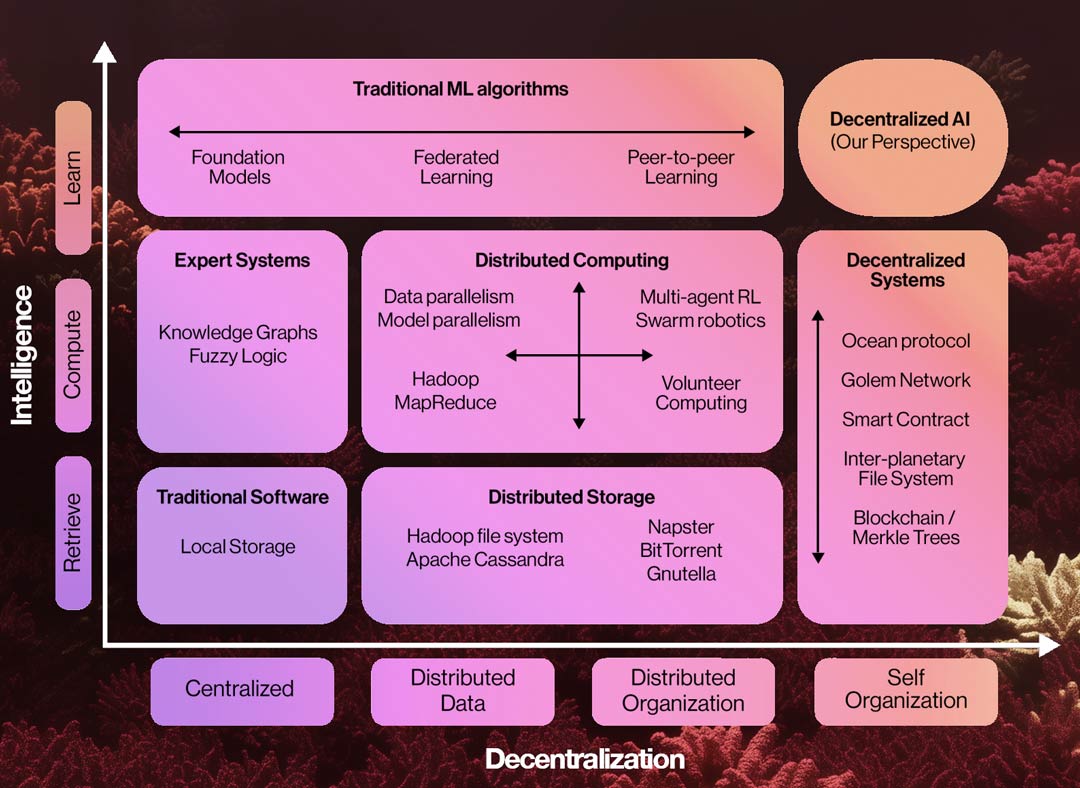
“Enter the landscape of existing paradigms and the path towards decentralized AI. ML algorithms like foundation models excel in AI capabilities but remain centralized. Decentralized systems, like blockchains and volunteer computing, distribute storage and computation but lack intelligence. We argue that bringing the two capabilities together can have an outsized impact. We call upon the AI community to focus on the open challenges in the upper-right quadrant, where decentralized architectures can give rise to anew generation of AI systems that are both highly capable and aligned with the values of a decentralized society.”

A Perspective on Decentralizing AI
Abhishek Singh, Charles Lu, Gauri Gupta, Nikhil Behari, Ayush Chopra, Jonas Blanc, Tzofi Klinghoffer, Kushagra Tiwary, and Ramesh Raskar
MIT Media Lab

Everyman Metaphor

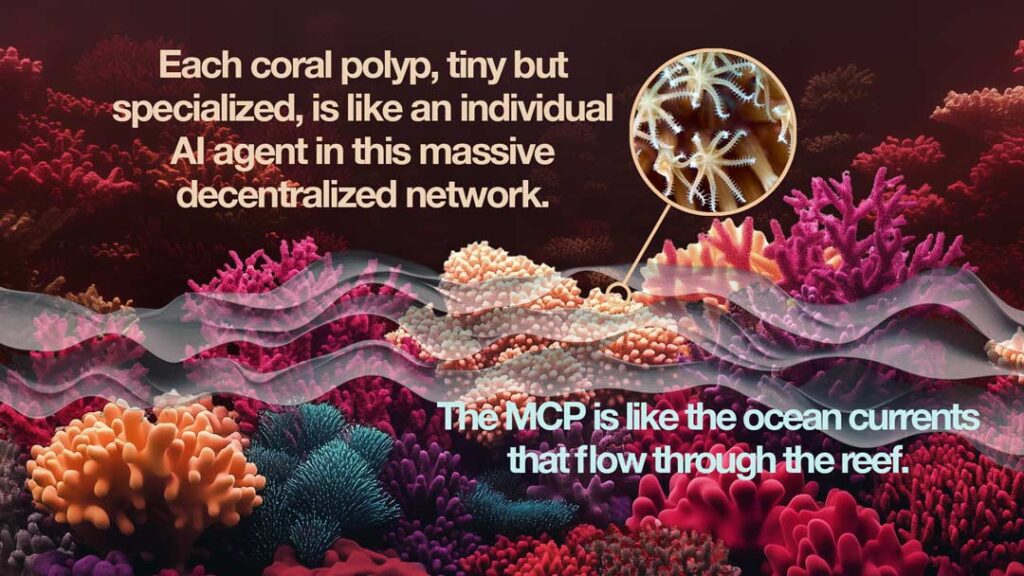
Imagine a vast coral reef ecosystem.

Each coral polyp, tiny but specialized, is like an individual AI agent in this massive decentralized network. Some filter nutrients, others build the reef, and still others host symbiotic relationships with fish, algae, and crustaceans—each with its unique role.

Similarly, AI agents in NANDA perform specific tasks—learning, navigating, transacting, and interacting—each contributing to the broader ecosystem.

The Model Context Protocol (MCP) is similar to the ocean currents that flow through the reef. These currents are consistent, structured, and essential—they allow nutrients, larvae, and signals to move through the system. In the same way, MCP ensures that information flows smoothly, securely and predictably between agents, tools, and resources.

But ocean currents alone don’t make a thriving reef.

That’s where NANDA comes in—it’s the reef structure itself, the intricate, interconnected framework built over time that supports the life within. NANDA provides the scaffolding—the decentralized architecture—where all these AI agents (like reef dwellers) can thrive together. It allows for scalability, resilience, and collaboration across countless agents, just like a healthy reef sustains an immense variety of life.

So in this metaphor:

  • AI agents = reef creatures and coral polyps
  • MCP = ocean currents and nutrient flows
  • NANDA = the coral reef’s skeleton, enabling life to flourish at scale

Together, they form a self-sustaining, adaptive ecosystem—an Internet of AI agents as vibrant and alive as a coral reef teeming with collaborative intelligence.


Why NANDA Matters to a CEO

Strategic Advantage
Adopting NANDA positions organizations to lead in AI-driven markets by supporting everything from R&D to regulated processes. Its infrastructure enables flexibility for creative automation and ensures reliability for mission-critical applications. By aligning AI maturity with business goals, NANDA facilitates a smoother path to AI adoption, providing long-term competitive advantages in industries where agility and scalability are key.

Decentralized Intelligence at Scale
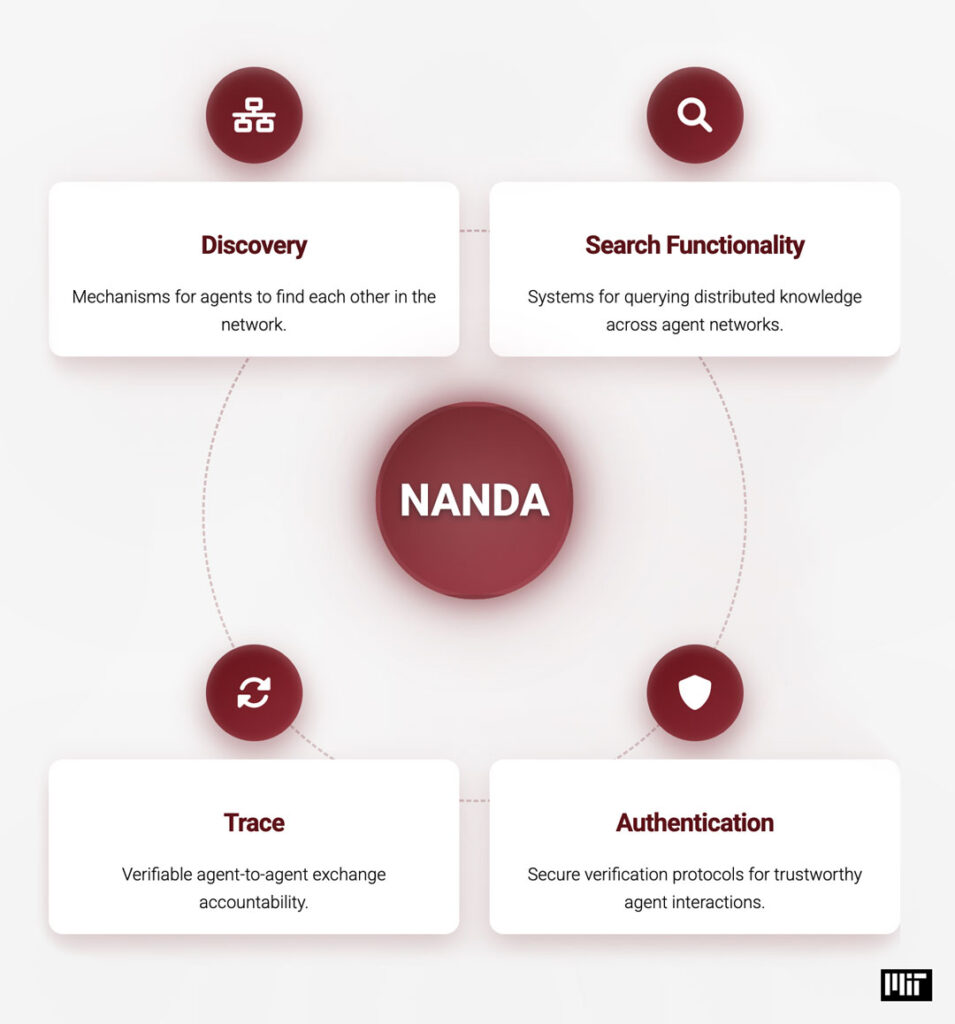
NANDA’s approach transforms traditional AI systems by decentralizing both the data and control, enabling an intelligent ecosystem of agents that collaborate seamlessly. This enables secure, dynamic workflows across industries, from healthcare to finance. Unlike standalone AI systems, NANDA offers enhanced capabilities for discovery, search, authentication, and interaction traceability—ensuring secure and scalable intelligence for enterprise environments.

Innovation with Governance
With NANDA, organizations can embrace innovation while maintaining full control over security and compliance. NANDA balances rapid development with the need for governance by providing developers with tools for building secure, verifiable applications and agents. Secure authentication protocols and verifiable interaction logs (“Trace”) ensure that the system remains accountable, transparent, and aligned with regulatory standards for sensitive operations.

Why NANDA Will Quickly Provide a Secure Solution

For institutions like hospitals or financial organizations, adopting a decentralized system like NANDA may initially raise concerns regarding security and compliance. However, NANDA is designed to address these concerns head-on. Built from the ground up with trust and accountability at its core, NANDA leverages secure multi-layered encryption, authentication mechanisms, and immutable trace logs to ensure the integrity of data and interactions.

Additionally, NANDA’s infrastructure is designed to scale while meeting the most stringent privacy and regulatory requirements. By incorporating real-time verification, verifiable agent-to-agent interactions, and decentralized control, NANDA provides a robust security framework that enables organizations to trust its decentralized agents with mission-critical tasks while ensuring compliance with industry standards. The framework’s focus on decentralized trust eliminates the need for a single point of failure, further strengthening its suitability for high-security environments like healthcare or finance.

Core Value Proposition and Enabling Technology

NANDA explicitly positions itself as not just an interaction protocol (like MCP) but as a comprehensive infrastructure designed to support decentralized, large-scale AI collaboration. By providing a network fabric with critical components such as:

  • Registries for discovering agents, tools, and resources
  • Interaction databases for auditing and referencing agent interactions
  • Developer tools and SDKs to integrate third-party applications

NANDA creates the foundation for building a secure, scalable ecosystem where AI agents can collaborate across industries with confidence.

Key Differentiation Factors in the AI Agent Ecosystem

NANDA distinguishes itself from other AI agent frameworks through its explicit focus on decentralization, its large-scale infrastructure, and its strong academic foundation. By prioritizing decentralized trust, NANDA addresses the core limitations of centralized AI models and networks. Furthermore, NANDA’s traceable accountability systems ensure that every action is verifiable, creating a trustworthy environment for enterprise-scale applications.

Unlike frameworks like LangChain or AutoGen, which focus on individual agents or small-team coordination, NANDA aims to build the “interstate highway system” for decentralized AI—creating the infrastructure needed for billions of agents to collaborate seamlessly across the globe. This vision, coupled with a deep academic research foundation, positions NANDA as a true leader in the development of decentralized intelligence.


Elevator Pitch (AI Strategy Lens):

NANDA is a secure AI framework that helps businesses innovate with confidence. It connects specialized AI agents across a decentralized network, enabling them to collaborate, learn, and make decisions autonomously. Built on Anthropic’s MCP, NANDA offers strong security with encrypted communication, real-time authentication, and verifiable logs, ensuring that sensitive operations stay secure and compliant. With easy integration and developer tools, NANDA supports rapid innovation, making it a scalable and reliable solution for your business to harness AI safely and effectively.

NANDA Ecosystem

Discovery within the NANDA ecosystem enables agents to find and interact with one another efficiently across the network. This includes robust Search Functionality for querying distributed knowledge, and Authentication mechanisms to ensure secure and trustworthy agent interactions. A Trace layer supports verifiable accountability in agent-to-agent exchanges. The system is built on a modular architecture comprising a Protocol Layer that forms the foundation for AI communication, Developer Tools to empower builders within the ecosystem, an Infrastructure Layer maintaining a registry of agents, resources, and interactions, and a suite of Applications that support third-party integrations via SDKs, registries, and databases.

SOURCE:

General Information


Reality Check: Federated Agentic and Decentralized Artificial Intelligence

Joe Skopek · September 12, 2024 ·

AI is evolving rapidly, and a new approach is gaining momentum: agentic AI. Unlike current tools like ChatGPT, which require human input to operate, agentic AI is designed to act independently – monitoring competitors’ marketing efforts, scheduling real-time content updates, or predicting real-world equipment needs – without waiting for instructions. As these systems take on more autonomy, robust security measures become essential to ensure their actions remain safe, aligned, and trustworthy.

MIT Media Lab – Ramesh Raskar: A Perspective on Decentralizing AI

“A.I. co-pilots, assistants and agents promise to boost productivity with helpful suggestions and shortcuts. “

New York Times, September 2024

While this technology is still in the early stages, it’s being hyped as the next big thing in AI, promising to boost productivity and innovation. However, we’re not there yet – agentic AI is mostly a vision for the future that’s rapidly approaching.

Governance Challenges: Accountability, Regulation, and Security

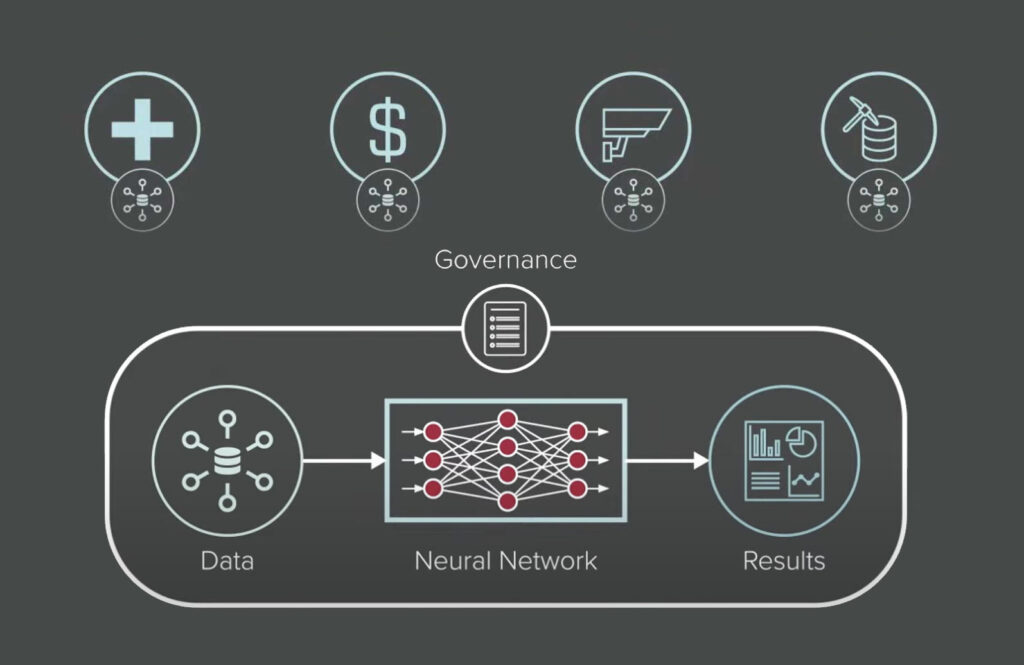
Governance issues with Agentic AI and decentralized computing stem from a lack of centralized control, making regulation and enforcement difficult across jurisdictions. In decentralized systems, no single authority oversees operations, while in Agentic AI, autonomous decisions raise questions about accountability, such as who is responsible when things go wrong – developers, users, or the AI itself.

Ethical and legal compliance is a significant challenge, as both agentic AI and decentralized systems often operate beyond traditional frameworks, making it difficult to ensure they adhere to laws or ethical guidelines.

Security is another concern. Decentralized systems may suffer from vulnerabilities due to inconsistent protocols, while agentic AI can be manipulated or exhibit harmful behaviors. Existing regulatory frameworks are frequently outdated, creating oversight gaps for these emerging technologies.

Both technologies also face issues with coordination and standardization. Decentralized systems require consensus among many participants, which can slow progress, and agentic AI currently lacks widely accepted standards.

Finally, the lack of transparency in AI decision-making, combined with the difficulty of auditing decentralized systems, further complicates governance and accountability.

This is where Federated Machine Learning offers a compelling solution.

Federated Machine Learning (FedML)

FedML is an approach that enables organizations with limited data – so-called “small data” organizations – to collaboratively train and benefit from sophisticated machine learning models. The definition of “small data” depends on the complexity of the AI task being addressed.

In Pharma, for example, having access to a million annotated molecules for drug discovery is relatively small in view of the vast chemical space.

In Marketing that small data set might be in the form of brand specific visual data – brand guidelines scattered across PDFs, emails, and shared drives.

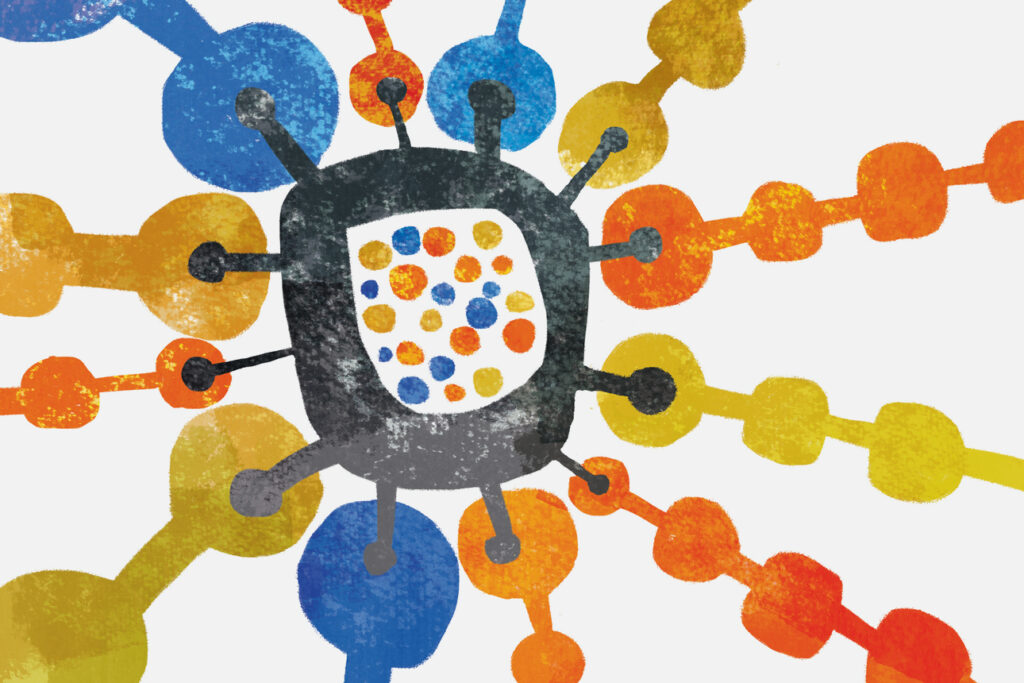
Image: Jing Jing Tsong/theispot.com

Is Federated Agentic AI the answer?

Federated Agentic AI refers to a blend of two advanced AI concepts: federated learning and agentic AI.

Federated learning enables AI models to be trained across decentralized devices or data sources while keeping the data local and secure, thereby enhancing privacy and scalability. Meanwhile, agentic AI refers to self-contained systems that, once implemented by humans, operate autonomously around the clock. These systems are capable of controlled decision-making and can adapt based on real-time data without further human intervention.

When combined, Federated Agentic AI allows multiple autonomous agents to collaborate across a secure distributed network. These agents can handle tasks independently while continuously learning from local data sources, without needing to share sensitive information across the network. This setup is particularly useful in environments like healthcare, finance, or IoT, where data privacy is critical but complex tasks still require intelligent automation.

For instance, a federated agentic system might be deployed in a network of smart devices where each device autonomously manages specific tasks (e.g., thermostats optimizing energy use) while learning from local data (e.g., weather conditions). These devices can also share insights without revealing user data, improving overall system efficiency and privacy​.

Final Thoughts: Designing for new technology is a completely different challenge from a traditional design project.

Typically, users already know how to interact with familiar products – like swiping a credit card at a payment terminal or using a TV remote to change channels. But with emerging technology, there are no familiar cues, making it harder for users to figure out how to engage with it effectively. Think back to when users first encountered smartphones – there was no clear precedent for touchscreens or gestures, making it challenging to learn entirely new interactions.

Adoption of new tech often lags behind confusion and speculation, so creating a seamless, intuitive user experience is essential for success.

That said, designing something entirely new isn’t easy – but it’s exactly where the team at Velocity Ascent excels. We navigate the space between excitement for emerging technology and the need to deliver real, secure, user-centered value. By following key principles, we transform unfamiliar tech into products that people and teams love to work with.

For CMOs, this means a potential shift in how to approach marketing and customer engagement. As AI becomes more autonomous, the question will be: how do we control and guide these powerful tools to enhance our strategies while still ensuring privacy? Ultimately it is about using AI in smarter, more effective ways to drive business growth.

Sources:

Analytics Vidhya, The GitHub Blog

MIT Media Lab: Decentralized AI Overview

A Perspective on Decentralizing AI

Velocity Ascent

© 2026 Velocity Ascent · Privacy · Terms · YouTube · Log in