• Skip to primary navigation
  • Skip to main content
Velocity Ascent

Velocity Ascent

Looking toward tomorrow today

  • Research
  • Design
  • Development
  • Strategy
  • About
    • Home
    • Who we work with…
      • Product Leaders
      • Innovation Teams
      • Founder-Led Organizations
    • Services
    • Contact Us
  • Show Search
Hide Search

the Blog

From Idea to Impact: The Skunkworks Magic of Rapid Software Prototyping

velocityascent · January 26, 2024 ·

We blend vision, research, planning, and collaboration to craft software solutions that make a meaningful impact.

The term “skunkworks” is generally used in a generic sense to refer to a innovation-focused group or team that focuses on accelerated and new-to-world projects.

Product of the Skunk works

The concept of a skunkworks was popularized by Lockheed Martin’s Skunk Works division, —a name inspired by a mysterious locale from the comic strip Li’L Abner— known for its pioneering work on advanced aircraft designs, but the term itself is widely used to describe similar innovation-focused teams.
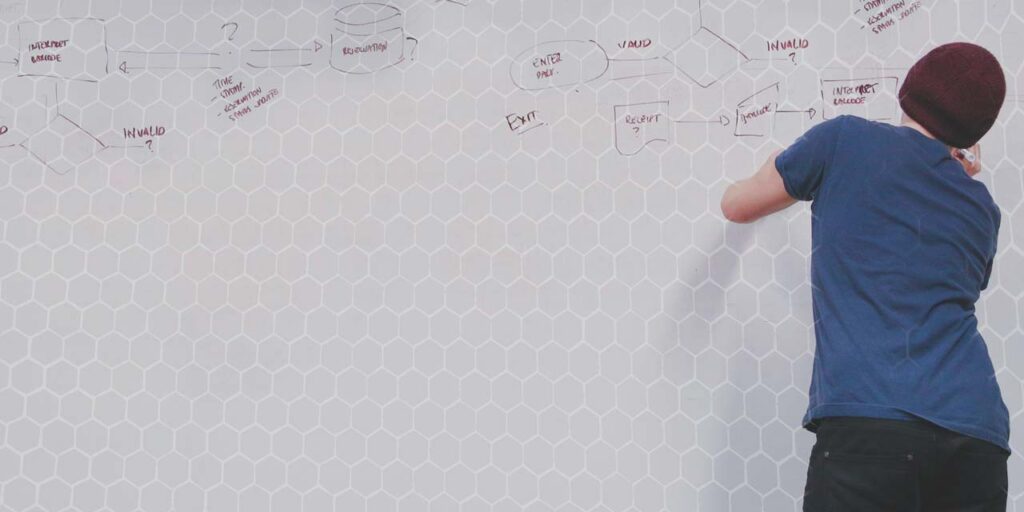
Whiteboarding ideas

While software development differs from aerospace engineering, there are valuable principles and elements from Skunk Works that can be applied to your process:

  1. Innovation Culture: Foster a culture of innovation and encourage team members to think creatively, take calculated risks, and explore unconventional solutions to problems.
  2. Cross-Disciplinary Teams: Assemble diverse teams with expertise in various aspects development, including coding, user experience design, data analysis, and domain-specific knowledge. We have found that interdisciplinary collaboration often leads to innovative solutions.
  3. Rapid Prototyping: Our team uses rapid prototyping and iterative development to build quick (Fail Fast), low-fidelity prototypes to visualize ideas, gather feedback early, and iterate on software solutions based on real-world insights.
  4. Human-Centric Approach: Understanding your users and their needs is crucial to an accelerated pace. It is vital to conduct user research, gather feedback, and design software with the end-user in mind. Human-centric design leads to successful results.
  5. Data-Driven Decision-Making: Once live, leverage data feeds and live analytics to inform future software development. Real-world data provides valuable insights into user behavior and preferences, resulting in informed decisions.
  6. Secrecy and Confidentiality: While not all projects require secrecy, the team should be well-versed at maintaining confidentiality with sensitive or groundbreaking work. Ideas are one of a company’s most valuable assets, safeguarding intellectual property (IP) during development is paramount.
  7. Agile Methodologies: The implementation of industry-standard agile methodologies allow quick adaptation to changing project requirements and market dynamics. Frequent iterations and incremental development allow for flexibility and responsiveness.
  8. Continuous Learning: A culture of continuous learning and adaptation ensures that the team is always seeking ways to enhance their skills and knowledge to “stay ahead of the curve”.
  9. Quality Assurance: Place a strong emphasis on details and quality assurance testing throughout the development process. Thorough testing ensures that our software solutions meet the highest standards of performance, stability and reliability.
  10. Collaboration and Communication: Assure that the team maintains open lines of communication with participants and stakeholders. Effective collaboration and clear documentation of decisions and progress are essential for success.
  11. Scaling Success: Early on in the process consider how to scale effectively exploring future opportunities for expanding features, platforms, or user bases to maximize impact.
  12. Leadership and Vision: Provide strong leadership and a clear vision for development, setting the tone for innovation, commitment to quality, and the pursuit of excellence.

While the aerospace and software industries differ, the principles of innovation, collaboration, agility, and user-centricity can be applied to software development to create innovative and successful solutions.

Secure Agentic Pipelines for Regulated Industries

Velocity Ascent Live · March 2, 2026 ·

Why secured networked AI agents are the operational layer financial services has been waiting for.

Most organizations adopting AI in regulated environments are doing it backwards. They start with the model and work outward, hoping compliance will follow. It rarely does.

The fundamental challenge is not whether AI can generate content, write reports, or produce imagery. It can. The challenge is whether every output can withstand scrutiny from compliance teams, clients, and regulators. In financial services, healthcare, and legal practice, the answer to that question determines whether AI is an asset or a liability.

The Compliance Problem Nobody Talks About: Can Agentic AI do the work in a way that every stakeholder in the chain can verify.

Traditional AI pipelines are monolithic. A single system ingests data, processes it, and produces output. When something goes wrong; a licensing violation, a hallucinated claim, a brand-inconsistent asset – the effort required to identify where the failure occurred can be substantial.


Agentic Architecture: Specialized Agents, Governed Workflows

Agentic pipelines take a fundamentally different approach. Instead of a single monolithic system, the work is distributed across specialized agents, each responsible for a discrete function. An orchestration layer coordinates handoffs, enforces sequencing, and maintains the audit trail.

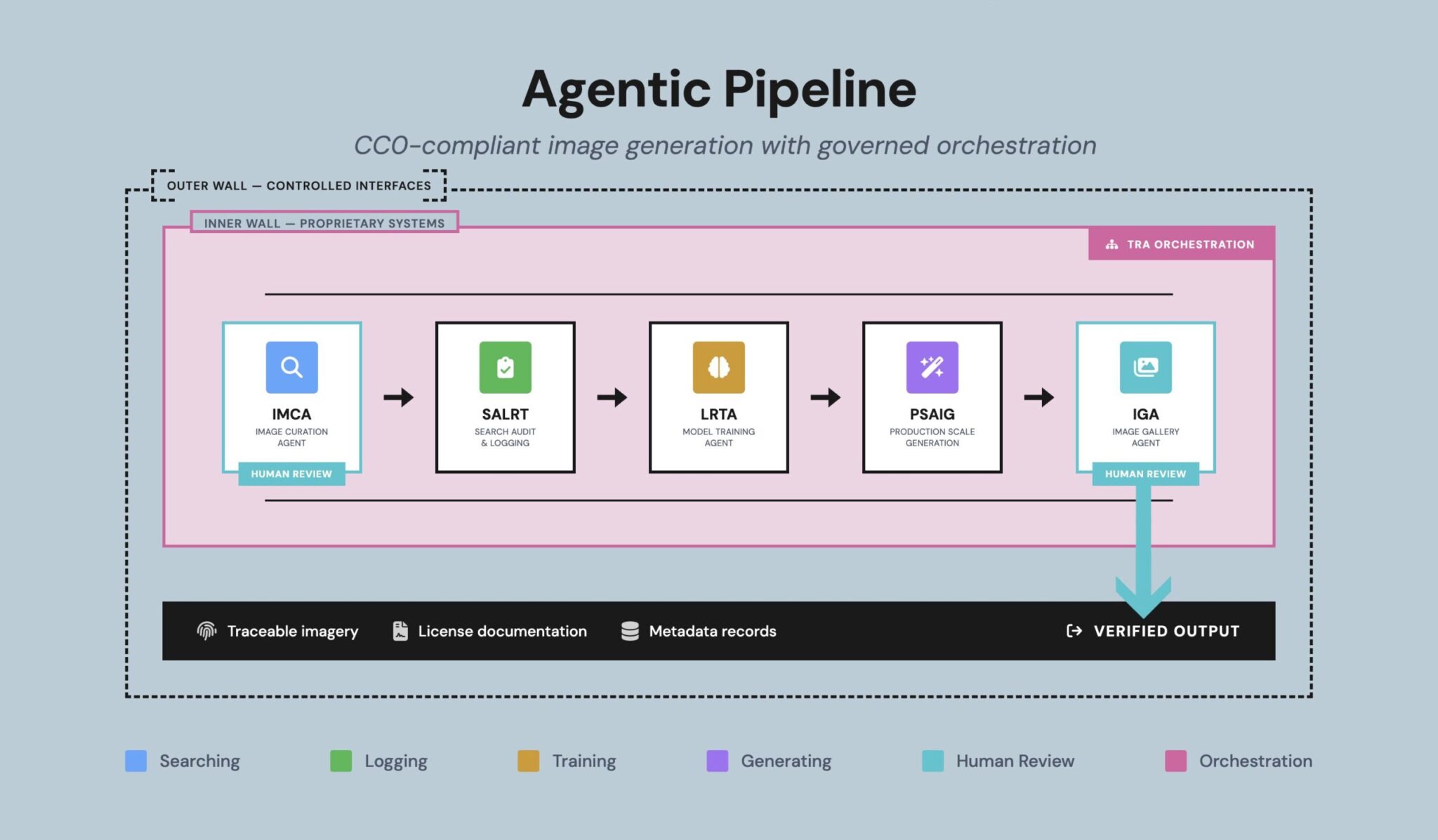
Consider a production pipeline for compliance-sensitive content. Rather than a single AI tool doing everything, the architecture employs dedicated agents for sourcing, verification, model training, generation, quality assurance, and delivery. Each agent operates within defined boundaries. Each produces records that downstream agents and human reviewers can inspect.

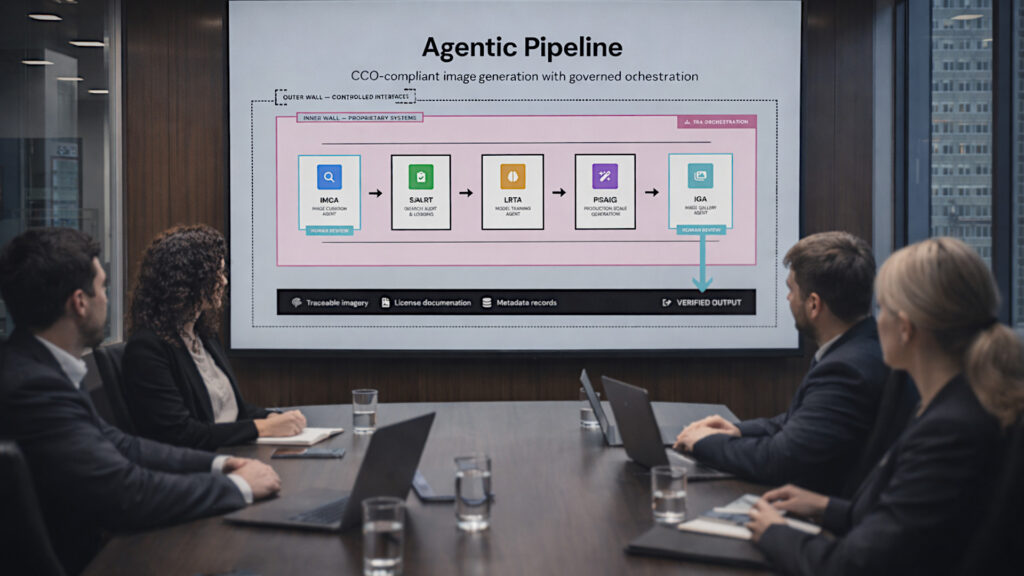
Agentic pipeline architecture: specialized agents with governed orchestration and human review gates. From Joe Skopek’s Financial Marketer article: “Marketing’s next frontier is autonomous networked intelligence.“

The orchestration agent functions as a traffic controller, routing work between agents based on status, priority, and pipeline rules. It does not make creative or compliance decisions. It enforces process. Human review gates are positioned at the points where judgment is irreplaceable–source curation and final output quality.

This is not theoretical architecture. Production systems built this way are operating today, handling thousands of assets through end-to-end pipelines where every step is logged, every input is traceable, and every output is defensible.

Trust You Can Demonstrate

In regulated environments, trust must be demonstrable rather than implied. Agentic systems are designed to produce clear, reviewable records of origin, licensing, and decision flow. Compliance discussions move away from subjective assurances and toward documented system behavior.

Every agent in the pipeline writes to a shared provenance record. When a sourcing agent identifies an asset, it logs the license type, the retrieval date, and the verification status. When a training agent builds a model, it records the dataset composition, the training parameters, and the lineage back to original sources. When a generation agent produces output, the full chain of custody is available on demand.

This matters because regulators do not ask whether your AI is good. They ask whether you can prove it did what you say it did. Agentic pipelines answer that question by design, not by retrofit.

Collaboration Without Exposure

Financial services firms have historically avoided collaboration on models or data because the risk outweighed the benefit. Sharing training data exposes proprietary logic. Sharing models reveals competitive advantage. The default has been isolation.

Agentic architecture changes this calculation through what we call the Double Garden Wall. The inner wall protects proprietary datasets, screening logic, and brand-governance frameworks. These remain sealed and non-negotiable. The outer wall exposes only what external systems require: controlled capability interfaces, verifiable records, and traceable outputs.

Built this way, systems gain interoperability without dilution, collaboration without intellectual property leakage, and scale without compromising compliance.

Advances in distributed learning and controlled execution now allow verified partners to contribute capability without sharing raw data or proprietary logic. Agents can be registered in decentralized directories, verified against published capability specifications, and bound by enforceable policy contracts–all without exposing internal methods. Capability expands while risk remains bounded.

Parallel Workflows Without Parallel Headcount

Traditional AI pipelines execute sequentially. One step finishes before the next begins. Networked agentic systems enable multiple stages of work to operate concurrently across compatible agents. This event-driven, contract-based execution model allows firms to handle volume surges without linear increases in staffing or infrastructure.

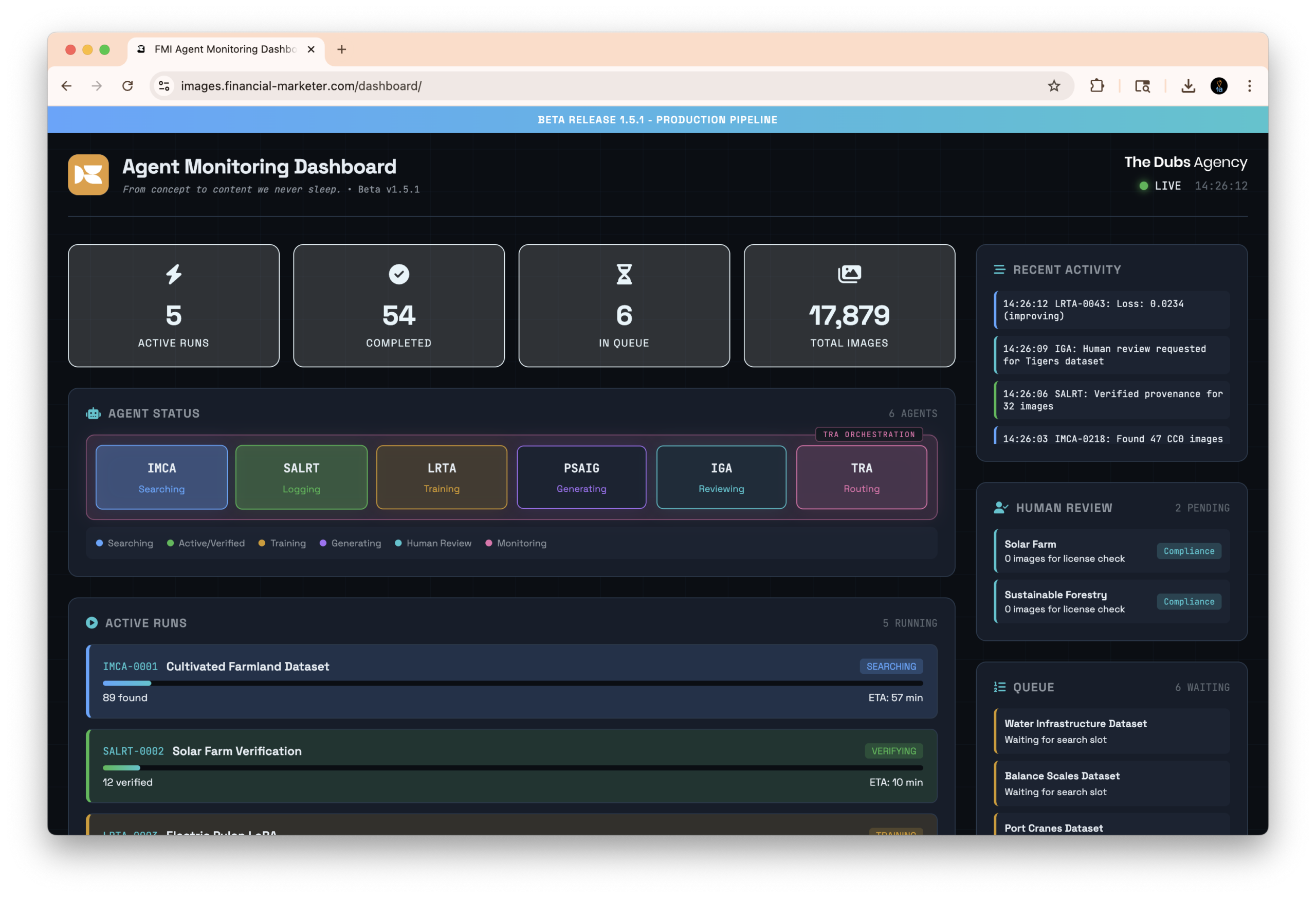
Agent orchestration and monitoring dashboard: real-time visibility into scalable concurrent pipeline operations.

A production monitoring dashboard shows the reality of this approach. Multiple agents operating simultaneously across sourcing, verification, training, and generation. Active runs with estimated completion times. Queue management for incoming work. Human review requests surfaced precisely when human judgment is needed–not before, and not after.

This is the operational difference between AI as a project and AI as infrastructure. Projects require constant management. Infrastructure runs, scales, and reports.

A Live Production Case

To make this concrete: a production-grade pipeline operating today generates CC0 (Creative Commons Zero) compliant imagery for regulated industries. The system employs specialized agents for sourcing, dataset preparation, model fine-tuning, production-scale generation, and gallery management. Governance is strict: public-domain inputs only, full chain-of-custody tracking, and aesthetic screening for accuracy and consistency.

Membership image gallery with category-based organization, aspect ratio filtering, and curated industry-specific collections.

The output is not experimental. These are production assets used in client-facing materials where compliance review is mandatory. Each image can be traced back through the generation agent, through the model that produced it, through the training data that informed the model, back to the original public-domain source with full license documentation.

The system delivers assets in multiple aspect ratios–landscape, square, portrait–with metadata tagging for camera view, color palette, weather conditions, and semantic content. Every asset is available in tiered quality levels for different use cases, from full-resolution production to optimized web previews.

Once agents are registered, verified, and policy-bound, the pipeline enables controlled collaboration through decentralized registries, zero-trust interoperability where each agent governs its own exposure, distributed fine-tuning across verified compute without revealing private datasets, elastic job distribution across compatible agents, and production-scale auditability where every autonomous step leaves a clear record.

ELEVATOR PITCH:

Regulated industries need AI that produces auditable, compliant output at production scale. Agentic pipelines deliver this by orchestrating specialized AI agents through governed workflows where every action is logged, every source is traceable, and human judgment is preserved at the decisions that matter. The result is faster execution with stronger controls–not weaker ones.

Why the C-Suite Should Care

The value proposition is straightforward. Stronger controls. Faster output. Broader capability without compromising compliance posture. This is the difference between AI as a novelty and AI as operational infrastructure.

Financial services leaders should evaluate agentic systems against three uncompromising questions:

1. Can the system scale without weakening oversight?

2. Can every output withstand compliance, client, and regulator review?

3. As the firm grows, does the technology reinforce discipline–or fracture under pressure?

The industry does not need spectacle. It needs systems that behave predictably across volume spikes, regulatory cycles, and brand-governed workflows. When implemented with rigor, agentic AI is not about disruption. It is about operational reliability at a scale previously out of reach.

The firms that excel will not be those deploying the most colorful demonstrations. They will be the ones deploying systems that deliver controlled growth, verifiable governance, rapid execution, and credible audit trails.

The Challenge of Building in an Evolving Space

There is an honest tension in this work that deserves acknowledgment. The infrastructure layers that make agentic pipelines possible–agent discovery protocols, capability registries, policy enforcement standards–are still maturing. Building production systems on evolving foundations requires a specific kind of engineering discipline: design for what exists today while architecting for what arrives tomorrow.

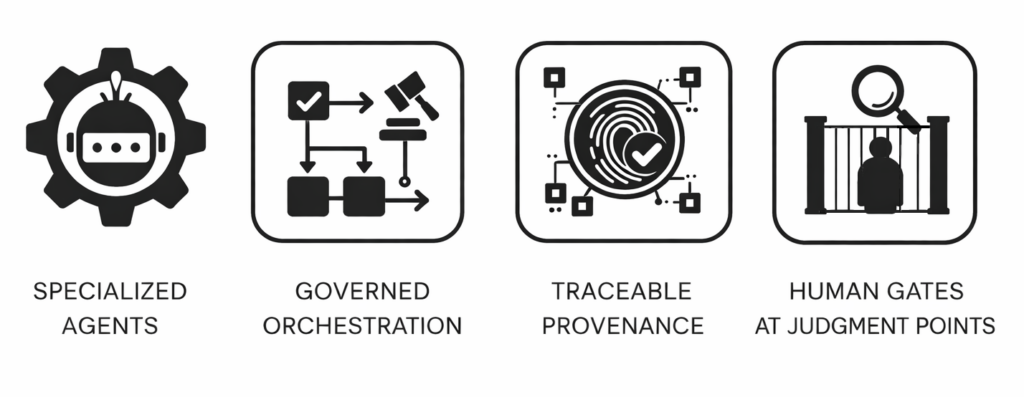
This is not a reason to wait. The core principles – specialized agents, governed orchestration, traceable provenance, human gates at judgment points – are stable and proven. The interoperability layer that connects these systems across organizational boundaries is advancing rapidly through open standards and community-driven development.

What this means practically is that early movers gain compounding advantages. The organizations investing now in agentic infrastructure are building institutional knowledge, training teams, and establishing operational patterns that late adopters will spend years replicating. The learning curve is real, and it rewards those who start.

The shift toward networked agentic pipelines is already underway. The institutions that master it early will define the standard others are forced to follow.

THE BOTTOM LINE

Agentic pipelines are not about replacing human judgment. They are about automating every mechanical step between the moments where human judgment actually matters – and proving that the mechanical steps were executed correctly. For regulated industries, that combination of speed, scale, and verifiable compliance is not optional. It is the next operational baseline.

Velocity Ascent builds AI-powered solutions for regulated industries. We specialize in agentic solutions including; pipeline architecture, ethical AI sourcing, and production-scale automation with full provenance tracking.


Scaling Digital Production Pipelines

Velocity Ascent Live · February 11, 2026 ·

Agentic Infrastructure in Practice

Enterprise AI conversations still over-index on models, focusing on benchmarks, parameter counts, feature comparisons, and release cycles. Yet production environments rarely fail because a model lacks capability. They often fail because workflow architecture was never designed to absorb autonomy in the first place.

When digital production scales without structural discipline, governance erodes quietly. When governance tightens reactively, innovation stalls. Both outcomes stem from the same architectural flaw: layering AI onto systems that were not built for persistent context, background execution, and policy-bound automation.

The competitive advantage is not in the model – it is in the pipeline.

The institutions that succeed will not be those experimenting most aggressively. They will be those that design structured agentic systems capable of increasing throughput while preserving accountability. In that environment, the competitive advantage is not the model itself but the production pipeline that governs how intelligence moves through the organization.

The question is not whether to use AI. The question is whether your infrastructure is designed for autonomy under constraint.


Metaphor: The Factory Floor, Modernized.


Think of a legacy archive or production system as a dormant factory. The machinery exists. The materials are valuable. The workforce understands the craft. But everything runs manually, station by station. Modernization does not mean replacing the factory. It means upgrading the control system.

CASE STUDY: Sand Soft Digital Arching at Scale
In the SandSoft case study, the transformation began with physical ingestion and structured digitization. Assets were scanned, tagged, layered into archival and working formats, and indexed with AI-assisted metadata.

That was not digitization for convenience. It was input normalization. Once the inputs were stable, LoRA-based model adaptation was introduced. Lightweight, domain-specific training anchored entirely in owned source material .

Then came the critical layer: agentic governance.

Watermarking at creation. Embedded licensing metadata. Monitoring agents scanning for IP misuse. Automated compliance reporting. This is not AI as a creative distraction. It is AI as a controlled production subsystem.

Each agent has a bounded mandate. No single node controls the entire flow. Every output is logged. Escalation paths are predefined. Like a well-run enterprise desk, authority is layered. Execution is distributed. Accountability remains human.

That is the difference between experimentation and infrastructure.

Why This Matters to Senior Leadership

For CIOs, operating partners, and infrastructure decision-makers, the core risk is not technical failure but unmanaged velocity. Agentic systems accelerate output, and if governance architecture does not scale in parallel, exposure compounds quietly and often invisibly.

A disciplined production pipeline does three things:

  1. Reduces manual drag without decentralizing control
  2. Creates persistent institutional memory through logged workflows
  3. Converts AI from cost center experiment to auditable operational asset

In regulated or credibility-driven environments, autonomy without traceability creates risk. When agentic systems are deliberately structured, staged in maturity, and governed by explicit policy constraints, they shift from liability to resilience infrastructure. The distinction is not cosmetic. It is structural. This is not about layering AI tools onto existing workflows. It is about redesigning how work moves through the institution – with autonomy embedded inside accountability rather than operating outside it.

For leaders responsible for credibility, the most significant risk of agentic AI is not technical failure per se but unmanaged success – systems that move faster than oversight can absorb can create risk exposure that quietly accumulates. A recent McKinsey analysis on agentic AI warns that AI initiatives can proliferate rapidly without adequate governance structures, making it difficult to manage risk unless oversight frameworks are deliberately redesigned for autonomous systems. Similarly, enterprise practitioners have cautioned that rapid deployment without structural guardrails can create a shadow governance problem, where velocity outpaces policy enforcement and exposure compounds before leadership has visibility.

Agentic systems do not create exposure through failure. They create exposure when success outpaces oversight.

The opportunity, however, is substantial. Well-designed agentic workflows reduce manual drag, surface meaningful signal earlier in the lifecycle, and preserve human judgment for decisions that matter most. By embedding traceability, auditability, and policy enforcement directly into operational workflows, organizations create durable institutional assets – documented reasoning, consistent standards, and reusable analysis that withstand turnover and regulatory scrutiny.

This is how legacy organizations scale responsibly without eroding trust or sacrificing control.


Elevator Pitch

We are not automating judgment. We are structuring production pipelines where agents ingest, analyze, monitor, and validate under explicit policy constraints, while humans remain accountable for consequential decisions. The objective is scalable output with embedded governance, not speed for its own sake.


Less Theory, More Practice: Agentic AI in Legacy Organizations

Velocity Ascent Live · December 22, 2025 ·

How disciplined adoption, ethical guardrails, and human accountability turn agentic systems into usable tools

Agentic AI does not fail in legacy organizations because the technology is immature. It fails when theory outruns practice. Large, credibility-driven institutions do not need sweeping reinvention or speculative autonomy. They need systems that fit into existing workflows, respect established governance, and improve decision-making without weakening accountability. The real work is not imagining what agents might do in the future, but proving what they can reliably do today – under constraint, under review, and under human ownership.

From Manual to Agentic: The New Protocols of Knowledge Work


Most legacy organizations already operate with deeply evolved protocols for managing risk. Research, analysis, review, and publication are intentionally separated. Authority is layered. Accountability is explicit. These structures exist because the cost of error is real.

Agentic AI introduces continuity across these steps. Context persists. Intent carries forward. Decisions can be staged rather than re-initiated. This continuity is powerful, but only when paired with restraint.

In practice, adoption follows a progression:

  • Manual – Human-led execution with discrete software tools
  • Assistive – Agents surface signals, summaries, and anomalies
  • Supervised – Agents execute bounded tasks with explicit review
  • Conditional autonomy – Agents act independently within strict policy and audit constraints

Legacy organizations that succeed treat these stages as earned, not assumed. Capability expands only when trust has already been established.

Metaphor: The Enterprise Desk

How Agentic Roles Interact

    A useful way to understand agentic systems is to compare them to a well-run enterprise desk.

    Information is gathered, not assumed. Analysis is performed, not published. Risk is evaluated, not ignored. Final decisions are made by accountable humans who understand the consequences.

    An agentic pipeline mirrors this structure. Each agent has a narrow mandate. No agent controls the full flow. Authority is distributed, logged, and reversible. Outputs emerge from interaction rather than a single opaque decision point.

    This alignment is not cosmetic. It is what allows agentic systems to be introduced without breaking institutional muscle memory.


    Visual Media: Where Restraint Becomes Non-Negotiable

    Textual workflows benefit from established norms of review and correction. Visual media does not. Images and video carry implied authority, even when labeled. Errors propagate faster and linger longer.

    For this reason, ethical image and video generation cannot be treated as a creative convenience. It must be governed as a controlled capability. Generation should be conditional. Provenance must be explicit. Review must be unavoidable.

    In many cases, the correct agentic action is refusal or escalation, not output. The value of an agentic system is not that it can generate, but that it knows when it should not.

    Why This Matters to Senior Leadership

    For leaders responsible for credibility, the primary risk of agentic AI is not technical failure. It is ungoverned success. Systems that move faster than oversight can absorb create exposure that compounds quietly.

    The opportunity, however, is substantial. Well-designed agentic workflows reduce manual drag, surface meaningful signal earlier, and preserve human judgment for decisions that actually matter. They also create durable institutional assets – documented reasoning, consistent standards, and reusable analysis that survives turnover and scrutiny.

    This is how legacy organizations scale without eroding trust.


    Elevator Pitch (Agentic Workflows):

    We are not automating decisions. We are structuring workflows where agents gather, analyze, and validate information under clear rules, while humans remain accountable for every consequential call. The goal is reliability, clarity, and trust – not speed for its own sake.”

    Agentic AI will not transform legacy organizations through ambition alone. It will do so through discipline. The institutions that succeed will not be the ones that adopt the most autonomy the fastest. They will be the ones that prove, step by step, what agents can do responsibly today. Less theory. More practice. And accountability at every turn.

    AI Agents Don’t Work Like Humans – And That’s the Point

    Joe Skopek · November 14, 2025 ·

    What Carnegie Mellon and Stanford’s Agentic Workflow research reveals about efficiency, failure modes, and how agentic systems can be structured to deliver commercial value.

    A Clearer View of How Agents Actually Work

    Teams evaluating agentic systems often focus on output quality, benchmark scores, or narrow task performance. Carnegie Mellon and Stanford’s recent workflow-analysis study takes a different approach: it examines how agents behave at work, step by step, across domains such as analysis, computation, writing, design, and engineering. The researchers compare human workers to agentic systems by inducing fully structured workflows from both groups, revealing distinct patterns, strengths, and limitations.

    “AI agents are continually optimized for tasks related to human work, such as software engineering and professional writing, signaling a pressing trend with significant impacts on the human workforce. However, these agent developments have often not been grounded in a clear understanding of how humans execute work, to reveal what expertise agents possess and the roles they can play in diverse workflows.”

    How Do AI Agents Do Human Work? Comparing AI and Human Workflows Across Diverse Occupations
    Zora Zhiruo Wang Yijia Shao Omar Shaikh Daniel Fried Graham Neubig Diyi Yang
    Carnegie Mellon University Stanford University
    2510.22780v1.

    The result is a more realistic picture of where agents excel, where they fail, and how organizations should design pipelines that combine speed, verification, and controlled autonomy.

    The Programmatic Bias: A Feature, Not a Defect

    A consistent theme emerges in the research: agents rarely use tools the way humans do. Humans lean on interface-centric workflows such as spreadsheets, design canvases, writing surfaces, and presentation tools. Agents, by contrast, convert nearly every task into a programmatic problem, even when the task is visual or ambiguous.

    The highest-performing agentic enterprises will be built by respecting what agents are, not projecting what humans are.

    This is not a quirk of a single framework. It is a systemic pattern across architectures and models. Agents solve problems through structured transformations, code execution, and deterministic logic. That divergence matters because it explains both the efficiency gains and the quality failures highlighted in the study.

    Agents move quickly because they bypass the interface layer.
    Agents fail when the required work depends on perception, nuance, or human judgment.

    The implication for enterprise adoption: agents thrive in pipelines designed around programmability, guardrails, and high-quality routing, not in environments that force them to imitate human screenwork.


    Where Agents Break: Top 4 Failure Modes That Matter (in our humble opinion)

    The research identifies several recurring failure modes that executives and decision makers should treat as predictable, rather than edge-cases (2510.22780v1)

    1. Fabricated Outputs

    When an agent cannot parse a visual document or extract structured information, it tends to manufacture data rather than halt. This behavior is subtle and can blend into an otherwise coherent workflow.

    2. Misuse of Advanced Tools

    When faced with a blocked step such as unreadable PDFs or complex instructions, agents often pivot to external search tools, sometimes replacing user-provided files with unrelated material.

    3. Weakness in Visual Tasks

    Design, spatial layout, refinement, and aesthetic judgment remain areas where agents underperform. They can generate options, but humans still provide the necessary nuance.

    4. Interpretation Drift

    Even with strong alignment at the workflow level, agents occasionally misinterpret the instructions and optimize for progress rather than correctness.

    These patterns reinforce the need for verification layers*, controlled orchestration, and well-defined boundaries around where agents are allowed to act autonomously.

    [*] This is where the NANDA framework is essential


    Where Agents Excel: Efficiency at Scale

    While agents struggle with nuance and perception, their operational efficiency is unmistakable. Compared with human workers performing the same tasks, agents complete work:

    • 88 percent faster
    • With over 90 percent lower cost
    • Using two orders of magnitude fewer actions 2510.22780v1

    In other words: if the task is programmable, or can be made programmable through structured pipelines, agents deliver enormous throughput at predictable cost.

    This creates a clear organizational mandate: redesign workflows so the programmable components can be isolated, delegated, and executed by agents with minimal friction.


    Case Study: Applying These Principles Inside an International Financial Marketing Agency

    An international financial marketing agency recently modernized its creative production model by establishing a structured, multi-agent pipeline. Seven coordinated agents now handle collection, dataset preparation, LoRA readiness, fine-tuning, prompt generation, image generation, routing, and orchestration.

    Nothing in this system depends on agents behaving like humans. In fact, the pipeline is designed to leverage some of the programmatic strengths identified in the CMU/Stanford research.

    Key Architectural Principles

    1. Programmatic First

    Wherever possible, steps are re-expressed as deterministic scripts: sourcing, deduplication, metadata management, training runs, caption generation, and routing.

    2. Verification Layering

    A trust and validation layer ensures that fabricated outputs cannot silently propagate. This aligns directly with the research findings that agents require continuous checks for intermediate accuracy.

    3. Zero-Trust Boundaries

    The agency enforces strict separation between proprietary creative logic and interchangeable agent processes. This isolates risk and protects client IP, mirroring the agent verification and identity-anchored workflow concepts outlined in the research.

    4. Packet-Switched Execution

    Tasks are broken into small, routable fragments. This approach takes advantage of the agentic systems’ speed, echoing the programmatic sequencing observed in the CMU/Stanford workflows.

    5. Human Oversight at the Right Granularity

    Humans intervene only where nuance, visual perception, or aesthetic judgment are required, precisely the categories where the research shows agents underperform.

    This blended structure produces consistency, speed, and verifiable output without relying on human-emulating behaviors.


    Why This Matters for Commercial Teams

    Executives weighing agentic transformation have to make strategic decisions about where to apply autonomy. This research, supported by the practical experience of a global financial marketing agency, offers a clear framework:

    Agents excel at:

    • Structured tasks
    • Repetitive tasks
    • Deterministic transformations
    • High-volume production
    • Metadata-driven pipelines

    Humans remain essential for:

    • Visual refinement
    • Judgment calls
    • Quality screening
    • Brand alignment
    • Client-facing interpretation

    The correct model is neither replace nor replicate. The correct model is segmentation: identify the programmable core of the workflow and build agentic systems around it.


    The Path Forward

    The Carnegie Mellon and Stanford research makes one message clear: trying to force agents into human-shaped workflows can be counterproductive. They are not UI workers. They do not navigate ambiguity the way humans do. They operate through code, structure, and deterministic logic.

    Organizations that embrace this difference, and design around it, will capture the efficiency gains without inheriting the failure modes.

    Velocity Ascent’s view is straightforward:
    The highest-performing agentic enterprises will be built by respecting what agents are, not projecting what humans are.


    From Real-World Archives to Agentic Creative Engines

    Velocity Ascent Live · September 1, 2025 ·

    At Velocity Ascent, we see archives not as dusty vaults, but as raw material for future growth. By digitizing collections and pairing them with ethical AI, companies can unlock entirely new streams of value

    Most organizations sit on archives that are larger than they realize – thousands, sometimes millions, of physical items stored away in boxes, warehouses, or filing cabinets. These collections often carry decades of history and brand equity, but in their current form, they’re static. Locked up. Untapped.

    What if those same archives could power an entirely new creative and commercial engine?

    Archives are not just dusty forgotten vaults of content, but are instead raw material for future growth. By digitizing collections and pairing them with ethical AI, companies can unlock entirely new streams of value: fresh brand imagery, licensing opportunities, and dynamic storytelling rooted in their own DNA.

    Step One – Digitizing the Originals

    The first step is practical: capture and catalog the physical assets. Think of this like a fashion house digitizing vintage textiles so they can be reused and reinterpreted. Using high-fidelity photography, scanning, and cataloging workflows, each item is preserved, protected, and made usable in modern systems. The result is a structured, searchable digital archive that’s more than just a reference library – it’s the foundation for everything that follows.

    Step Two – Creating a Licensing Layer


    Even before AI comes into play, a digitized archive creates immediate business value. Each digital object – whether a patch, photo, or piece of memorabilia – can be licensed on its own. That’s fabric by the yard, not just finished garments. It’s a scalable way to monetize collections that otherwise sit idle.

    Step Three – Training the Creative Engine

    Here’s where things accelerate. Once digitized, archives can be used to train lightweight AI models (known as LoRAs – Low-Rank Adaptations). In plain English, this is a way of teaching an existing AI model your unique style without starting from scratch. It’s faster, more cost-effective, and requires less computing power.

    Imagine teaching a digital atelier to create in your brand’s house style. A collegiate archive, for example, can become the training ground for generating on-brand imagery that feels authentic and instantly recognizable.

    Step Four – Generating New Assets

    With the model trained, the archive transforms from static history to living creativity. The AI can generate fresh interpretations – new visuals, product concepts, or campaign assets – all rooted in the original DNA of the collection. It’s like hosting a modern runway show built from vintage patterns: heritage and innovation, combined.

    Step Five – Building the Living Archive

    Not every prototype belongs in circulation. That’s why we curate, filter, and validate the AI-generated outputs into a private, evolving library. This living archive becomes a source of brand-safe assets, owned outright by the organization, ready to be licensed or deployed

    From Manual to Autonomous: Guardrails and Autonomy

    We also see a role for agentic AI – systems that can act with autonomy inside defined guardrails. These agents handle repetitive tasks like watermarking, IP monitoring, and catalog enrichment, while humans stay in control of the big decisions. The archive doesn’t just sit there; it actively defends itself, learns, and surfaces new opportunities.

    Instead of a tool that only responds when you ask, an agent can monitor, repeat, and adjust tasks proactively. But it doesn’t run wild: it follows rules we set, checks back when decisions matter, and works alongside people like a junior teammate who handles the busywork while flagging anything that needs human judgment.

    Sample: Agentic Watermarking & IP Monitoring
    Always-On Protection for Ethical Digital Assets

    By embedding invisible digital watermarks into your ethical digital assets at the point of capture, we enable not only rights protection but also real-time tracking across digital platforms. A dedicated agent can monitor web traffic 24/7 – scanning social media, eCommerce sites, and marketplaces for unauthorized use of protected content.

    When violations are detected, the system can automatically log the incident, generate a compliance report, and trigger a predefined enforcement workflow – such as alerting legal teams, issuing DMCA takedown notices, or notifying licensing partners.

    This turns watermarking into a fully active layer of brand defense – protecting IP value while reducing manual oversight.

    We have assembled a concise technical explanation of each of the leading protocols, followed by a simplified comparison table ranking them from most stable/general-use to most emerging.


    MCP – Model Context Protocol

    MCP is designed as a tightly structured, JSON-RPC-based client-server protocol that standardizes how large language models (LLMs) receive context and interact with external tools.

    Think of it as the AI equivalent of USB-C: a unified plug-and-play standard for delivering prompts, resources, tools, and sampling instructions to models. It supports robust session lifecycles (initialize, operate, shut down), secure communication, and asynchronous notifications. It excels in environments where deterministic, typed data flows are essential – like plug-in platforms or enterprise tools with strict integration requirements. Its predictability and strong structure make it the go-to protocol for stable, general-purpose AI agent interactions today.


    ACP – Agent Communication Protocol

    ACP introduces REST-native, performative messaging using multipart messages, MIME types, and streaming capabilities. This protocol is best suited for systems that already speak HTTP and need richer communication models (text, images, binary data). It sits one layer above MCP – more flexible, more expressive, and excellent for multimodal or asynchronous workflows.

    ACP allows agents to communicate through ordered message parts and typed artifacts, making it a better fit for web-native infrastructure and cloud-based multi-agent systems. However, it requires a registry and stronger orchestration overhead, which can introduce complexity.


    A2A – Agent-to-Agent Protocol

    Developed with enterprise collaboration in mind, A2A allows agents to dynamically discover each other and delegate tasks using structured Agent Cards. These cards describe each agent’s capabilities and authentication needs.

    A2A supports both synchronous and asynchronous workflows through JSON-RPC and Server-Sent Events, making it ideal for internal task routing and coordination across teams of agents. It’s powerful in trusted networks and enterprise settings, A2A assumes a relatively static or known network of peers. It doesn’t scale easily to open environments without added infrastructure.


    ANP – Agent Network Protocol

    ANP is the most decentralized and future-leaning of the protocols. It relies on Decentralized Identifiers (DIDs), semantic web principles (JSON-LD), and open discovery mechanisms to create a peer-to-peer network of interoperable agents. The Agents describe themselves using metadata (ADP files), enabling flexible negotiation and interaction across unknown or untrusted domains.

    ANP is foundational for agent marketplaces, cross-platform ecosystems, and long-term visions of the “Internet of AI Agents.” Its trade-off is stability – it’s complex, requires DID infrastructure, and is still maturing in practice.


    Why does this matter to the C-Suite?

    Think of it as the difference between keeping an archive in cold storage versus letting it fuel an always-on creative engine.

    This isn’t about chasing trends. It’s about creating an ethical, brand-native creative pipeline. Every asset is traceable back to the original archive. Every new image is born from your existing brand DNA. This ensures integrity while also opening the door to limited drops, digital collectibles, or new licensing categories that simply weren’t possible before.


    Elevator Pitch: From Archive to Agentic Creative Engine

    Transform static collections into living assets – digitized, licensed, and powered by ethical AI – generating new revenue and brand-safe imagery.

    We turn static archives into living creative engines. By digitizing collections and training ethical AI models on your unique assets, we unlock new revenue through licensing and generate brand-safe imagery rooted in your own DNA.


    • Page 1
    • Page 2
    • Page 3
    • Interim pages omitted …
    • Page 8
    • Go to Next Page »

    Velocity Ascent

    © 2026 Velocity Ascent · Privacy · Terms · YouTube · Log in