• Skip to primary navigation
  • Skip to main content
Velocity Ascent

Velocity Ascent

Looking toward tomorrow today

  • Research
  • Design
  • Development
  • Strategy
  • About
    • Home
    • Who we work with…
      • Product Leaders
      • Innovation Teams
      • Founder-Led Organizations
    • Services
    • Contact Us
  • Show Search
Hide Search

Artificial Intelligence (AI)

Fashion Tech, Revisited: From Sketch-to-Storefront to Storefront-to-Agent

Velocity Ascent Live · June 1, 2026 ·

The future I sketched in 2024 is no longer hypothetical. It’s shipping, it’s backfiring, and it’s rewriting who wins.

A follow-up to “Fashion Tech: The Present Future of Fashion and Technology” (October 2024)

When I published that first piece in October 2024, I argued that the blend of fashion and artificial intelligence was creating “limitless possibilities.” Roughly eighteen months on, the possibilities are no longer hypothetical. They are shipping. They are also forcing the harder questions the original post only gestured at: not just whether we can generate a model, a garment, or a storefront, but whether we should, and on whose terms.

The original throughline still holds. I compared today’s AI tooling to the sewing machine of the 19th century, a technology that reshaped how fashion is made, marketed, and consumed, mostly by collapsing time and cost. That frame has aged well. What I underestimated was the speed of the collapse, and how quickly the conversation would shift from efficiency to ethics, labor, and trust.

Here is where things actually landed.

The trajectory I called: hyper-personalization went from edge to baseline

In 2024 I described hyper-personalization, virtual fitting rooms, and digital “Sketch-to-Storefront” workflows as the leading edge. They are now closer to table stakes. By early 2026, McKinsey’s fashion technology outlook put adoption of machine learning for trend forecasting, planning, and 3D sample generation at roughly 48% of global brands. The AI-generated fashion photography market, barely a line item when I was writing, grew from about $1.51 billion in 2024 to around $2.01 billion in 2025.

The design tools I singled out, Browzwear and Lalaland.ai, did not just survive; they matured into a connected pipeline. Browzwear’s framing for 2026 is “idea to twin to shelf,” with the same digital twin now feeding not only fit and production but AI-generated marketing imagery. Virtual sampling, by various industry estimates, now cuts sample-development cost by 60 to 70% and time-to-market by up to half. The “first physical sample is the only sample” pitch I quoted in the original has, for a lot of teams, simply become true.

The proof point is no longer a vendor demo. MAS Holdings, the apparel manufacturer behind many of the intimates, swimwear, and performance brands you already know, (Victoria’s Secret, Nike, lululemon) began its digital product creation push in 2017 and stood up a dedicated Centre of Excellence in 2020.

It now develops more than 4,000 unique 3D styles a year for over 50 brands, with real-time co-creation replacing rounds of physical samples. The faster lead times and lower fabric waste arrived as byproducts of integration, not as one-off stunts. That is the version of “Sketch-to-Storefront” I was describing in 2024, finally operating at industrial scale.

Shift one: the synthetic model walked out of the back office and onto the cover

In the first piece I treated AI imagery mostly as a production convenience. The technology has since become good enough to be indistinguishable from a photograph, and that is exactly where the trouble started.

seraphinnevallora model on the runway.

Mango ran AI-generated models in a 2024 campaign, with its CEO defending the move on speed grounds. Levi’s tested AI models and then walked the messaging back, insisting it was not a diversity strategy and that live shoots would continue.

Then, in August 2025, a Guess advertisement in Vogue, produced by the AI studio Seraphinne Vallora, became a genuine firestorm. The images were polished enough to read as editorial photography; only a small disclaimer revealed the model did not exist. The backlash was loud, and it was not really about image quality. It was about disclosure, displaced creative labor, and the narrow, conventionally “perfect” definition of beauty that synthetic models tend to default toward.

Regulation moved in parallel. The EU AI Act, adopted in 2024 and rolling out through 2027, pushes toward disclosure of synthetic media, transparency around training data, and respect for intellectual property, even when the underlying tools are open-source.

This is the part of the landscape closest to my own work, so I will be direct about the lesson. The defensible position is not “we used AI” versus “we didn’t.” It is whether you can show your work: where the training imagery came from, whether it was used with consent or under a clean license, and whether the audience was told.

Provenance stopped being a compliance footnote and became part of the product. The brands that weather the next backlash will be the ones that can answer “where did this image come from?” without flinching.

Shift two: the storefront itself is starting to dissolve

My 2024 piece assumed a shopper who visits a storefront, even a hyper-personalized one. The most disorienting development since then is that the visit may not happen at all. The shopper increasingly delegates to an agent.

The infrastructure arrived fast. OpenAI introduced an Agentic Commerce Protocol with Stripe; Google launched a Universal Commerce Protocol at NRF in January 2026; Microsoft shipped Copilot Checkout; Shopify rolled out agentic storefronts that let merchants sell inside ChatGPT, Copilot, and Gemini at once. Walmart and OpenAI announced a buy-in-chat partnership in October 2025, and Amazon extended its “Buy for me” capability while pointing its Rufus assistant toward comparison and autonomous purchasing. Shopify has said orders originating from AI-powered search grew roughly fifteen fold year over year.

And yet the reality check is just as instructive. OpenAI quietly paused its Instant Checkout, with fewer than 30 of Shopify’s millions of merchants live, conceding the experience lacked the flexibility it wanted. Walmart reportedly saw in-chat purchase conversion run about three times lower than sending shoppers to its own site. Forrester’s read on the moment was blunt: everyone has the fear of missing out, and nobody has actually figured it out yet.

For anyone building in this space, and I spend most of my week here, the takeaway is unglamorous but clear. The near-term winners are not the brands automating checkout most aggressively. They are the ones making their catalogs, inventory, pricing, and trust signals as readable by machines as by humans. The storefront is becoming an API. Fashion brands that still treat product data as marketing copy, rather than structured source-of-truth data, will simply be invisible when an agent comes shopping.

The map redrew itself, and not only because of technology

My original piece ranked the top online fashion retailers by 2023 sales: Shein at $14.4 billion, Walmart at $12.3 billion, Amazon at $8.4 billion. That snapshot is already a historical document, and the force that dated it was policy, not algorithms.

In 2025 the U.S. ended the “de minimis” exemption that had let sub-$800 parcels enter the country duty-free, the loophole that made the Shein and Temu model viable at scale. Prices rose, both companies warned customers directly, and transactional data showed price-sensitive shoppers migrating toward off-price department stores, secondhand apps, and domestic players. It is a useful corrective to any tech-first narrative: the consumer’s behavior is shaped at least as much by tariff schedules and trade policy as by virtual try-on.

The story so far is mostly digital, but one of the more interesting sustainability bets of 2026 is chemical.

In April, the Bezos Earth Fund committed $34 million to rethink what clothes are actually made of, on the logic that materials and manufacturing account for roughly 80% of fashion’s environmental footprint. The largest grant, $11.5 million, went to Columbia University in partnership with the Fashion Institute of Technology to grow a textile fiber from bacteria fed on agricultural waste: strong and breathable, compostable at end of life, requiring almost no land, and producing no microplastic pollution.

A fiber whose origin is a documented feedstock and a known biological process is provenance pushed all the way down to the molecule. The question the industry asks: “where did this come from?”, is now being asked of the thread itself.

The real divider isn’t AI adoption. It’s digital maturity.

Step back from any single tool and a pattern emerges. The brands getting caught flat-footed and the ones quietly compounding advantage are not separated by whether they use AI. They are separated by how deeply it is woven in.

A useful framing here comes from Browzwear’s digital-maturity work: maturity is not the act of adopting tools, it is integrating them into every part of the business until they drive continuous, scalable impact. Buying the software is the easy part. Rewiring how the organization works around it is the actual transformation.

That work sketches a five-phase climb, and it maps almost too neatly onto the stories above:

  1. The analog trap. Traditional, siloed processes, no real strategy, digital as an afterthought.
  2. Reactive experimentation. Isolated pilots run by individual teams, no executive sponsorship, wins that never scale past the team that ran them.
  3. Intentional progress. A genuine digital strategy appears, often anchored by a dedicated Centre of Excellence, but adoption is still patchy across functions.
  4. Integrated growth. Leadership-backed, cross-departmental, with digital embedded in day-to-day operations rather than bolted on.
  5. Digital maturity. Agile, data-driven, customer-centric. Digital is no longer an add-on; it is the core the business runs on.

Seen through that ladder, a lot of last year’s headlines look less like innovation and more like Phase 2 wearing a Phase 5 costume. A splashy AI ad with a near-invisible disclaimer is an isolated pilot optimized for a press cycle, not an integrated practice with disclosure and provenance designed in from the start. The paused in-chat checkout was the same reflex at platform scale: ship the demo, skip the plumbing. Real maturity is comparatively boring. It looks like a manufacturer quietly producing thousands of digital styles a year because the whole organization, not one enthusiastic team, was rebuilt around it.

Provenance-clean, properly licensed training data is what lets you use AI imagery without inviting a backlash.

Here is where it connects back to my own throughline, and why I do not treat the ethics question and the agentic-commerce question as separate from this. The discipline that gets you up the maturity ladder, clean integrated data and a single source of truth, is the same discipline that makes you ready for both shifts.

Provenance-clean, properly licensed training data is what lets you use AI imagery without inviting a backlash. Structured, machine-readable product data is what lets an agent actually find and buy what you sell. Disclosure, provenance, and machine-readability are not three separate compliance chores. They are three faces of one mature operation that knows where its data comes from and where it goes.

NY Tech Week event at The Fashion Institute of Technology.

Field notes from FIT Tech Week: the bleeding edge

I recently attended the Fashion Institute of Technology’s Tech Week event, listening to the founders actually building this layer, and the view from inside is more concrete, and more interesting, than the trend pieces suggest.

The sharpest demonstration came from Emily of Make the Dot, who walked through producing a denim collection called OSSA in roughly the time it usually takes to schedule a fitting. The old playbook she is replacing is familiar: watch what is selling, copy the winning trends, order in enormous quantities, and eat the waste. Her version inverts it.

An agent, “Dot,” aggregated the entire signal chain, from runway to brands to influencers to social to Google search trends, and generated design variations out of the pattern in that data. A human, Nicole, curated, deciding which pieces actually made the collection. Fit was tested digitally, and the agent produced a line sheet specified down to the wash, the whiskers, and the PP spray. Because the supply chain is vertically integrated, cotton to mill to cut-and-sew, a cycle she described as “six plus six” now runs in about four weeks.

Make the Dot is an AI-native product development platform that connects design, development, and merchandising in a single digital workflow.

Two of her lines stuck with me. “When making something small is nimble, a bet becomes a test,” she said, describing how a brand can float a social ad to gauge demand before committing a single yard to production. And the one that quietly reframes the whole sustainability conversation: “the path to the least waste also means more time for creativity.” She delivered it wearing the jeans.

That is the optimistic, operational story. The panel I sat in on, “Beyond the Headlines: The Real Ways AI Is Changing Fashion,” moderated by Rachel Sterling of The Pattern Maker and Alternew, pushed on where this goes next, and the founders mostly agreed the change is structural rather than cosmetic.

Franz Tschimben of ALLSIDES was candid that the specifics are hard to predict, but bet that 3D will emerge as a default mode of content creation as the cost of producing it collapses, the same digital-twin logic from earlier in this piece, generalized. Yusan Lin of Mirror Mirror AI described a decentralization of discovery: a world where anyone can be scouted, rather than waiting to be found by a gatekeeper. Sreya Halder of The Mall extended that to creation itself, a world where everyone gets to build their own village and curate it themselves.

Then Sophia Sterling, formerly of Google Creative Lab and now building a stealth venture called Paprika, planted the flag I found most worth carrying home. The company is named for the Diana Vreeland line, “a little bad taste is like a nice splash of paprika,” her argument against the tyranny of no taste at all. Sterling’s pitch is for what lives outside the algorithm: the human, physical, slightly-wrong instinct that recommendation engines flatten on contact.

It is the same tension the rest of this piece keeps circling. Dot can aggregate every signal in the market, but Nicole still decides what is good. The tools democratize who gets to make and be seen, and in the same breath they raise the value of the one thing they cannot generate, a point of view. If the last eighteen months were about proving the machinery works, the bet these founders are placing is that the next eighteen are about taste.

What this means for “the present future”

The sewing machine analogy I leaned on still works, but it needs a second half. The sewing machine made garments faster and cheaper, and in doing so it created entirely new questions about labor, standardization, and who got to call themselves a maker. AI is repeating that pattern at compressed speed across the whole pipeline, from concept render to synthetic model to autonomous checkout. The efficiency is real. So are the questions.

If the 2024 story was “limitless possibilities,” the 2026 story is that the possibilities now carry a price of admission, and that price is maturity: disclosed AI, consented and licensed training data, traceable provenance, and honest, machine-readable product information, all integrated rather than bolted on. The brands and builders who treat that as a constraint will keep getting caught flat-footed. The ones who treat it as the design spec are, I think, the ones who actually inherit the present future.


Joe Skopek is the founder of Velocity Ascent, an AI-first innovation consultancy based in New York and a member of the Leadership Team of the NYC Chapter of the NANDA Project from MIT Media Lab.


Sources and further reading

McKinsey & Company, The State of Fashion 2026: When the rules change (Nov 2025); McKinsey fashion technology outlook on ML adoption (early 2026)

Business of Fashion, on generative AI and virtual try-on (Jan 2026)

FASHN AI, Fashion AI: 7 Key Use Cases in 2026 (AI-generated photography market sizing, Feb 2026)

Browzwear, The Future of Digital Product Development: Trends Shaping Fashion in 2026 (“idea to twin to shelf”); Browzwear, A Digital Maturity Framework for Brands & Manufacturers (five-phase maturity model, MAS Holdings case study)

CNN, AI models in Vogue (Mango and Levi’s context, Jul 2025); Good Morning America / FashionNetwork, on the Guess-Vogue / Seraphinne Vallora campaign (Aug 2025)

Fast Company, Shop ’til you bot (agentic commerce, Instant Checkout pause, 2026); commercetools, The Agentic Commerce Radar (protocols, Walmart conversion data, 2026); Digital Commerce 360 (platform strategies, Apr 2026)

WWD and Morning Consult, on the end of de minimis and the Shein/Temu impact (2025); Business of Fashion, Will the End of De Minimis Kill the Shein Haul? (Jul 2025)

Bezos Earth Fund, Reinventing Clothes: $34 Million in Grants (Apr 2026); Columbia Engineering, on the $11.5M Columbia/FIT bacterial-fiber grant (Apr 2026)

FIT Tech Week (2026), author’s field notes: panel “Beyond the Headlines: The Real Ways AI Is Changing Fashion” (moderator Rachel Sterling, The Pattern Maker / Alternew; panelists Franz Tschimben, ALLSIDES; Yusan Lin, Mirror Mirror AI; Sreya Halder, The Mall; Sophia Sterling, Paprika), and the Make the Dot presentation (Emilie Ho, co-founder and CEO). Vreeland quote from D.V. (1984)


The Plumbing Nobody’s Building: Agentic Web’s Missing Infrastructure

Joe Skopek · May 27, 2026 ·

When your agents can’t prove they’re trustworthy, your business can’t either.

Everyone is racing to build smarter AI agents. Fewer people are asking the harder question: once we have trillions of them, how do they find each other, verify each other’s credentials, and collaborate without tearing the whole system apart?

Sandeep Mahendru – an Engineering Leader and Senior System Architect at Google, where he builds AI-driven solutions for the financial market – recently published a piece on Medium that lays out the clearest architecture I’ve seen for answering that question. It’s called Proposal for the Global Backbone of the Agentic Web, and it’s worth a careful read.

“We are currently building millions of specialized agents, yet we have no global address book to find them, no shared language to verify their skills, and no scalable security layer to ensure they aren’t actively sabotaging our workflows.”

I am walking through it in this post as it maps to work we’ve been doing at Velocity Ascent – and because the ideas in it have real consequences for anyone thinking seriously about where enterprise AI is heading.

The “Wild West” Moment

Sandeep opens with a frame I find hard to argue with:

“We are currently building millions of specialized agents, yet we have no global address book to find them, no shared language to verify their skills, and no scalable security layer to ensure they aren’t actively sabotaging our workflows.”

This is the gap. It’s not a technical gap in the narrow sense – the individual pieces exist. Large language models are remarkable. Agent frameworks are maturing. But the connective tissue between agents – the infrastructure that makes a network of agents trustworthy and useful rather than just chaotic – doesn’t yet exist at scale.

Sandeep calls this the “Cisco Moment” of the Agentic Web. The analogy is deliberate: the winners in the next era of AI won’t be defined by who builds the smartest model. They’ll be defined by who builds the backbone; the discovery, routing, and trust layer – that lets trillions of specialized agents find and work with each other safely.

* A “Cisco moment” is a stock market analogy referring to the dot-com era when networking giant Cisco Systems saw its stock plummet roughly 80% after telecom companies stopped buying its hardware. Today, financial analysts use the term to warn that massive capital expenditures in AI might create a similar bubble, particularly drawing parallels between Cisco in 2000 and Nvidia today. [1, 2, 3, 4]

From Code-First to Intent-First

The shift Sandeep describes isn’t just infrastructural – it’s epistemological.

Traditional software development is code-first. A developer translates a goal into explicit instructions, one procedure at a time. What’s emerging is intent-first orchestration: you describe what you want, and an underlying intelligent infrastructure figures out which combination of specialized agents can execute it.

“Instead of building monolithic software silos, developers are now focused on defining high-level goals that are executed by a ‘quilt’ of autonomous, specialized agents.”

The “quilt” metaphor is worth sitting with. Not a single God Model that does everything, but a federated patchwork of best-in-class experts – each sovereign, each specialized, each discoverable. The question is how you stitch them together in real time.

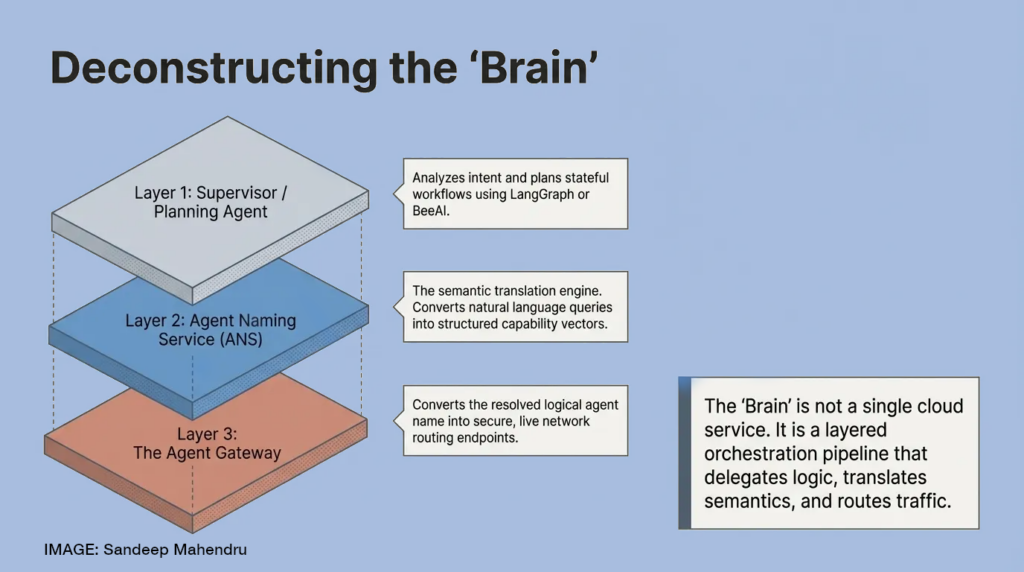
That stitching mechanism is what Sandeep calls the Brain.

The Brain: Semantic Intent Parsing at Scale

The Brain is the orchestration intelligence at the center of this architecture. Think of it less like a search engine and more like a very sophisticated dispatcher.

Traditional keyword search is too blunt for this. If a user’s request is “help me optimize our supply chain for Q4,” a keyword search returns documents. An intelligent Brain decomposes that intent into a structured, multi-agent workflow – logistics expert, finance agent, demand forecasting agent – and routes each sub-task to the best available specialist in real time.

Image: Sandeep Mahendru on Medium.

Critically, Sandeep argues against a centralized bottleneck architecture:

“A standardized metadata routing protocol allows secure, local orchestrators to decompose human requests into multi-agent workflows while maintaining strict context isolation.”

This is a subtle but important design principle. Discovery doesn’t have to be centralized to be powerful. A federated model, where a lightweight metadata layer indexes agent capabilities across independently governed registries, can be both scalable and resilient.

The Discovery Gap: Why Agent Cards Aren’t Enough

The current standard for agent interoperability is A2A (Agent-to-Agent protocol), which gives every agent a structured “Agent Card” – essentially a business card declaring its capabilities, authentication requirements, and communication standards. A2A is built on established web infrastructure: JSON-RPC 2.0 over HTTP/S, OAuth 2.0, mTLS. It’s solid, enterprise-grade, and open.

But Agent Cards are self-declared. And self-declaration, as anyone who’s reviewed a vendor pitch deck knows, is not the same as verified performance.


AgentFacts: Report Cards, Not Business Cards

“Trust is no longer a ‘claim’ or a static audit; it’s an audited metric signed by third-party authorities and constantly tested via automated prompting and local consensus.”

AgentFacts are the proposed evolution beyond Agent Cards. Where an Agent Card says “I am a financial analysis agent,” an AgentFact is a cryptographically signed, W3C Verifiable Credential that says “this agent has been independently audited, has completed 12,000 successful tasks with a 97.3% accuracy rate, and has zero confirmed hallucinations in regulated output contexts.”

The distinction matters enormously in enterprise settings. When an agent is making decisions that touch compliance, financial transactions, or patient care, “trust me, I’m good at this” is not an acceptable credential.

Byzantine Fault Tolerance: In-Flight Security

Even cryptographically signed AgentFacts don’t solve the full security problem. Sandeep’s architecture adds a layer that I think most people building in this space haven’t adequately grappled with: Byzantine Fault Tolerance.

The analogy in the piece is the best summary I can offer:

“A Secure Federated Registry is like a ‘No Fly List’ – it keeps known bad actors out. But Byzantine Fault Tolerance is like ‘In-Flight Security’ – it protects the passengers even if someone with a valid ticket turns out to be a threat.”

BFT, in this context, means triangulating outputs across multiple independent agents and using quorum voting to detect when a “trusted” actor is hallucinating, has been compromised, or is simply wrong. Because traditional consensus mechanisms add latency, Sandeep proposes economic staking and slashing as the enforcement layer – agents put something at risk when they participate, and bad actors lose it.

This is crypto-native thinking applied to AI infrastructure. Whether or not you have a background in distributed systems, the principle is intuitive: skin in the game changes behavior.

Cognitive Liquidity: The AI-NPM Model

The long-term economic vision Sandeep lays out is what he calls Cognitive Liquidity – the ability to “import” verified intelligence as easily as a developer imports a software library today.

“By integrating discovered agents directly into low-code environments… developers can ‘import’ verified intelligence as easily as they import software libraries today.”

This is the AI-NPM model. Just as npm transformed software development by making reusable, versioned, community-maintained code packages trivially accessible, a mature Agentic Web would make reusable, verifiable, audited AI capabilities trivially accessible – streamable on demand, licensed transparently, and composable into complex workflows without custom integration work.

The infrastructure question isn’t just technical. It’s economic. Whoever builds the registry, the Brain, and the trust layer controls the tollbooth for an enormous amount of future AI commerce.

* In the context of AI, NPM (Node Package Manager) primarily refers to its role as the distribution hub for AI developer tools, libraries, and autonomous agents. While originally built for JavaScript, it has evolved into a “universal distribution platform” for the AI ecosystem.

Open Standards and the Public Good Mandate

One of the most important arguments in the piece is the one Sandeep makes almost as a footnote: this infrastructure needs to be governed by neutral bodies, not owned by any single platform.

A2A is already moving in this direction through the Linux Foundation and related open standard initiatives. NANDA – the Naming and Discovery Architecture – is one of the projects building the federated registry layer. If any single company owns the “Global Address Book,” the network effect becomes a chokehold. Open governance is the only model that scales without creating the kind of rent-extraction that would strangle the ecosystem before it matures.

A Note on Where This Work Lives

Sandeep Mahendru and I are both members of the NYC Chapter of the NANDA Project, an initiative out of MIT Media Lab focused on building the open naming and discovery layer for the Agentic Web. The work Sandeep describes isn’t purely theoretical – it’s the kind of architecture we’re actively thinking about in that community, and it’s influencing real infrastructure decisions being made right now.

The Agentic Web isn’t coming. It’s being built. The question is whether the backbone gets built right.

Why Agent Trust Matters to the C-Suite

If you’re a technology leader or founder thinking about AI strategy, Sandeep’s framework suggests a few reorienting questions:

  • Are you building agents that will be discoverable by other agents? Or are you building another closed silo?
  • How are you establishing verifiable trust in your AI outputs – not just internally, but in ways that external systems could validate?
  • Are your AI investments positioned for the intent-first world, or optimized for the code-first world you’re leaving behind?

The companies that get this right early will have an enormous structural advantage. The backbone of the Agentic Web is being laid now, and the patterns being established will be hard to reverse.


Sandeep Mahendru’s original article, Proposal for the Global Backbone of the Agentic Web, is published on Medium. Sandeep is an Engineering Leader and Senior System Architect at Google, where he builds AI-driven innovative solutions for financial markets.

Joe Skopek is the founder of Velocity Ascent, an AI-first innovation consultancy based in New York. Both are part of the Leadership Team of the NYC Chapter of the NANDA Project from MIT Media Lab.

The Missing Middle: How IoT and Agentic AI Are Converging on the Same Infrastructure

Velocity Ascent Live · May 14, 2026 ·

What the shift from fixed hardware to portable intelligence means for your organization

Most discussions around AI focus on models. Most discussions around IoT focus on devices. Both miss the more consequential shift happening beneath both industries: the decoupling of supervisory software from proprietary hardware ecosystems.

Across industrial automation, edge computing, and distributed AI systems, organizations are deploying vendor-neutral orchestration layers that coordinate workloads across heterogeneous infrastructure — not because the hardware changed, but because the coordination logic no longer has to be bound to it. The result is software-defined operational infrastructure: architectures where deployment logic, analytics, and control are more portable than the physical systems they govern.

This shift is most visible where distributed autonomy must operate under real-world constraints — cybersecurity requirements, regulatory frameworks, interoperability limits, latency boundaries, and the physical realities of industrial environments. These aren’t edge cases. They are the environment.

The real infrastructure shift isn’t in the hardware, it’s in the coordination layer above it. When supervisory software decouples from proprietary ecosystems, the entire operational stack becomes composable.”

Simultaneously, AI research is moving beyond isolated models toward networked ecosystems of cooperating agents. Rather than a single model responding to prompts, these architectures involve distributed populations of specialized agents capable of delegation, negotiation, memory exchange, tool use, and coordinated execution across cloud and edge environments. The MIT Media Lab’s NANDA framework sits at the intersection of this work – treating agents not as assistants but as interoperable operational services that can discover, coordinate with, and supervise other agents across distributed infrastructure layers. The framework can be defined as an “Internet of AI Agents” -this is more than a metaphor. It describes a topology.

This is the moment of convergence for IoT. Traditional architectures depend on tightly coupled device logic, vendor-specific integrations, and centralized supervisory platforms. Agent-oriented orchestration replaces that rigidity with adaptive supervisory layers that coordinate heterogeneous devices, data streams, control systems, and edge workloads through higher-level semantic and operational abstractions. The hardware doesn’t have to change. The coordination model does.

The Shift From Fixed Hardware to Portable Intelligence

For decades, industrial and operational systems were built around tightly integrated hardware stacks. PLCs (Programmable Logic Controllers), SCADA (Supervisory Control and Data Acquisition) systems, embedded controllers, and industrial gateways were often deeply tied to specific vendors and deployment models. Expanding or modernizing those environments typically required significant infrastructure replacement and operational disruption.

That model is evolving.

Modern edge platforms are moving toward software-defined operations where orchestration, supervision, and intelligence exist independently from the underlying hardware layer. Applications are increasingly containerized. Workloads are portable. Infrastructure is abstracted. Supervision is decoupled from hardware.

This creates operational flexibility that most older architectures were never designed to support.

An intelligent workload that once depended on a specific physical appliance can now move between hardware environments with minimal reconfiguration. AI inference can execute locally at the edge rather than relying exclusively on centralized cloud infrastructure. Operational systems can scale horizontally across fleets of devices rather than vertically through increasingly expensive proprietary infrastructure.

In industrial environments, this transition is already being operationalized through virtual PLCs, edge-native SCADA, and software-defined automation frameworks. In AI infrastructure, the same architectural logic is driving the shift toward distributed agentic systems — where intelligence, like workloads, is becoming something that can be coordinated across environments rather than anchored to any single one.s virtual PLCs, edge-native SCADA, and software-defined automation.


The Convergence Between Industrial Edge and Agentic AI

Industrial automation and agentic AI appear to belong to separate categories. They are beginning to solve the same problems.

Modern agentic systems operate as distributed execution environments, not standalone applications. Multiple agents coordinate asynchronously across systems and contexts. Some workloads execute locally. Others route through centralized orchestration. Human approval gates, telemetry, policy enforcement, audit trails, and workload supervision are operational necessities – not optional features.

This is industrial infrastructure logic applied to AI.

The challenge is no longer generating outputs from a model. It’s supervising a distributed network of intelligent processes across heterogeneous environments while maintaining reliability, governance, and operational traceability. That is precisely the problem edge orchestration platforms were built to address – managing software updates, security policies, telemetry, workload deployment, fault monitoring, and rollback capability across thousands of distributed nodes, regardless of underlying hardware vendor or device architecture.

Agentic AI systems are encountering the same operational realities. The nodes are no longer just physical machines – they are inference workloads, autonomous agents, localized automation systems, and policy-bound execution environments.

Industrial edge infrastructure is becoming software-native. Agentic AI is becoming infrastructure-native. The gap between them is closing faster than either community has recognized.

Why Hardware Abstraction Matters to the C-Suite

One of the largest operational challenges in both IoT and distributed AI is fragmentation — and it’s almost never a deliberate choice. Infrastructure accumulates over time. Vendors change. Acquisitions happen. Deployment environments diverge. The result is operational complexity that compounds as organizations scale, and that complexity has a cost: slower deployment cycles, higher maintenance overhead, and technology lock-in that constrains future investment decisions.

Hardware abstraction addresses this at the architectural level. Rather than building operational logic around specific hardware platforms, organizations manage workloads through software layers capable of deploying and supervising across heterogeneous device environments simultaneously. The infrastructure beneath becomes largely irrelevant to the operational layer above it.

For executive decision-makers, this translates into four concrete advantages.

Capital flexibility. Hardware strategies can evolve without rewriting operational systems – reducing the switching costs that typically lock organizations into legacy vendor relationships.

Deployment speed. New edge infrastructure can be provisioned remotely through zero-touch deployment models, compressing rollout timelines and reducing dependence on field engineering resources.

Operational resilience. Workloads are no longer anchored to specific hardware. When devices fail or conditions change, execution shifts – automatically and without manual intervention.

AI at operational scale. Inference can run locally where latency, bandwidth, privacy, or regulatory constraints make centralized cloud execution impractical – unlocking AI deployment in environments where it previously couldn’t operate.

These are not just IT considerations that surface in infrastructure reviews. They are strategic constraints on how quickly organizations can move, how much they pay to maintain what they’ve built, and how much leverage they carry into vendor negotiations.


The Companies Driving the Shift

The market for edge orchestration and distributed operational infrastructure is still forming, and the vendors shaping it are approaching it from distinctly different angles — reflecting the diversity of the environments they were built to serve.

Companies such as ZEDEDA and SUSE Industrial Edge anchor the enterprise end of the market, with platforms built around Kubernetes-native deployment, large-scale fleet supervision, and hardware-agnostic lifecycle management. Their architectures are designed for organizations operating thousands of distributed nodes across complex, multi-vendor environments.

A different set of vendors — including Barbara and Mutexer — are focused on industrial modernization from the operational technology side. Their work centers on OT/IT convergence, software-defined automation, and reducing dependency on tightly coupled legacy hardware. Where the first group abstracts infrastructure for cloud-native operators, this group is meeting industrial environments where they actually are.

Platforms such as Clea by SECO and FairCom Edge occupy a more embedded tier — emphasizing telemetry, OTA lifecycle management, and lightweight edge AI deployment for constrained hardware environments where full Kubernetes orchestration isn’t practical.

Open-source ecosystems are also emerging as a significant force. Projects including KubeEdge, Open Horizon, and EdgeX Foundry are increasingly attractive to organizations prioritizing vendor neutrality, sovereign infrastructure control, or air-gapped deployments — particularly in regulated industries and public sector contexts.

Taken together, these efforts reflect a market converging on a shared architectural premise: that operational intelligence should be portable, distributed, and decoupled from the hardware layer beneath it. The vendors disagree on implementation. They agree on direction.


Leading vendors: hardware-agnostic edge control, orchestration, and supervision software

A few companies consistently emerge as leaders in this space — particularly across industrial automation, IIoT, edge AI, and distributed operations.

Here are some of the current strongest players by category as defined in our research:

ProviderCore FocusStrengthsTypical Customers
ZEDEDAEdge orchestration & lifecycle managementStrong hardware abstraction, zero-touch deployment, Kubernetes/VM supportIndustrial, retail, telecom, energy
BarbaraIndustrial edge AI platformOT/IT convergence, container orchestration, broad protocol supportUtilities, manufacturing, energy
SUSE Industrial EdgeIndustrial edge infrastructureKubernetes-native, GitOps workflows, scalable fleet opsEnterprise industrial operations
Clea by SECOFull-stack edge/IoT frameworkHardware-agnostic orchestration, OTA, AI deploymentOEMs, embedded systems vendors
Eclipse ioFogOpen-source EdgeOpsDistributed workload orchestration, air-gapped deploymentsDefense, industrial, research
FLECSIndustrial software layerSoftware-defined automation environmentsMachine builders, automation OEMs
FairCom EdgeIndustrial data integrationOT protocol translation, edge persistence, telemetryManufacturing, utilities
MutexerVirtual PLC / SCADA platformSoftware-defined controls on generic Linux hardwareModern industrial automation teams

How the market is taking shape

The market is converging around Kubernetes-native, containerized edge orchestration — and “hardware-agnostic” has become a term of art with fairly consistent meaning across vendors: ARM and x86 compatibility, support for hardware platforms such as NVIDIA Jetson, Intel, and industrial IPCs, container portability across virtualized environments, and independence from proprietary PLC ecosystems.

The clearest differentiator between platforms is where they sit in the stack. Some — including ZEDEDA and SUSE — focus on IT-style edge orchestration: abstracting heterogeneous hardware and managing large-scale distributed infrastructure. Others, such as Barbara and Mutexer, target industrial OT environments directly, working to replace tightly coupled PLC and SCADA stacks with portable software layers. A third group — including Clea by SECO and FairCom Edge — centers on IoT telemetry, OTA lifecycle management, and lightweight edge AI deployment.

For industrial control specifically, the most consequential trend is the move toward virtual PLCs, software-defined automation, edge-native SCADA, and AI-assisted operations at the edge. This is why vendors like Mutexer and Barbara are drawing attention: they’re not just modernizing the interface to industrial systems — they’re attempting to replace the underlying control architecture entirely.

ZEDEDA occupies a different position: a recognized horizontal platform that abstracts heterogeneous edge hardware and supports distributed management at scale, without being tied to any specific industrial vertical.)

The open-source layer

Open-source ecosystems are playing an increasingly significant role. Projects including Eclipse ioFog, KubeEdge, Open Horizon, and EdgeX Foundry tend to surface in environments where vendor neutrality is a priority, air-gapped deployments are required, or organizations need to avoid cloud lock-in — conditions common in regulated industries, defense-adjacent infrastructure, and public sector deployments.

One way to read the competitive landscape:

CategoryRepresentative vendors
Cloud-native edge infrastructureZEDEDA, SUSE, ioFog
Industrial automation modernizationBarbara, FLECS, Mutexer
Embedded / IoT edge platformsClea, FairCom
AI-centric edge orchestrationBarbara, Clea, TwinEdge

The convergence that matters

What makes this moment distinct is that the convergence isn’t just between IT and OT – it’s between physical operational infrastructure and the emerging layer of distributed agentic AI. The platforms being built today to supervise heterogeneous edge hardware are, in many respects, the same platforms that will eventually coordinate heterogeneous agent ecosystems. The infrastructure problem and the AI problem are becoming the same problem.

Velocity Ascent helps organizations think through the infrastructure and AI questions that don’t have obvious answers yet. If that’s where you are, we should talk.


Learn More: Core Concepts — A Plain-English Overview

What Are Industrial Edge Systems?

Industrial edge systems are localized computing environments that sit close to physical operations rather than inside centralized cloud infrastructure.

Rather than routing every sensor reading, command, or signal back to a distant data center, edge systems process information at or near its source. The practical effect is meaningful: lower latency, stronger resilience, and the ability to keep operations running even when cloud connectivity is interrupted or unavailable.

Examples include factory floor automation, utility monitoring infrastructure, logistics and warehouse operations, transportation systems, energy infrastructure, and oil and gas facilities.

These environments typically operate continuously, under strict requirements for reliability, low latency, and operational oversight — conditions that make edge processing not just useful, but necessary.


What Are Agentic AI Systems?

Agentic AI systems are environments where software agents perform tasks autonomously or semi-autonomously on behalf of users or organizations.

Unlike a traditional chatbot that generates a single response, an agentic system can retrieve information, make decisions, coordinate with other agents, trigger workflows, monitor systems, generate outputs, request approvals, and execute operational tasks — often in sequence, and often without direct human involvement at each step.

A mature agentic system behaves less like a standalone application and more like a distributed operational workforce: specialized digital actors operating under defined rules, permissions, and supervisory controls.


What is IoT?

IoT “the Internet of Things” refers to the connection of physical devices to digital networks so they can collect, transmit, receive, and act on data.

The devices themselves span a wide range: environmental sensors, smart meters, connected industrial machinery, surveillance systems, wearables, fleet tracking hardware, and building automation systems, among others.

The core idea is straightforward but consequential: physical infrastructure becomes digitally observable and, increasingly, digitally controllable.

What Is Hardware-Agnostic Edge Control Software?

Hardware-agnostic edge control software is a supervisory layer that manages distributed systems regardless of who manufactured the underlying hardware.

Traditionally, operational systems were tightly bound to proprietary hardware ecosystems with software and hardware sold and maintained together, by the same vendor, on the same roadmap.

Modern orchestration platforms break that coupling. Workloads become portable. Hardware becomes interchangeable. Vendor lock-in becomes a choice rather than a structural constraint.

In practice, this means organizations can deploy workloads across mixed hardware fleets, centrally supervise distributed systems, push software updates remotely, scale without replacing infrastructure, standardize governance and security policies, and run AI workloads across diverse environments – all through a single coordination layer.

In simple terms: software intelligence becomes more portable than the hardware beneath it.


What Are PLCs and SCADA Systems?

PLCs and SCADA systems are two foundational technologies in industrial operations – and increasingly, two of the most important targets for modernization.

A PLC (Programmable Logic Controller) is a rugged industrial computer designed to control machinery and operational processes in environments such as factories, utilities, and infrastructure facilities. A SCADA (Supervisory Control and Data Acquisition) system sits above that layer, providing centralized visibility across an industrial environment: collecting telemetry, displaying operational status, triggering alerts, and allowing operators to monitor or intervene across distributed systems.

Historically, both were highly proprietary – hardware and software sold together, deeply coupled to specific vendor ecosystems, and difficult to update or extend without significant infrastructure investment.

Modern edge orchestration platforms are beginning to change that, virtualizing and modernizing these environments through software-defined approaches that decouple operational logic from the hardware beneath it.

What Is NANDA?

NANDA – the Networked Agents and Decentralized Architecture framework, developed at the MIT Media Lab – is an emerging standard for how AI agents discover, communicate with, and coordinate across distributed infrastructure.

Where most AI frameworks focus on what a single model can do, NANDA focuses on what networks of agents can do together. Agents in a NANDA-aligned system are designed to be interoperable, capable of finding other agents, negotiating tasks, delegating work, and operating across mixed infrastructure without requiring a centralized controller to manage every interaction.

The framework is sometimes described conceptually as an “Internet of AI Agents” – a topology where agents function less like applications and more like addressable services that can be composed, coordinated, and supervised at scale.

For organizations thinking about edge infrastructure and distributed operations, NANDA is worth watching. The same architectural problems it addresses in AI – heterogeneous environments, decentralized coordination, autonomous execution under governance constraints – are the problems industrial edge platforms have been working on for years. The two bodies of work are converging on the same solution space.

How Do You Scope Work You’re Not Allowed to See? You Build Agents.

Joe Skopek · April 16, 2026 ·

Analyze Everything. Read Nothing. A court-ordered constraint became the design brief for a new class of agentic pipeline – built for legal, compliance, and regulated document work at any scale.

The most interesting systems get built under impossible constraints.

In early 2026, Velocity Ascent was engaged to support a high-volume foreign language legal document translation project under active litigation. A New York City translation company had been retained by an international law firm operating under a court-issued protective order. The requirement was precise and non-negotiable: produce an accurate translation scope and cost estimate across thousands of pages of scanned source documents – without any member of the project team reading the underlying content.

Velocity Ascent designs bespoke agentic systems that maximize what AI can do autonomously – while staying precisely within the legal, regulatory, and compliance requirements specific to each client’s situation.

The documents existed. The estimate had to be produced. The protective order governed exactly what could and could not be touched. The gap between those two facts is where the engineering began.

Velocity Ascent designs bespoke agentic systems that maximize what AI can do autonomously – while staying precisely within the legal, regulatory, and compliance requirements specific to each client’s situation. The system described here was built for one engagement. The architecture behind it is built for any.

What emerged from that constraint is an agentic pipeline we believe has implications well beyond a single translation project – for any organization that needs to analyze, classify, or route sensitive document corpora without exposing their contents to human reviewers.”


The Compliance Problem Nobody Talks About: What happens when the requirement is to analyze without access?

Most regulated document workflows assume that the people building the pipeline can see what’s inside it. Translation firms scope work by reading samples. Legal teams estimate review hours by examining files. Compliance officers assess risk by opening documents.

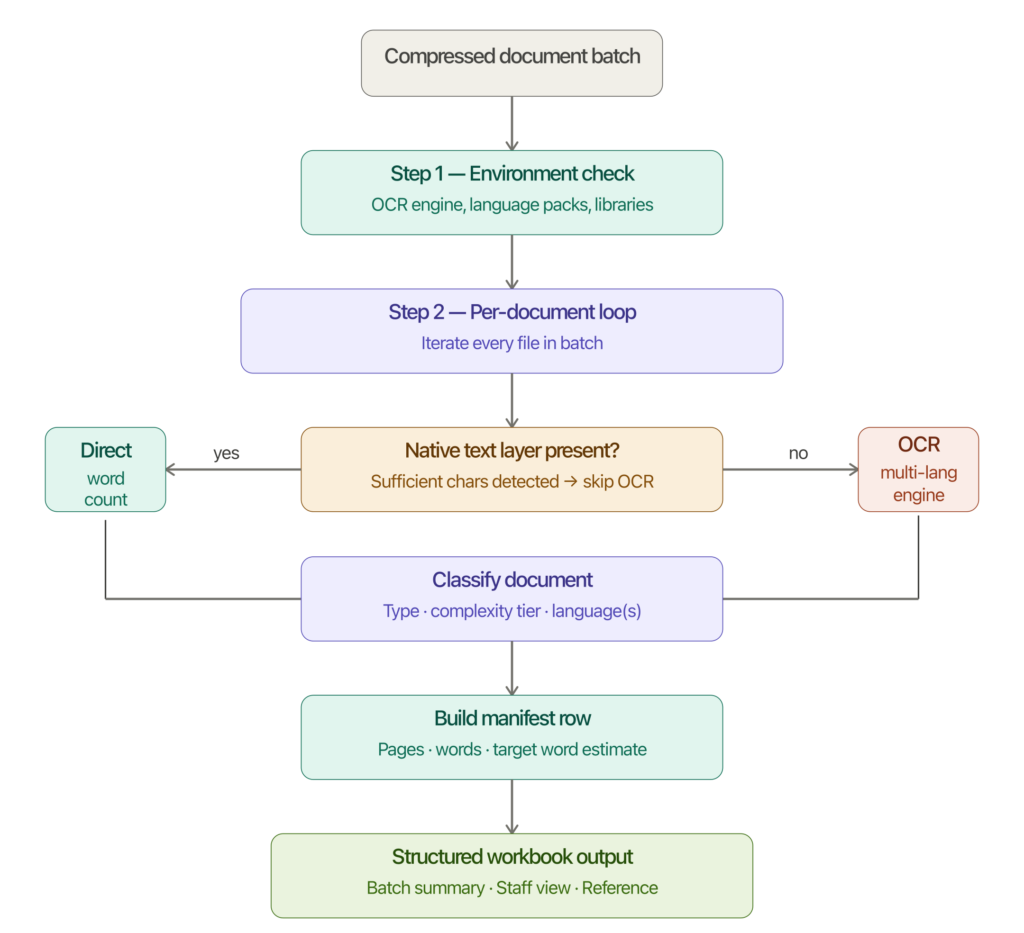
Batch Analyzer – Ingests a compressed document batch, runs OCR where needed, classifies each file by type and complexity, and outputs a structured workbook ready for quoting and assignment.

Court orders, privilege designations, data sovereignty rules, and cross-border regulatory requirements increasingly break that assumption. The analyst cannot read the document. The estimator cannot open the file. But the work still has to be scoped, quoted, and delivered accurately.

Traditional approaches fail here in a specific way: they treat “review the documents” and “estimate the scope” as a single inseparable step. If you cannot do the first, you cannot do the second. The project stalls, costs inflate, or the constraint gets quietly worked around in ways that create downstream exposure.

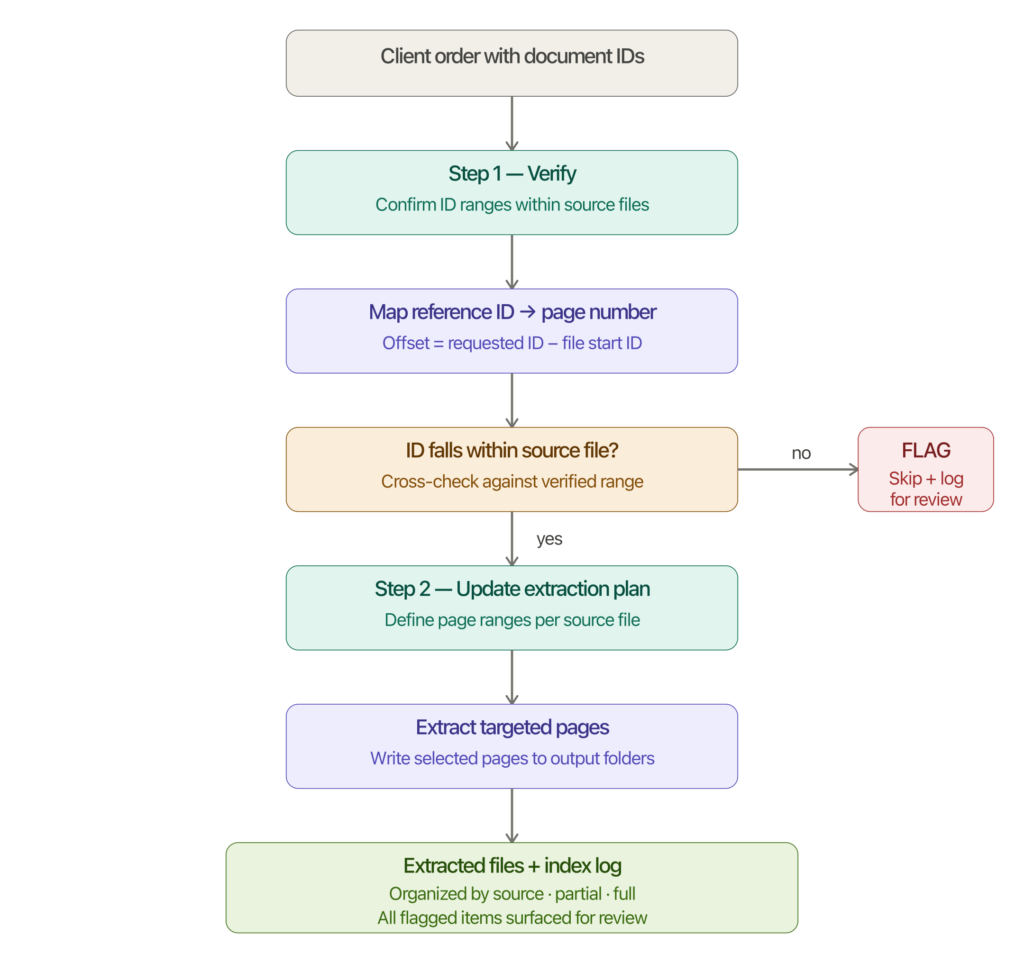
Batch Extractor – Takes a client order specifying document IDs, maps each ID to a physical page within the source files, flags any unresolvable references for review, and extracts only the targeted pages into organized output folders.

Agentic pipelines solve this by separating observation from comprehension. A properly designed agent can characterize a document – page count, word density, language composition, structural complexity, document type – without surfacing a single line of content to any human reviewer. The observation layer and the content layer never meet.

Agentic Architecture: The Double Garden Wall Applied to Document Intelligence

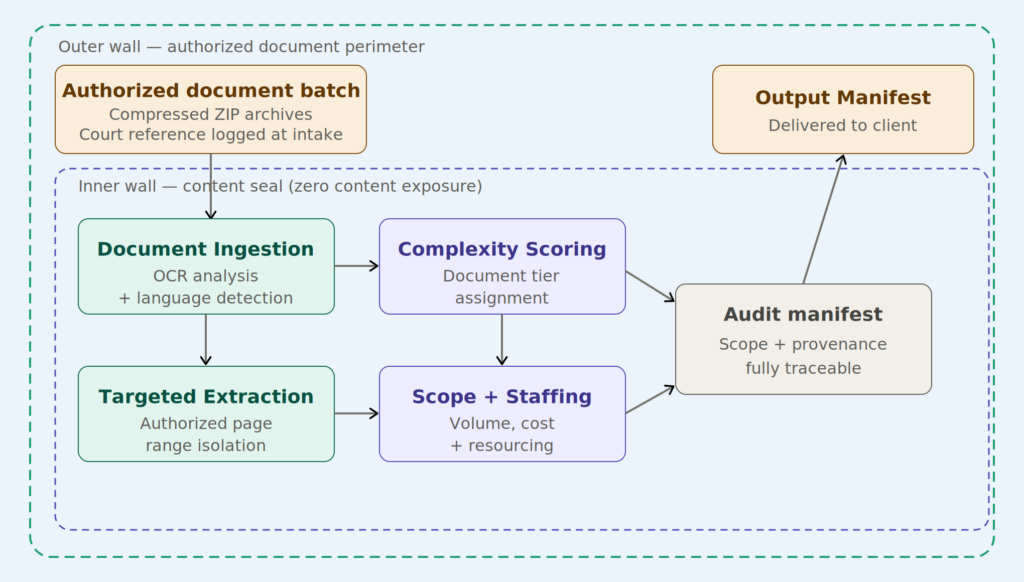
The Double Garden Wall is an architecture we first developed for our ethical AI image generation tool – a system that needed to guarantee CC0 provenance on every training asset without relying on human memory or manual spot-checks. The principle transfers directly to regulated document handling.

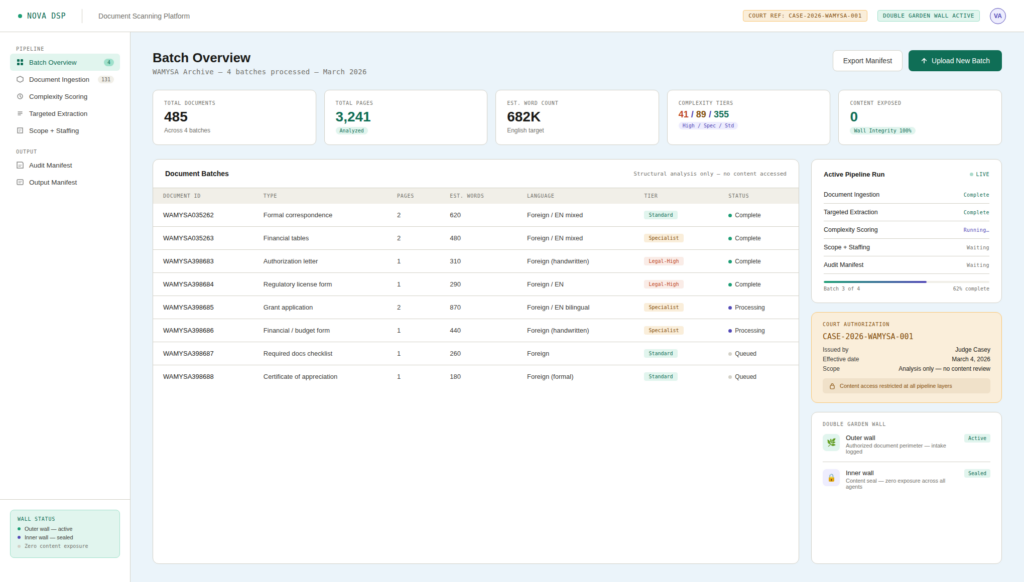
Double Garden Wall architecture: specialized agents operating within layered compliance boundaries, where every document is characterized structurally and no content crosses to any human reviewer.

The outer wall defines what enters the system at all: only authorized document batches, governed by a court reference number logged at intake. Nothing flows in without an audit trail attached to it. The inner wall ensures that what exists inside the system – the actual document content – never crosses to the analysis agents. Statistical signals are sufficient. Page counts, word densities, language composition, Bates-to-page mappings, and structural classification are all derivable without any agent reading the underlying text.

The architecture employs two core agents working in sequence:

The Batch Analyzer ingests a ZIP archive of scanned documents and runs OCR analysis across every file. It classifies each document by legal complexity tier – standard, specialist, or legal-high – based on structural signals: form density, mixed-language composition, handwritten elements, embedded stamps, and regulatory formatting patterns. It produces a structured manifest with word count estimates, page totals, and staffing recommendations. No human reviewer sees any document content. The agent produces numbers and classifications from signal, not from reading.

The Batch Extractor handles partial-translation requests, which are common in litigation contexts where only specific Bates-numbered page ranges are required. Rather than requiring a human to manually locate and pull pages from multi-hundred-page archive PDFs, the extractor maps document IDs to physical page positions and organizes extracted pages into structured output folders ready for translator handoff. The mapping logic is deterministic: the physical page equals the requested ID minus the first ID in that file. There is no guesswork, and no human touches the content to produce the extraction.

Together, these agents answer the core question: how do you scope work you are not permitted to see?

A Live Production Case

The engagement in question involved four document batches totaling thousands of pages of foreign language legal materials from a multi-decade archive. Documents ranged from formal organizational correspondence and regulatory licensing forms to handwritten authorization letters, financial tables, grant applications, and certificates.

Every document was a scanned image PDF – no text layer, no searchable content. The pipeline had to run OCR, classify complexity, map Bates IDs, and produce a scope estimate accurate enough to serve as the basis for a formal translation services agreement – all without any member of our team reading a single document.

Nova DSP platform interface: real-time pipeline visibility across document ingestion, complexity scoring, and scope generation – with court authorization tracking, agent-by-agent run status, and a live wall integrity monitor confirming zero content exposure at every layer.

The output from the Batch Analyzer provided page counts, estimated word counts, and per-document complexity classifications that allowed the translation firm to staff the engagement correctly: how many legal-specialist translators were required, how many standard-tier translators could handle the lighter materials, what a realistic daily delivery cadence looked like, and what the full project investment would be.

The Batch Extractor then handled the partial-document requests that arrived as the engagement progressed – court-specified page ranges that needed to be pulled, organized, and handed off to translators without any bulk export of content that fell outside the authorized scope.

The audit trail for the entire engagement is complete. Every document batch has a court reference number attached to its intake record. Every OCR pass is logged. Every classification decision is traceable to the signals the agent used to make it. If the protective order is ever challenged, the record demonstrates exactly what was accessed, when, by which process, and what output it produced.

That kind of defensibility is not a feature you add to a pipeline after the fact. It has to be designed in from the first line.

ELEVATOR PITCH:

Regulated industries face a specific class of problem that general-purpose AI tools are not designed to solve – analyzing sensitive document corpora without exposing content to unauthorized reviewers. Agentic pipelines built on a Double Garden Wall architecture handle this by separating observation from comprehension: agents characterize documents through structural signals without any human or downstream system ever accessing the underlying content. The result is an accurate, auditable scope – produced under constraint, defensible under review.

Why the C-Suite Should Care

Today, most organizations answer those questions through manual sampling, senior reviewer time, and informed estimation. Enterprise eDiscovery tools solve this problem for litigation teams with six-figure software budgets. Nova DSP was built for the organizations those tools weren’t designed for. That approach scales poorly, introduces inconsistency, and creates exposure every time a document is touched by a reviewer who should not have seen it.

Every organization that handles regulated documents – legal practices, financial institutions, healthcare systems, government contractors, compliance functions – operates under some version of the same constraint: certain materials cannot be broadly accessed, but decisions still have to be made about them. What are they? How many are there? How complex are they? What will it cost to process them? How do we route them to the right people?

“Every organization that handles regulated documents operates under some version of the same constraint: certain materials cannot be broadly accessed.”

C-suite leaders should evaluate agentic document intelligence against three questions that apply regardless of industry or document type:

1. Can the system produce accurate scope estimates without creating unauthorized access records?

2. Can every classification decision be traced back to the specific signals that drove it – not to a reviewer’s recollection?

3. When regulatory scrutiny arrives, can the system demonstrate what was done, when, by which process, and with what authorization?

The answer to all three, for a properly designed agentic pipeline, is yes by construction – not yes in principle, subject to human discipline.

The firms that recognize this distinction early will move faster, engage more confidently in document-intensive regulated work, and carry significantly less risk when the oversight questions inevitably come.

THE BOTTOM LINE

Agentic pipelines for regulated document work are not about processing documents faster. They are about processing documents correctly – within constraint, with full traceability, without the exposure that manual workflows introduce every time a human reviewer opens a file they should not have. For legal practices, compliance functions, and any organization operating under court order, data sovereignty rules, or privilege designations, that combination of analytical capability and content containment is not a competitive advantage. It is the operating standard the work requires.

Velocity Ascent builds AI-powered solutions for regulated industries. We specialize in agentic pipeline architecture, ethical AI sourcing, and production-scale document intelligence with full provenance tracking.


GLOSSARY

Batch Analyzer (n.) A software agent that ingests a structured collection of documents and produces a quantitative characterization of the corpus – page counts, word volumes, language composition, and complexity classification – without accessing or surfacing the underlying content of any individual file.


Batch Extractor (n.) A software agent that identifies and isolates specific documents or page ranges from a large multi-file archive based on externally supplied reference identifiers, organizing the extracted material into structured output folders ready for downstream processing or handoff.

Secure Agentic Pipelines for Regulated Industries

Joe Skopek · March 2, 2026 ·

Why secured networked AI agents are the operational layer financial services has been waiting for.

Most organizations adopting AI in regulated environments are doing it backwards. They start with the model and work outward, hoping compliance will follow.

It rarely does.

The fundamental challenge is not whether AI can generate content, write reports, or produce imagery. It can. The challenge is whether every output can withstand scrutiny from compliance teams, clients, and regulators. In financial services, healthcare, and legal practice, the answer to that question determines whether AI is an asset or a liability.

The Compliance Problem Nobody Talks About: Can Agentic AI do the work in a way that every stakeholder in the chain can verify.

Traditional AI pipelines are monolithic. A single system ingests data, processes it, and produces output. When something goes wrong; a licensing violation, a hallucinated claim, a brand-inconsistent asset – the effort required to identify where the failure occurred can be substantial.


Agentic Architecture: Specialized Agents, Governed Workflows

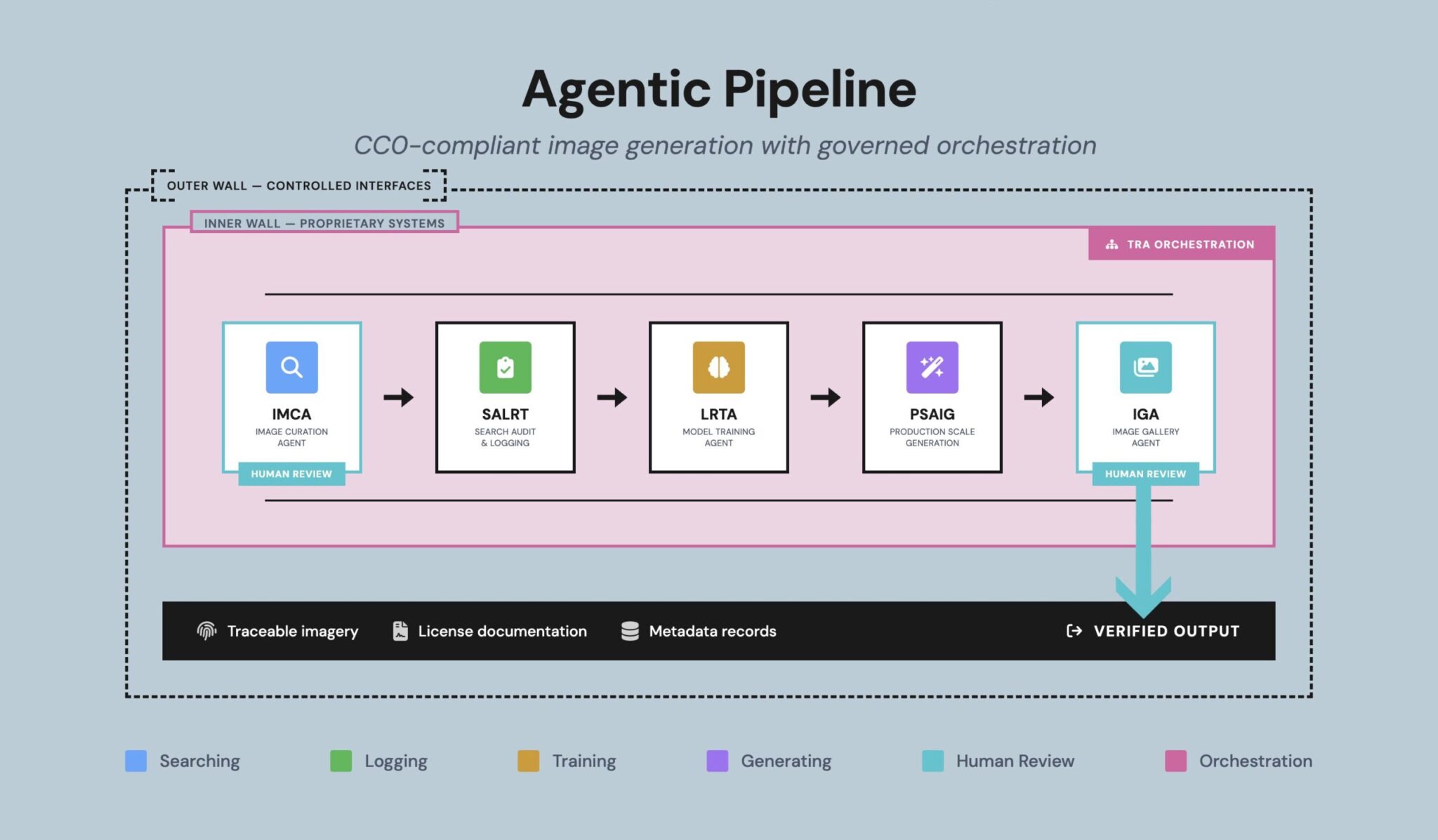
Agentic pipelines take a fundamentally different approach. Instead of a single monolithic system, the work is distributed across specialized agents, each responsible for a discrete function. An orchestration layer coordinates handoffs, enforces sequencing, and maintains the audit trail.

Consider a production pipeline for compliance-sensitive content. Rather than a single AI tool doing everything, the architecture employs dedicated agents for sourcing, verification, model training, generation, quality assurance, and delivery. Each agent operates within defined boundaries. Each produces records that downstream agents and human reviewers can inspect.

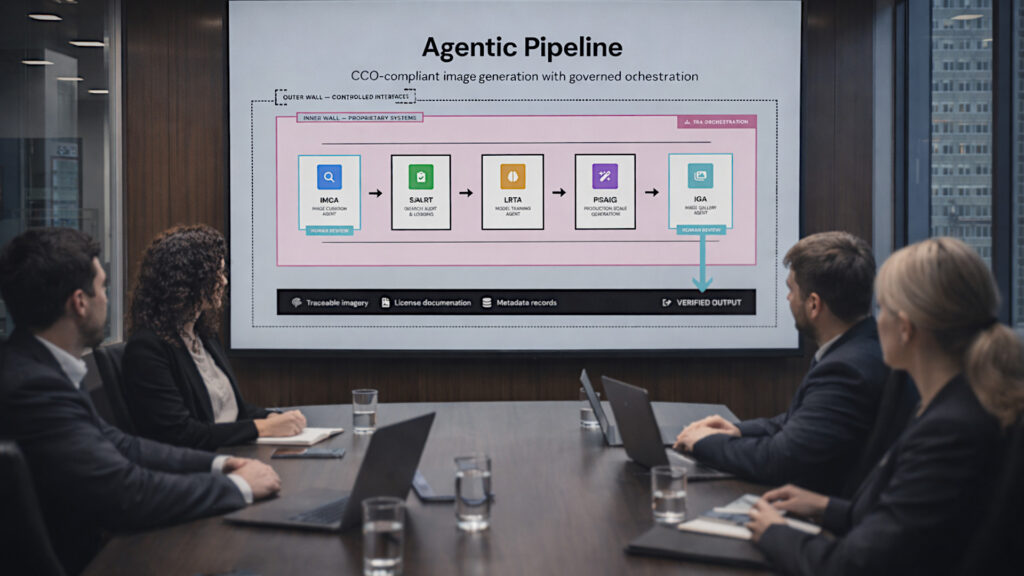
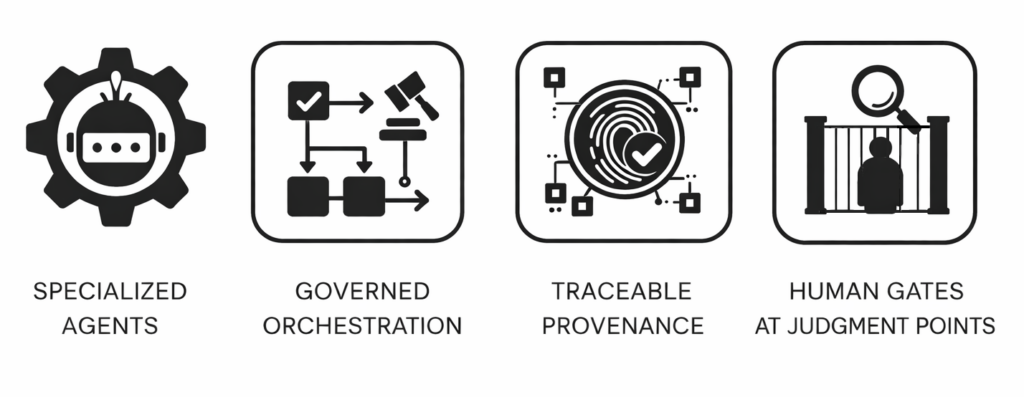
Agentic pipeline architecture: specialized agents with governed orchestration and human review gates. From Joe Skopek’s Financial Marketer article: “Marketing’s next frontier is autonomous networked intelligence.“

The orchestration agent functions as a traffic controller, routing work between agents based on status, priority, and pipeline rules. It does not make creative or compliance decisions. It enforces process. Human review gates are positioned at the points where judgment is irreplaceable – source curation and final output quality.

This is not theoretical architecture. Production systems built this way are operating today, handling thousands of assets through end-to-end pipelines where every step is logged, every input is traceable, and every output is defensible.

Trust You Can Demonstrate

In regulated environments, trust must be demonstrable rather than implied. Agentic systems are designed to produce clear, reviewable records of origin, licensing, and decision flow. Compliance discussions move away from subjective assurances and toward documented system behavior.

Every agent in the pipeline writes to a shared provenance record. When a sourcing agent identifies an asset, it logs the license type, the retrieval date, and the verification status. When a training agent builds a model, it records the dataset composition, the training parameters, and the lineage back to original sources. When a generation agent produces output, the full chain of custody is available on demand.

This matters because regulators do not ask whether your AI is good. They ask whether you can prove it did what you say it did. Agentic pipelines answer that question by design, not by retrofit.

Collaboration Without Exposure

Financial services firms have historically avoided collaboration on models or data because the risk outweighed the benefit. Sharing training data exposes proprietary logic. Sharing models reveals competitive advantage. The default has been isolation.

Agentic architecture changes this calculation through what we call the Double Garden Wall. The inner wall protects proprietary datasets, screening logic, and brand-governance frameworks. These remain sealed and non-negotiable. The outer wall exposes only what external systems require: controlled capability interfaces, verifiable records, and traceable outputs.

Built this way, systems gain interoperability without dilution, collaboration without intellectual property leakage, and scale without compromising compliance.

Advances in distributed learning and controlled execution now allow verified partners to contribute capability without sharing raw data or proprietary logic. Agents can be registered in decentralized directories, verified against published capability specifications, and bound by enforceable policy contracts–all without exposing internal methods. Capability expands while risk remains bounded.

Parallel Workflows Without Parallel Headcount

Traditional AI pipelines execute sequentially. One step finishes before the next begins. Networked agentic systems enable multiple stages of work to operate concurrently across compatible agents. This event-driven, contract-based execution model allows firms to handle volume surges without linear increases in staffing or infrastructure.

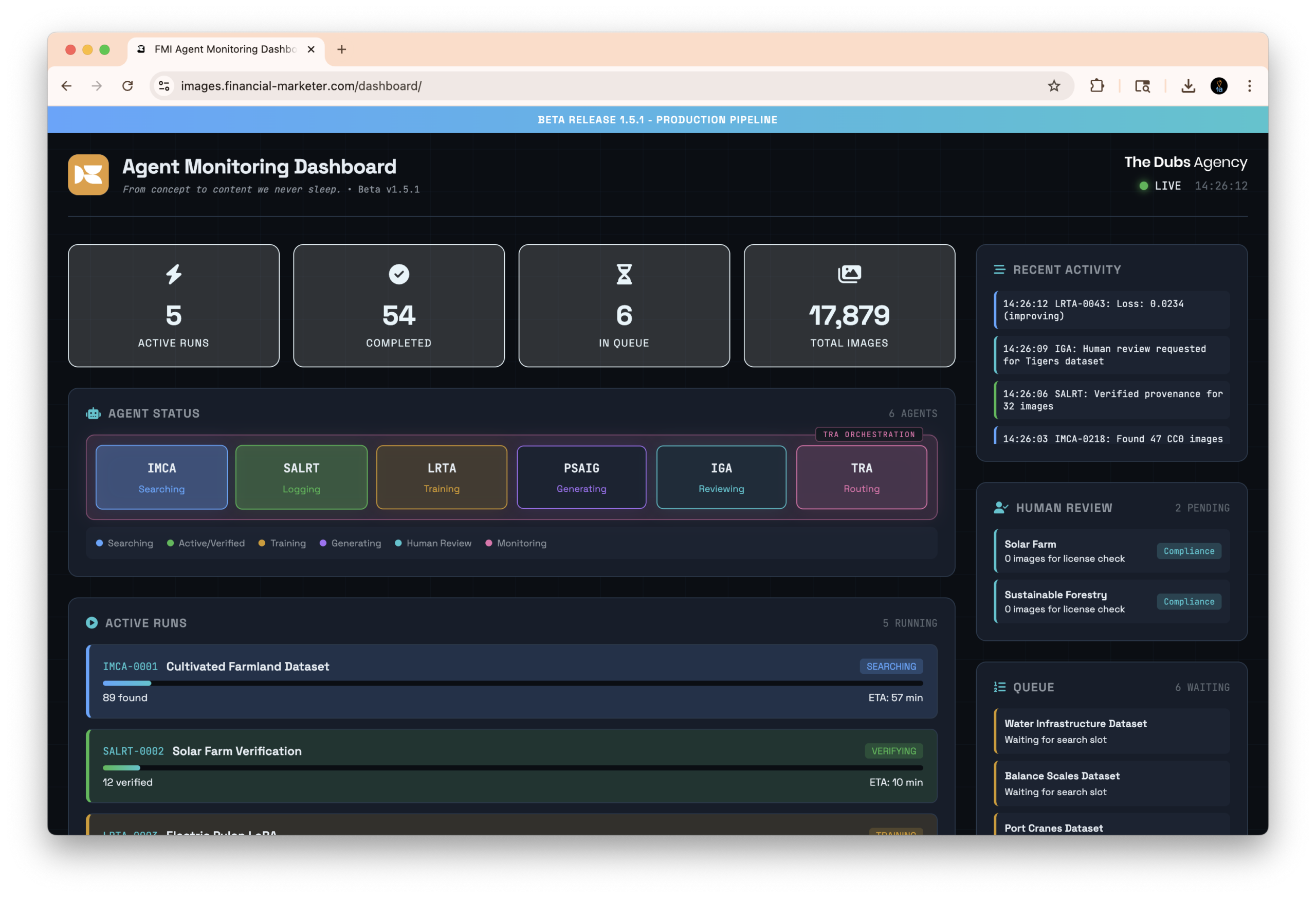
Agent orchestration and monitoring dashboard: real-time visibility into scalable concurrent pipeline operations.

A production monitoring dashboard shows the reality of this approach. Multiple agents operating simultaneously across sourcing, verification, training, and generation. Active runs with estimated completion times. Queue management for incoming work. Human review requests surfaced precisely when human judgment is needed–not before, and not after.

This is the operational difference between AI as a project and AI as infrastructure. Projects require constant management. Infrastructure runs, scales, and reports.

A Live Production Case

To make this concrete: a production-grade pipeline operating today generates CC0 (Creative Commons Zero) compliant imagery for regulated industries. The system employs specialized agents for sourcing, dataset preparation, model fine-tuning, production-scale generation, and gallery management. Governance is strict: public-domain inputs only, full chain-of-custody tracking, and aesthetic screening for accuracy and consistency.

Membership image gallery with category-based organization, aspect ratio filtering, and curated industry-specific collections.

The output is not experimental. These are production assets used in client-facing materials where compliance review is mandatory. Each image can be traced back through the generation agent, through the model that produced it, through the training data that informed the model, back to the original public-domain source with full license documentation.

The system delivers assets in multiple aspect ratios–landscape, square, portrait–with metadata tagging for camera view, color palette, weather conditions, and semantic content. Every asset is available in tiered quality levels for different use cases, from full-resolution production to optimized web previews.

Once agents are registered, verified, and policy-bound, the pipeline enables controlled collaboration through decentralized registries, zero-trust interoperability where each agent governs its own exposure, distributed fine-tuning across verified compute without revealing private datasets, elastic job distribution across compatible agents, and production-scale auditability where every autonomous step leaves a clear record.

ELEVATOR PITCH:

Regulated industries need AI that produces auditable, compliant output at production scale. Agentic pipelines deliver this by orchestrating specialized AI agents through governed workflows where every action is logged, every source is traceable, and human judgment is preserved at the decisions that matter. The result is faster execution with stronger controls–not weaker ones.

Why the C-Suite Should Care

The value proposition is straightforward. Stronger controls. Faster output. Broader capability without compromising compliance posture. This is the difference between AI as a novelty and AI as operational infrastructure.

Financial services leaders should evaluate agentic systems against three uncompromising questions:

1. Can the system scale without weakening oversight?

2. Can every output withstand compliance, client, and regulator review?

3. As the firm grows, does the technology reinforce discipline–or fracture under pressure?

The industry does not need spectacle. It needs systems that behave predictably across volume spikes, regulatory cycles, and brand-governed workflows. When implemented with rigor, agentic AI is not about disruption. It is about operational reliability at a scale previously out of reach.

The firms that excel will not be those deploying the most colorful demonstrations. They will be the ones deploying systems that deliver controlled growth, verifiable governance, rapid execution, and credible audit trails.

The Challenge of Building in an Evolving Space

There is an honest tension in this work that deserves acknowledgment. The infrastructure layers that make agentic pipelines possible–agent discovery protocols, capability registries, policy enforcement standards–are still maturing. Building production systems on evolving foundations requires a specific kind of engineering discipline: design for what exists today while architecting for what arrives tomorrow.

This is not a reason to wait. The core principles – specialized agents, governed orchestration, traceable provenance, human gates at judgment points – are stable and proven. The interoperability layer that connects these systems across organizational boundaries is advancing rapidly through open standards and community-driven development.

What this means practically is that early movers gain compounding advantages. The organizations investing now in agentic infrastructure are building institutional knowledge, training teams, and establishing operational patterns that late adopters will spend years replicating. The learning curve is real, and it rewards those who start.

The shift toward networked agentic pipelines is already underway. The institutions that master it early will define the standard others are forced to follow.

THE BOTTOM LINE

Agentic pipelines are not about replacing human judgment. They are about automating every mechanical step between the moments where human judgment actually matters – and proving that the mechanical steps were executed correctly. For regulated industries, that combination of speed, scale, and verifiable compliance is not optional. It is the next operational baseline.

Velocity Ascent builds AI-powered solutions for regulated industries. We specialize in agentic solutions including; pipeline architecture, ethical AI sourcing, and production-scale automation with full provenance tracking.


  • Page 1
  • Page 2
  • Page 3
  • Interim pages omitted …
  • Page 5
  • Go to Next Page »

Velocity Ascent

© 2026 Velocity Ascent · Privacy · Terms · YouTube · Log in