• Skip to primary navigation
  • Skip to main content
Velocity Ascent

Velocity Ascent

Looking toward tomorrow today

  • Research
  • Design
  • Development
  • Strategy
  • About
    • Home
    • Who we work with…
      • Product Leaders
      • Innovation Teams
      • Founder-Led Organizations
    • Services
    • Contact Us
  • Show Search
Hide Search

the Blog

From Idea to Impact: The Skunkworks Magic of Rapid Software Prototyping

velocityascent · January 26, 2024 ·

We blend vision, research, planning, and collaboration to craft software solutions that make a meaningful impact.

The term “skunkworks” is generally used in a generic sense to refer to a innovation-focused group or team that focuses on accelerated and new-to-world projects.

Product of the Skunk works

The concept of a skunkworks was popularized by Lockheed Martin’s Skunk Works division, —a name inspired by a mysterious locale from the comic strip Li’L Abner— known for its pioneering work on advanced aircraft designs, but the term itself is widely used to describe similar innovation-focused teams.

Whiteboarding ideas

While software development differs from aerospace engineering, there are valuable principles and elements from Skunk Works that can be applied to your process:

  1. Innovation Culture: Foster a culture of innovation and encourage team members to think creatively, take calculated risks, and explore unconventional solutions to problems.
  2. Cross-Disciplinary Teams: Assemble diverse teams with expertise in various aspects development, including coding, user experience design, data analysis, and domain-specific knowledge. We have found that interdisciplinary collaboration often leads to innovative solutions.
  3. Rapid Prototyping: Our team uses rapid prototyping and iterative development to build quick (Fail Fast), low-fidelity prototypes to visualize ideas, gather feedback early, and iterate on software solutions based on real-world insights.
  4. Human-Centric Approach: Understanding your users and their needs is crucial to an accelerated pace. It is vital to conduct user research, gather feedback, and design software with the end-user in mind. Human-centric design leads to successful results.
  5. Data-Driven Decision-Making: Once live, leverage data feeds and live analytics to inform future software development. Real-world data provides valuable insights into user behavior and preferences, resulting in informed decisions.
  6. Secrecy and Confidentiality: While not all projects require secrecy, the team should be well-versed at maintaining confidentiality with sensitive or groundbreaking work. Ideas are one of a company’s most valuable assets, safeguarding intellectual property (IP) during development is paramount.
  7. Agile Methodologies: The implementation of industry-standard agile methodologies allow quick adaptation to changing project requirements and market dynamics. Frequent iterations and incremental development allow for flexibility and responsiveness.
  8. Continuous Learning: A culture of continuous learning and adaptation ensures that the team is always seeking ways to enhance their skills and knowledge to “stay ahead of the curve”.
  9. Quality Assurance: Place a strong emphasis on details and quality assurance testing throughout the development process. Thorough testing ensures that our software solutions meet the highest standards of performance, stability and reliability.
  10. Collaboration and Communication: Assure that the team maintains open lines of communication with participants and stakeholders. Effective collaboration and clear documentation of decisions and progress are essential for success.
  11. Scaling Success: Early on in the process consider how to scale effectively exploring future opportunities for expanding features, platforms, or user bases to maximize impact.
  12. Leadership and Vision: Provide strong leadership and a clear vision for development, setting the tone for innovation, commitment to quality, and the pursuit of excellence.

While the aerospace and software industries differ, the principles of innovation, collaboration, agility, and user-centricity can be applied to software development to create innovative and successful solutions.


The Power, and Challenge, of Automated Social Media Marketing.

velocityascent · January 16, 2024 ·

Unified Digital Experience: Optimizing your organization’s digital outreach to expand brand awareness.

The power of automation has transformed the way we connect with our audience, reach potential customers, and simplify marketing efforts. In this post, we’ll explore how automated social media can help you improve your digital presence and make your marketing outreach more efficient.

A unified digital presence improves the odds of success online reaching your target audience and expanding brand awareness. One of the key strategies to enhance digital presence is through an organized and regularly scheduled approach to social marketing and outreach.

The challenge of manual social media.

Gone are the days when businesses relied solely on manual social media management. The manual process to update and maintain unified digital presence often falls victim to scheduling challenges and publishing interruptions. These issues can lead to an impact on “freshness dating” and the public’s perception of the organization’s vitality. A simple example of this would be content from 2019 prominently posted on the home page.

Leveraging the life-cycle timeframe.

All businesses and products tend to have a life-cycle they travel through during the year. The foundation of the brand life-cycle is a combination of topical news and events about the brand coupled with traditional events during the calendar year. The life-cycle timeframe can be leveraged in creating a publishing calendar for outreach and marketing.

[Almost] Everything you wanted to know about Automated Social Media but were afraid to ask.

Automated social media refers to the use of tools and software to schedule, manage, and analyze your social media activities. It encompasses a range of tasks, from posting content at optimal times to engaging with your audience and tracking performance metrics.

Here’s why it’s a game-changer for your digital presence:

  1. Consistency is Key
    Consistency is a crucial factor in building a strong online presence. Automated social media allows you to schedule posts in advance, ensuring that your content reaches your audience regularly, even when you’re not actively online. This consistency builds trust and keeps your followers engaged.
  2. Saves Time and Effort
    Manual social media management can be time-consuming and exhausting. With automation, you can plan your content calendar, set it, and forget it. This frees up your time to focus on more strategic aspects of your business, such as creating high-quality content and engaging with your audience on a deeper level.
  3. Personalization and Targeting
    Automation tools often include features for audience segmentation and targeting. This means you can tailor your content to specific demographics, interests, and behaviors, making your messages more relevant and engaging for your audience.
  4. Analytics and Optimization
    Automated social media platforms provide in-depth analytics to track the performance of your posts and campaigns. You can easily identify what’s working and what’s not, allowing you to make data-driven decisions and continuously optimize your marketing efforts.
  5. Scaling Your Outreach
    As your business grows, so does your social media presence. Automation allows you to scale your outreach without increasing your workload proportionally. You can manage multiple social media accounts and platforms efficiently, reaching a wider audience with ease.

Making the most of Automated Social Media.

To harness the benefits of automated social media for your digital presence, follow these steps:

Engage Authentically: While automation is powerful, by far the most important thing to remember is, don’t forget the human touch. Engage with your audience genuinely, respond to comments and messages, and build meaningful connections. The digital landscape is overloaded and authenticity will always shine through – do not be shy about who you are and what your company or organization represents.

Choose the Right Tools: There are numerous automation tools available, such as Buffer, Hootsuite, and Sprout Social. Research and select the one that suits your needs and budget.

(View Social Media Automation Tools Overview below)

Create a Content Strategy: Develop a clear content strategy (Eg. Educational, Storytelling or User-Generated Content) that aligns with your brand and goals. Planning your content calendar in advance is vital to maintain consistency – automation allows for that preparation.

Segment Your Audience: Understand your audience’s preferences and behaviors to tailor your content and messaging effectively. Study other peers and competitors in your space and silo.

Track and Analyze: Use the analytics provided by your automation tool to measure the impact of your social media efforts. Adjust your strategy based on the data and then define time of day to post.

Social Media Automation Tools Overview

Buffer, Hootsuite, and Sprout Social are three of the leading social media management and automation tools that help individuals and businesses manage their social media presence more effectively. While they share some common features, they also have distinct differences. Here’s an overview of each platform and the key differences between them:

  1. Buffer:
    • Buffer is primarily known for its simplicity and ease of use. It focuses on scheduling and publishing content to various social media platforms.
    • Key Features:
      • Scheduling: Buffer allows you to schedule posts in advance for multiple social media platforms, including Facebook, Twitter, Instagram, LinkedIn, and Pinterest.
      • Analytics: Basic analytics are available to track post performance, such as engagement and reach.
      • Content Suggestions: Buffer provides content recommendations to help you discover relevant content to share with your audience.
  2. Hootsuite:
    • Hootsuite is a comprehensive social media management tool that offers a wide range of features beyond scheduling and publishing.
    • Key Features:
      • Social Listening: Hootsuite offers social listening capabilities to monitor brand mentions and track relevant keywords on social media.
      • Team Collaboration: It allows team members to collaborate and manage social media accounts together.
      • App Integration: Hootsuite offers integration with various third-party apps and tools, making it more versatile.
      • Advanced Analytics: Hootsuite provides detailed analytics and reports to help you measure the effectiveness of your social media campaigns.
  3. Sprout Social:
    • Sprout Social is a comprehensive social media management and engagement platform designed for businesses and agencies.
    • Key Features:
      • Social Inbox: It consolidates messages and notifications from different social media platforms into one unified inbox, making it easier to respond to comments and messages.
      • Social CRM: Sprout Social includes CRM-like features to help businesses manage relationships with their audience.
      • Advanced Reporting: It offers in-depth analytics and reporting tools to track campaign performance and audience engagement.
      • Publishing Calendar: Sprout Social provides a visual content calendar for planning and scheduling posts.

Key Differentiators:

  • Buffer is best suited for individuals and small businesses looking for a straightforward scheduling tool, while Hootsuite and Sprout Social offer more comprehensive features for larger organizations and agencies.
  • Hootsuite’s social listening and team collaboration features make it a strong choice for businesses wanting to monitor conversations and collaborate across teams.
  • Sprout Social’s focus on engagement and CRM tools makes it ideal for businesses that prioritize customer interactions and relationship management.

Ultimately, the choice between these platforms depends on your specific social media management needs, budget, and the size of your organization. Each tool has its strengths and weaknesses, so it’s essential to evaluate which one aligns best with your goals and requirements.

Micro-Moments

Micro-moments are brief instances when consumers turn to their mobile devices for quick answers or assistance, driven by an immediate need or curiosity. These moments represent opportunities for businesses to provide instant, relevant, and concise content that caters to users’ specific queries or requirements. Effective micro-moments strategies involve optimizing content for mobile and voice search to capture user attention and address their immediate needs in real-time.

Conclusion

In conclusion, automated social media is a game-changer for improving your digital presence and simplifying your marketing outreach. By leveraging automation tools and spending the time to strategically build a publishing calendar, you can reach your audience consistently, save time, and make data-driven decisions to achieve your online goals. One thing we know for sure is, garbage-in equals garbage out. Embrace automation, and watch your online presence soar to new heights.

Shameless Plug:

We believe that the small, robust, and nimble team at Velocity Ascent exemplifies this synergy. Guided by an unwavering commitment to best practices, combined with a deep understanding of user needs and preferences, forms the bedrock of exceptional design and production outcomes. As we begin to harness the power of AI to streamline processes and push creative boundaries, we hope to demonstrate that the future belongs to those who can navigate the delicate interplay between technology and human skill. The positive results achieved stand as a testament to the limitless possibilities that arise when human expertise and AI tools converge to craft experiences that delight and inspire.

Want to learn more – get in touch!

Enhancing User Experiences with Digital Humans: When, how, and if you should deploy

velocityascent · January 12, 2024 ·

Digital humans are AI-powered beings that simulate human interactions, often with a human-like appearance and conversational abilities. Some are incredibly life-like, others downright creepy.

In the current digital landscape, businesses and organizations are seeking innovative ways to connect with their users while providing exceptional online experiences. One exciting development in this regard is the emergence of digital humans – AI-driven entities that mimic human interaction. While digital humans offer a wide range of benefits, it’s essential to understand when and how to deploy them effectively.

Excel at Complex & Repetitive Interactions

Digital humans truly shine when it comes to conveying complex instructions or explaining intricate product features. Think of the success of YouTube instruction videos featuring real people demonstrating how things work. The visual and interactive nature of digital humans makes them ideal for scenarios where customers need a deeper understanding of a product or service.

They also excel at performing repetitive tasks, especially in a support role where repetition fatigue of Human support can negatively impact visitor experience. Having the Digital Human in the entry-point acts as a filter assigning visitors to correct Human support.

Not Suitable for Every Application

Digital humans are not a one-size-fits-all solution. In situations where customers seek quick and straightforward transactions, traditional user interfaces, chatbots, or voice assistants like Siri or Alexa may be more suitable. These automated systems can efficiently handle routine tasks and provide swift responses.

Harnessing the Power of Digital Humans

Deploying digital humans strategically can have a profound impact on customer satisfaction and engagement. These AI-driven entities bridge the gap between automation and human interaction, offering a unique blend of efficiency and personalization. Whether it’s guiding customers through complex product configurations, providing emotional support, or assisting with decision-making, digital humans have the potential to transform customer experiences.

Consider These Key Questions

To determine whether deploying a digital human is the right choice, consider the following questions:

1. Does the interaction involve emotional engagement?

  • Digital humans can convey empathy and reassurance through their human-like appearance, making them suitable for emotionally charged interactions.

2. Are users unsure of what they want from the interaction?

  • When customers are uncertain about their needs, digital humans can guide them through the decision-making process, offering personalized recommendations.

3. Is there room for exploration and consideration of different approaches or outcomes?

  • In scenarios where customers want to explore various options or consider different outcomes, digital humans can provide valuable insights and assist in decision-making.

4. Could the user benefit from a personalized explanation?

  • If the interaction requires a tailored explanation or a detailed walkthrough, digital humans can offer personalized guidance, ensuring customers fully comprehend the information.

The Role of Digital Humans

Digital humans are not here to take our jobs or replace human interaction entirely. Instead, they excel in specific areas, such as providing information, assistance, and emotional support in situations where human availability might be limited. They are valuable additions to customer service, education, and various other industries.

Dispelling Misconceptions

To address concerns effectively, let’s debunk some common misconceptions:

1. Loss of Human Touch: Digital humans are not a threat to the human touch in interactions. They are programmed to provide empathy and support, complementing human interaction rather than replacing it.

2. Job Displacement: Digital humans are tools that can handle routine tasks, freeing up human employees to focus on more complex and value-added activities. They can enhance efficiency rather than replace jobs.

3. Security and Privacy: Concerns about data security and privacy are valid. However, just like any other technology, digital humans can be designed with robust security measures to protect sensitive information.

4. Ethical Considerations: Ethical concerns about AI and digital humans are important. It’s crucial for organizations to use these technologies responsibly and transparently, addressing ethical issues head-on.

Example of Digital Human

The Advantages of Digital Humans

Now, let’s shift the focus to the advantages of embracing digital humans:

1. Efficiency: Digital humans can provide instant assistance and support, improving response times and overall efficiency.

2. Availability: They are available 24/7, ensuring that customers can get help whenever they need it.

3. Personalization: Digital humans can offer personalized recommendations and guidance, enhancing the user experience.

4. Scalability: They can be deployed at scale, making them cost-effective for businesses.

Digital humans are, at the core, tools that can enhance customer experiences, improve efficiency, and complement human interactions. As technology continues to evolve, embracing these innovations is one path forward to a more efficient and personalized future.

Conclusion

While digital humans may not be suitable for every application, their ability to excel in conveying complex information and engaging customers emotionally makes them a valuable addition to the customer service toolkit. By asking the right questions and considering the nature of the interaction, businesses can harness the power of digital humans to enhance customer experiences and stay ahead in today’s competitive digital landscape.

Shameless Plug:

At Velocity Ascent we believe that as we begin to harness the power of AI to streamline processes and push creative boundaries, we hope to demonstrate that the future belongs to those who can navigate the delicate interplay between technology and human skill. The positive results achieved stand as a testament to the limitless possibilities that arise when human expertise and AI tools converge to craft experiences that delight and inspire.

Want to learn more – get in touch!

The Slide Deck is dead – long live the Slide Deck!

velocityascent · January 7, 2024 ·

Bid farewell to outdated conventions and embrace the era of dynamic, engaging and impactful slide deck production.

Out with the old, in with the new: the traditional approach to slide deck creation is undergoing a profound transformation. As the demands of modern business evolve, so too must our methods of communication and presentation. Gone are the days of static, uninspiring slides littered with bullet points and blocks of twelve point text. Todays innovative tools and techniques empower us to captivate audiences like never before.

This Look Book video presents a variety of contemporary layouts for a slide.

As professionals, we are constantly challenged to elevate our content, captivate our audience, and deliver impactful messages. Amidst this evolution, understanding the nuances of slide deck production becomes crucial. Let’s delve into the realm of modern slide deck creation, exploring the diverse tools, debunking clichés, and uncovering industry best practices.

Debunking Clichés: Beyond Bullet Points and Clip Art

Gone are the days of monotonous slide decks inundated with bullet points and clichéd clip art. Today, effective communication demands creativity and authenticity. Engage your audience by incorporating visually striking graphics, compelling imagery, and concise text. Embrace storytelling techniques to craft narratives that resonate with your viewers. Break free from the shackles of tradition, and dare to experiment with unconventional layouts and multimedia elements. Remember, the goal is not merely to convey information but to leave a lasting impression that sparks dialogue and action.

Industry Best Practices: Crafting Compelling Narratives

In the realm of slide deck production, adhering to industry best practices can elevate your presentations from mundane to memorable. Begin with a clear outline, ensuring a logical flow of ideas throughout your slides. Maintain consistency in design elements such as color schemes, fonts, and imagery to enhance visual coherence. Prioritize brevity and clarity, avoiding information overload that can overwhelm your audience. Leverage the power of visuals to reinforce key points and evoke emotive responses. Lastly, rehearse your delivery to cultivate confidence and ensure seamless execution on the day of the presentation.

Leading Platforms: Navigating the Landscape

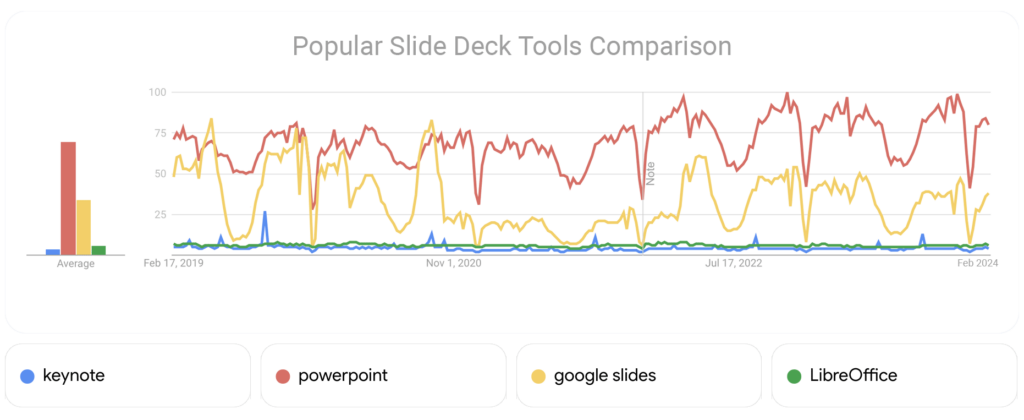
Among the leading platforms, Google Slides, PowerPoint, and Keynote stand out as stalwarts in the realm of slide deck production. Google Slides, with its collaborative prowess and cloud-based functionality, facilitates real-time collaboration and seamless sharing. PowerPoint, a longstanding favorite, offers unparalleled customization options and integrations with other Microsoft Office applications.

User comparison; Keynote, Powerpoint, Google slides and Libre Office – 2019-2024

Keynote, tailored for the Mac ecosystem, impresses with its intuitive interface and stunning templates. For those embracing open-source solutions, platforms like LibreOffice Impress offer robust functionalities without the constraints of proprietary software. Choosing the right tool aligns with your objectives and enhances the efficiency of your presentation endeavors.

Conclusion:

In conclusion, the slide deck may have evolved, but its relevance remains steadfast in the realm of professional communication. By harnessing the array of tools available, debunking clichés, embracing industry best practices, and leveraging leading platforms, savvy business professionals can elevate their presentations to new heights. Let us bid farewell to outdated conventions and embrace the era of dynamic and impactful slide deck production. Long live the slide deck!

Shameless Plug:

We believe that the small, robust, and nimble team at Velocity Ascent exemplifies the synergy of the new era. Guided by an unwavering commitment to best practices, combined with a deep understanding of user needs and preferences, forms our bedrock of exceptional design and production outcomes. As we begin to harness the power of AI to streamline processes and push creative boundaries, we hope to demonstrate that the future belongs to those who can navigate the delicate interplay between technology and human skill. The positive results achieved stand as a testament to the limitless possibilities that arise when human expertise and AI tools converge to craft experiences that delight and inspire.

Want to learn more – get in touch!

Everything you ever wanted to know about Start-Ups*

velocityascent · January 5, 2024 ·

*But Were Afraid To Ask.

On the one hand…

Working at a successful startup can be a dynamic and exhilarating journey, a thrilling blend of innovation, collaboration, and agility, where every day brings new challenges and opportunities. The pace is fast, and the stakes are high, but the potential for growth, impact, and development is unparalleled. In this environment, new ideas matter, a place where creativity thrives, and where the excitement of building something extraordinary permeates every aspect of the work.

This is true in the controlled environment of a laboratory – not very close to describing the typical start up environment. The real world version may, and will, be much more complex, stressful and challenging.

On the one other hand…

Taking a different approach, working at a successful startup can often feel like an unrelenting and exhausting ordeal. A grueling mix of perpetual innovation, never-ending collaboration, and the relentless need for quick thinking in a constant whirlwind of new problems. Every day brings a torrent of fresh challenges, a pace with stakes that leave slim margin for error. The potential for burnout, stress-induced breakdowns, and personal sacrifices knows no bounds and can take an immeasurable toll on well-being.

One way to avoid this is to review the success and failiure patterns of other companies, services and products.

How not to do it.

Top ten mistakes every startup makes

Here’s a list of the top ten mistakes that many startups commonly make:

  1. Lack of Market Research: Failing to thoroughly research and understand the target market can lead to launching a product or service that doesn’t meet customer needs.
  2. Overlooking a Solid Business Plan: Skipping the creation of a detailed business plan can make it challenging to secure funding and guide your startup’s growth.
  3. Hiring Ineffectively: Making hasty hiring decisions or not building the right team can hinder your startup’s success.
  4. Underestimating Costs: Failing to accurately forecast expenses can lead to financial challenges and potential cash flow problems.
  5. Scaling Too Quickly: Expanding too rapidly without a solid foundation can strain resources and lead to burnout or instability.
  6. Ignoring Customer Feedback: Not actively seeking and incorporating customer feedback can result in missed opportunities for improvement and growth.
  7. Ignoring Competition: Neglecting to analyze and keep an eye on competitors can result in missed opportunities or market threats.
  8. Not Adapting to Change: Refusing to pivot or adapt to changing market conditions can lead to obsolescence.
  9. Poor Marketing Strategy: Ineffective marketing or branding efforts can limit your startup’s visibility and growth potential.
  10. Neglecting Legal and Compliance Issues: Not addressing legal and regulatory requirements can lead to costly lawsuits or business disruptions.

Remember that these mistakes are common but can be avoided with careful planning, ongoing learning, and a willingness to adapt and improve!

There has got to be a better way!

In the world of startups, it’s a phrase we hear often: “There has got to be a better way!” And that’s exactly where the Velocity Ascent journey began. Fueled by the belief that efficiency should drive progress, we set out to challenge the status quo in start ups. We saw problems begging for solutions and industries ripe for disruption. With relentless curiosity and a passion for change, the team embarked on a mission to redefine and simplify the way things are done. Velocity Ascent is not just about providing products or services; it’s about pioneering a transformation, creating a brighter future, and answering the call for a better way.

We’re here to challenge conventions, reimagine possibilities, and make the world a slightly better place, one innovative solution at a time.

Best Practices = Best Path

“Best Practices” refer to proven and established methods, techniques, or processes that are widely recognized as effective and efficient in a particular industry or field. These practices are considered the most reliable and successful ways of achieving desired outcomes or standards. Here’s a list of the top ten best practices that are often observed in successful startups:

  1. Clear Value Proposition: Successful startups have a clear and compelling value proposition that addresses a specific problem or need in the market.
  2. Market Research: Thoroughly research and understand your target market, including customer preferences, pain points, and competition.
  3. Solid Business Plan: Create a well-defined business plan that outlines your goals, strategies, and financial projections, providing a roadmap for growth.
  4. Customer-Centric Approach: Prioritize customer feedback and continuously adapt your products or services to meet their evolving needs.
  5. Effective Team Building: Assemble a talented and diverse team with complementary skills and a shared vision for the company’s success.
  6. Agile Execution: Be agile and adaptable, willing to pivot or adjust strategies based on market feedback and changing circumstances.
  7. Financial Management: Maintain a strong focus on financial discipline, budgeting, and cash flow management to ensure sustainability.
  8. Investor Relations: Build strong relationships with investors by maintaining transparency and delivering on promises.
  9. Marketing and Branding: Develop a cohesive marketing strategy and brand identity to effectively reach and engage with your target audience.
  10. Legal and Compliance: Ensure compliance with all relevant regulations and protect your intellectual property to mitigate legal risks.

These best practices serve as foundational principles for startups aiming for success. However, it’s important to note that while these practices provide a strong framework, each startup’s journey is unique, and adaptability and innovation remain essential as you navigate the challenges and opportunities that come your way.

  • « Go to Previous Page
  • Page 1
  • Interim pages omitted …
  • Page 5
  • Page 6
  • Page 7
  • Page 8
  • Go to Next Page »

Velocity Ascent

© 2026 Velocity Ascent · Privacy · Terms · YouTube · Log in